
Home education in the Mountain State is anchored by strong statutory protections established under West Virginia Code § 18-8-1. West Virginia provides clear, reliable standards that respect parental authority while establishing basic accountability benchmarks[1].
Compulsory school attendance in West Virginia governs all children between the ages of six (6) and seventeen (17) under W. Va. Code § 18-8-1a.
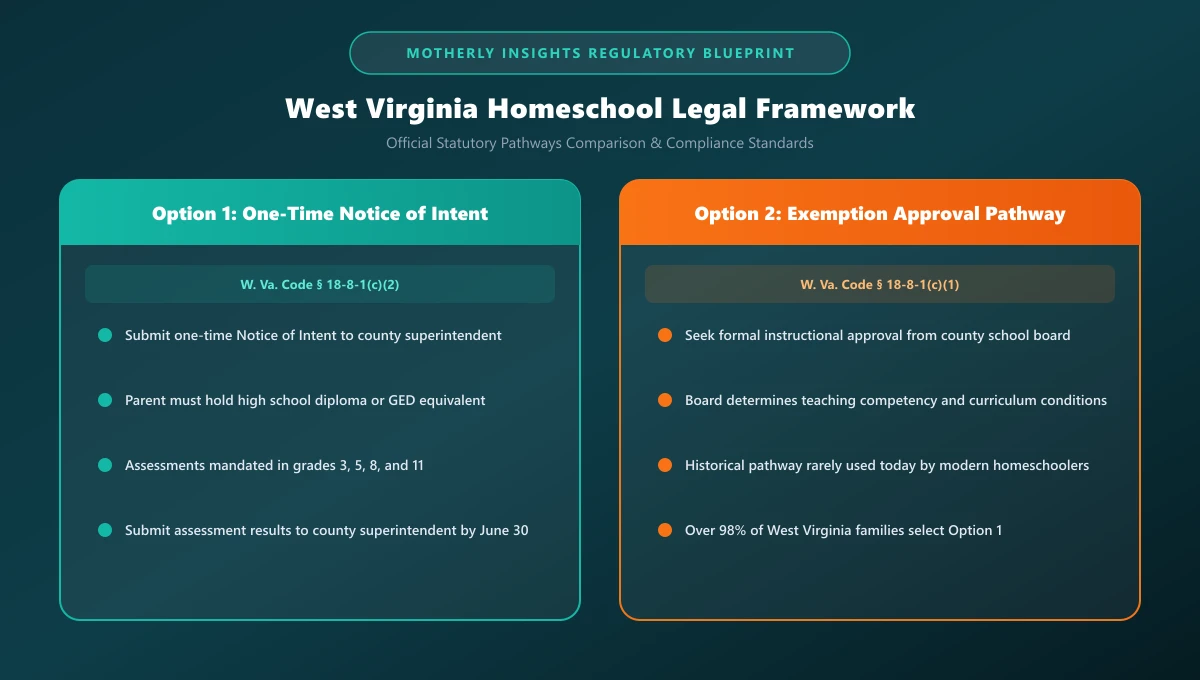
West Virginia Homeschool Legal Pathways: Regulatory Blueprint
1. Submitting the One-Time Notice of Intent (NOI)
Under W. Va. Code § 18-8-1(c)(2), parents establish their home education program by filing a formal Notice of Intent with the superintendent of their county school district[2]:
Filing Protocols:
- One-Time Submission: The notice is filed only once upon initiating home education. No annual re-notification is required unless you move to a new county or discontinue homeschooling.
- Parent Qualifications: The teaching parent or legal guardian must possess at least a high school diploma, GED, or post-secondary degree.
- Required Content: The notice includes the child’s name, address, age, assurance that core subjects will be taught (reading, language, mathematics, science, and social studies), and verification of the parent’s educational credentials.
2. Assessment Requirements in Grades 3, 5, 8, and 11
Unlike states that require annual testing, West Virginia mandates academic progress evaluations only at four specific grade milestones: grades 3, 5, 8, and 11[3].
Four Permissible Assessment Pathways:
- Nationally Standardized Achievement Test: Administering an approved test (such as the Iowa Assessments, Stanford-10, TerraNova, or California Achievement Test). The student must achieve a composite score at or above the 40th percentile (or show improvement over the previous assessment).
- Public School Testing: Participating in the statewide assessment program administered by the county school district at zero parental expense.
- Certified Teacher Narrative Portfolio Review: A written portfolio evaluation conducted by a certified teacher licensed in West Virginia or another state, certifying that the child is making acceptable educational progress.
- Alternative Assessment Plan: A custom evaluation method agreed upon by the parent and county superintendent in advance.
Filing Deadline: Assessment results for grades 3, 5, 8, and 11 must be submitted to the county superintendent by June 30 of that academic year.
3. Interscholastic Sports and Extracurricular Access (Tim Tebow Law)
Under W. Va. Code § 18-2-25c, commonly known as the West Virginia Tim Tebow Act, homeschooled students have protected rights to try out for interscholastic athletics and extracurricular activities sanctioned by the West Virginia Secondary School Activities Commission (WVSSAC)[4].
4. High School Graduation and the West Virginia PROMISE Scholarship
West Virginia home educators hold full statutory authority to design high school graduation requirements, issue official transcripts, and confer legitimate high school diplomas.
Furthermore, homeschool graduates are fully eligible for the prestigious West Virginia PROMISE Scholarship, providing up to full undergraduate tuition assistance across West Virginia colleges and universities. Homeschool applicants qualify by meeting the standard ACT composite benchmark (22) or SAT score (1100).
5. The West Virginia Hope Scholarship Navigation
West Virginia enacted one of the country’s most groundbreaking universal education choice programs: the Hope Scholarship (W. Va. Code § 18-31-1 et seq.):
- Funding Amount: Eligible West Virginia families receive an Education Savings Account (ESA) funded with approximately $4,500 to $5,000 annually per qualifying student.
- Qualified Educational Expenses: Funds can be used for individual curriculum purchases, online academy tuition, tutoring services, standardized testing fees, and educational therapies.
- Legal Distinction: Operating under the Hope Scholarship creates a legally distinct regulatory status from traditional independent homeschooling under W. Va. Code § 18-8-1(c)(2). Parents sign an agreement to submit annual student academic portfolios or assessment results to the Hope Scholarship Board.
6. Homeschool Recordkeeping and Compliance Binder Blueprint
Veteran West Virginia homeschool leaders recommend organizing a comprehensive compliance binder:
- Notice of Intent & Acknowledgment: Store your original dated copy of the Notice of Intent submitted to the county superintendent, along with postal return receipts.
- Parent Credential Proof: Retain a copy of your high school diploma, GED certificate, or college transcript.
- Assessment Results: Keep copies of all test reports or certified teacher evaluations from grades 3, 5, 8, and 11 permanently.
- Curriculum Syllabi: Document textbooks, course descriptions, and major projects.
- High School Transcript: Maintain a running four-year high school credit summary.
7. Special Education Child Find and Voluntary Consultative Services
Under federal IDEA law, West Virginia county school districts must provide Child Find screening to identify children with disabilities. Homeschooled students can receive diagnostic psychoeducational evaluations, speech pathology screenings, and hearing checks through their resident county school board at no charge.
8. High School Transcripts and College Admissions
West Virginia homeschool diplomas issued by parents carry full statutory recognition for higher education admissions (including West Virginia University and Marshall University), trade certifications, and military enlistment.
9. Homeschooling Neurodivergent Learners in West Virginia
West Virginia’s flexible statutory structure provides tremendous advantages for neurodivergent children, including those diagnosed with dyslexia, ADHD, sensory processing disorders, or autism spectrum conditions:
- Pacing Adaptability: Parents can adjust daily instructional blocks to prevent cognitive fatigue.
- Multisensory Curricula: Home educators can choose specialized structured literacy curricula (such as All About Reading or Logic of English) and multisensory mathematics programs (such as Math-U-See).
- Stress-Free Evaluation: Rather than subjecting an anxious child to high-stakes testing in grades 3, 5, 8, and 11, parents can opt for a gentle teacher narrative review.
10. Frequently Addressed West Virginia Homeschool Inquiries
Does West Virginia require attendance hour tracking?
No. W. Va. Code § 18-8-1(c)(2) does not mandate logging daily hours or submitting attendance sheets to the county superintendent.
What happens if an assessment composite score falls below the 40th percentile?
If a student scores below the 40th percentile, the statute requires the parent to develop a remedial education plan. The county superintendent cannot terminate home education unless the student fails to show acceptable progress for two consecutive assessment years.
💡 Related Educational Pathways: To compare related legal frameworks and recommended study programs, explore our detailed reviews on California homeschool legal guidelines, Ohio homeschool notification regulations, Pennsylvania Act 169 requirements.