
For homeschooling high schoolers aiming for selective universities, competitive STEM programs, or substantial institutional merit aid, demonstrating academic rigor is paramount. While parents can easily design honors-level coursework at home, one title carries unmatched universal recognition across collegiate admissions committees worldwide: Advanced Placement (AP).
Yet many homeschooling parents are surprised to learn that you cannot simply purchase an AP textbook, teach the material, and write “AP Calculus AB” or “AP European History” on your child’s high school transcript.
The terms “Advanced Placement” and “AP” are registered trademarks of the College Board. Under College Board institutional policy and federal trademark law, no secondary educational institution—including a homeschool—may legally label a course as “AP” on an official transcript unless the curriculum has undergone and passed the official AP Course Audit.
If a student’s transcript includes unauthorized AP course titles, university admissions officers who cross-reference the official AP Course Ledger will discover that the course is not authorized, potentially casting doubt on the integrity of the entire homeschool application.
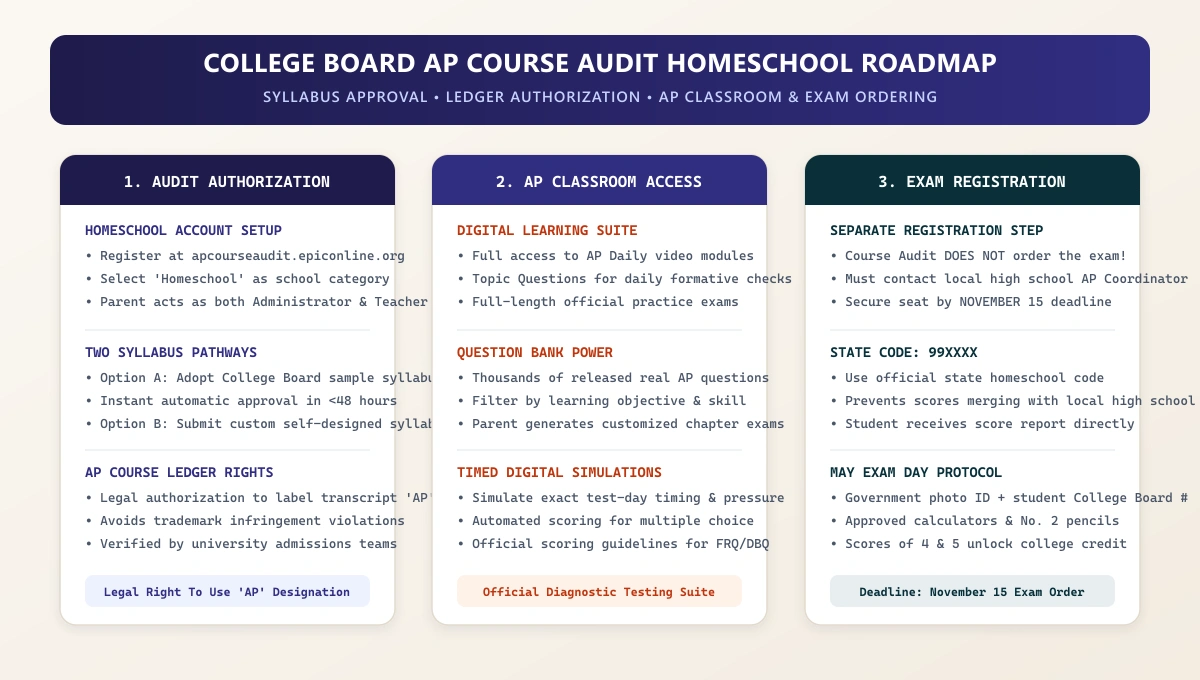
Fortunately, the College Board provides a direct, accessible, and completely free process specifically designed for homeschooling parents. By completing the homeschool AP Course Audit, you not only earn the legal right to list authorized AP courses on your child’s transcript, but you also unlock AP Classroom—a premier digital diagnostic platform packed with official formative question banks and full-length released practice exams.
This comprehensive guide walks you through every stage of the audit process, from syllabus adoption to exam day logistics.
1. Why Complete the Audit? Ledger Listing vs. Independent Exam Taking
It is essential to understand the difference between taking an AP course and taking an AP exam:
Two Distinct AP Pathways for Homeschoolers
Pathway A: Course Audit Approved (The Gold Standard)
Parent submits their syllabus through the AP Course Audit. Once approved, the homeschool appears on the official AP Course Ledger. The transcript legally reads: 'AP Biology with Lab (Authorized)'. The student is awarded a full 5.0 weighted GPA point, and the parent gains complete access to AP Classroom teacher question banks.
Pathway B: Independent Study + Exam Only
The student studies the subject at home without audit approval and simply sits for the May exam at a local high school. On the transcript, this course must be titled: 'Advanced Biology (with AP Exam)' or 'Honors Biology (AP Exam Prep)'. It cannot be labeled 'AP Biology'.
While Pathway B is acceptable, Pathway A provides far greater institutional credibility and gives the parent the official diagnostic testing tools necessary to ensure the student scores a 4 or 5 on exam day.
2. Step-by-Step Walkthrough: The Homeschool Audit Process
The audit process takes less than 30 minutes if you utilize the pre-approved syllabus option:
Step 1: Create Your Educator Account
- Visit the official portal: apcourseaudit.epiconline.org.
- Click “Create an Account”. If you already have a College Board parent account, you can sign in with those credentials.
- When prompted to select your school affiliation, search for your homeschool or select the option designating you as a “Homeschool”.
- In the home educator profile, you will serve as both the Course Teacher and the School Administrator.
Step 2: Add Your Course
- From your educator dashboard, select “Add Course”.
- Choose your subject (e.g., AP United States History, AP Computer Science Principles, AP Psychology, or AP Chemistry).
- The system will prompt you to select how you intend to satisfy the course curricular requirements.
Step 3: Choose Your Syllabus Submission Method
The College Board offers three distinct options to satisfy curricular criteria:
- Option 1: Adopt an Endorsed Syllabus / Sample Syllabus (Recommended): The College Board provides 3 to 4 fully vetted, pre-approved sample syllabi for every single AP subject. By selecting “Adopt a Sample Syllabus”, you agree that your instruction will adhere to the learning objectives outlined in that approved curriculum. Approval is virtually instantaneous (within 24 to 48 hours) with zero review friction.
- Option 2: Claim an Endorsed Online Provider: If your child is taking an asynchronous online class through an accredited provider (such as Pennsylvania Homeschoolers / AP Homeschoolers, Well-Trained Mind Academy, or Lukeion Project), you can select the provider’s pre-approved syllabus code.
- Option 3: Submit a Custom Self-Authored Syllabus: If you have designed a unique, proprietary curriculum, you may upload your own PDF syllabus. It will be reviewed by a College Board university professor panel against the subject’s official Curricular Requirements. This review typically takes 3 to 6 weeks.
Step 4: Administrator Sign-Off
Once you submit the syllabus as the teacher, switch your role to Administrator within the same dashboard and click “Approve”. Within a few days, your course status will transition to “Authorized”, and your homeschool will be listed in the global AP Course Ledger for that academic school year!
3. Unlocking AP Classroom: The Parent-Teacher’s Superpower
The single greatest pedagogical benefit of completing the AP Course Audit is gaining teacher-level access to AP Classroom. In traditional schools, this platform is restricted to credentialed faculty. As an authorized homeschool educator, you receive full access:
AP Classroom Core Diagnostic Features
- 1. AP Daily Videos: Short, 5-to-10 minute lectures created by the nation's master AP instructors covering every single unit and essential learning objective in the curriculum.
- 2. Topic Questions: Formative check-for-understanding quizzes that you can assign after every chapter to diagnose conceptual blind spots before they compound.
- 3. The Teacher Question Bank: A searchable digital vault containing thousands of official, previously administered AP multiple-choice questions and Free Response Questions (FRQs), filterable by unit, historical era, or mathematical standard.
- 4. Full-Length Practice Exams: Access to complete unreleased mock exams that exactly replicate the timing, layout, and scoring curves of the live May administration.
Utilizing these tools transforms homeschool instruction from guesswork into an exact, benchmarked science.
4. The Crucial Caveat: Registering for the May Exam
Completing the AP Course Audit DOES NOT order or register your child for the live May exam. This is the number one mistake homeschooling families make.
Because homeschools are not certified testing centers with secure vault storage for exam booklets, your child must sit for the physical exam at a participating public or private high school:
The Annual AP Timeline to Exam Success
August – September: Complete AP Course Audit & Adopt Endorsed Syllabus.
October 1 – October 31: Contact local public/private school AP Coordinators to request exam seats.
NOVEMBER 15: Hard College Board Exam Ordering Deadline (late fees apply after this date).
May (First 2 Weeks): Official nationwide morning and afternoon exam administrations.
July: Official score reports delivered digitally to student College Board portals.
The AP Coordinator Outreach Protocol
- Start in September: Do not wait until winter. Local high schools order their exam materials in the autumn.
- Find Area Coordinators: Contact the guidance counseling departments of 3 to 5 nearby public high schools and private preparatory schools. Ask to speak directly with the AP Coordinator.
- Professional Script:
“Hello, I am a homeschooling parent in the district. My 11th-grade student is completing an authorized AP Chemistry course this year. We are looking for a testing seat for the May administration. Does your school accept external homeschool students for testing?”
- Pay the Exam Fee: The College Board charges a base fee (approximately $98 per exam). Schools are legally permitted to add a modest administrative proctoring surcharge (typically $15 to $30) to cover proctor compensation.
- Join Code Setup: The host school’s AP Coordinator will provide an “Exam Only Join Code”. Your child will log into their student College Board account, enter the join code, and confirm their exam seat.
The Homeschool State Code (99XXXX)
When your child takes the exam, they must bubbling in their state-specific Homeschool Code (available on the College Board website, formatted as 99 followed by the state abbreviation code). Using this code guarantees that your child’s score report is delivered directly to your home address and digital portal, completely isolated from the host school’s district statistical averages.
5. Course Descriptions for College Admissions Portfolios
Once your course is audit-approved and completed, substantiate the accomplishment in your high school Course Description Dossier:
Model Dossier Entry: AP United States History (Audit Authorized)
Credit: 1.0 High School Unit | Grade: A (96%) | Weight: 5.0 Quality Scale | Audit Syllabus #: 1984214
Primary Texts: Foner, Eric. (2020). Give Me Liberty! An American History (6th ed.). W. W. Norton & Co.
Curriculum Overview: An intensive college-level survey investigating political, cultural, and economic developments from pre-Columbian societies through modern America. Student mastered document-based analysis, completing 14 timed DBQ essays, unit formative assessments in AP Classroom, and historical research seminars.
External Validation: Official College Board AP Exam Score: 5.
By providing the official College Board Syllabus Number on your course description, you give university admissions officers instant proof that your homeschool curriculum met the highest national benchmark of secondary scholarship.
Pedagogical References and Regulatory Citations
- College Board. AP Course Audit Policy and Procedure Manual for Secondary Schools and Independent Educators. New York, NY.
- College Board. AP Central Educator Portal: Course and Exam Descriptions (CED) Directory.
- National Association for College Admission Counseling (NACAC). State of College Admission: Assessment of Honors and Advanced Placement Weighting Models.
- Education Commission of the States (ECS). Post-Secondary Credit Award Policies for Advanced Placement Examination Scores.
- American Council on Education (ACE). Credit Recommendations for Advanced Placement Examinations. Washington, DC.
Disclaimer: This post is for informational and educational purposes only, accurate to the best of our knowledge at publication. It does not constitute advice. We do not guarantee accuracy or completeness and accept no liability for any decisions or losses resulting from reliance on this content.