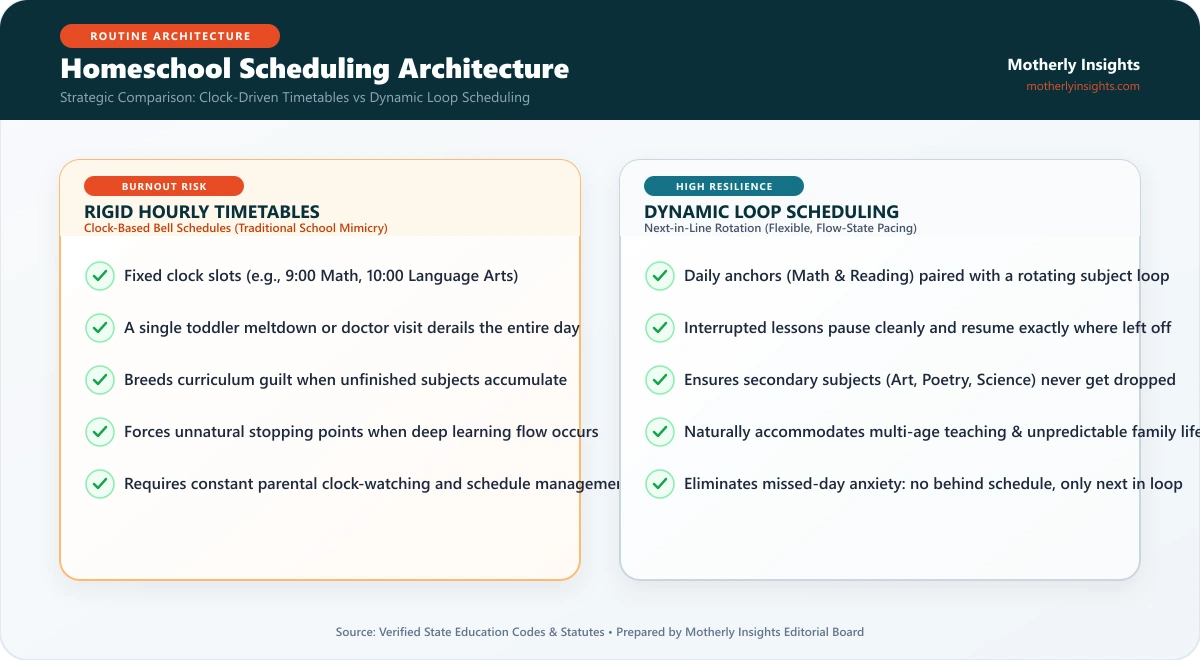
When parents begin homeschooling, their instinct is almost universally to recreate what they know: the institutional school day. They purchase hourly planners, construct color-coded charts dividing the day into rigid 45-minute blocks (9:00 AM Math, 10:00 AM Language Arts, 11:00 AM Science), and even consider ringing bells to signal passing periods.
Within three to six weeks, this model inevitably shatters. A toddler has a meltdown during phonics; a nursing infant needs feeding during math; a science experiment takes twice as long as anticipated; or an orthodontist appointment derails an entire Tuesday afternoon. When subjects are tied to rigid clock hours, any interruption causes a domino effect of unfinished work, creating pervasive parental anxiety and feelings of failure.
The secret to sustainable, joyful home education is replacing rigid clock-driven timetables with rhythms, block routines, and dynamic loop scheduling. This guide outlines how to build a flexible, multi-child homeschool schedule that honors family life while ensuring rigorous academic mastery.
1. The Real Time Equation: How Long Does Homeschooling Actually Take?
In a standard public school classroom of 25 students, the actual time spent on direct, focused instruction averages only 1.5 to 2.5 hours per six-hour school day. The remaining hours are consumed by roll call, lining up for transitions, bathroom breaks, disciplinary management, handing out worksheets, and waiting for the slowest student to finish.
In a home setting, one-on-one tutorial instruction eliminates these administrative bottlenecks entirely. Research from the National Home Education Research Institute (NHERI) confirms that homeschooled students achieve superior academic outcomes with significantly shorter daily instructional windows:
| Developmental Stage | Grade Levels | Realistic Daily Instructional Time | Core Structure |
|---|---|---|---|
| Early Years / Kindergarten | Pre-K – Kindergarten | 45 to 60 Minutes | Phonics (15m), Math (15m), Picture Books & Play (30m) |
| Early Elementary | Grades 1 – 3 | 1.5 to 2.0 Hours | Core Reading/Math (1 hr), Morning Basket & Loop (1 hr) |
| Upper Elementary | Grades 4 – 6 | 2.5 to 3.0 Hours | Independent Core (1.5 hrs), Content Subjects & Writing (1.5 hrs) |
| Middle School | Grades 7 – 8 | 3.5 to 4.0 Hours | Independent Work (2.5 hrs), Discussions, Labs & Electives (1.5 hrs) |
| High School | Grades 9 – 12 | 4.0 to 5.0 Hours | Rigorous Carnegie Units, Lab Sciences, Dual Enrollment & Literature |
If your third-grader finishes their core math and language arts in 90 minutes, you are not falling behind—you are done. Filling the remaining afternoon hours with busywork breeds academic burnout and destroys the child’s natural curiosity.
2. Loop Scheduling: The Antidote to Curriculum Guilt
The single greatest structural breakthrough for homeschool organization is Loop Scheduling.
How Traditional Calendar Scheduling Fails
In a traditional calendar schedule, parents assign specific subjects to specific days:
- Monday & Wednesday: History
- Tuesday & Thursday: Science
- Friday: Art & Music
If a doctor visit or sick day occurs on Tuesday, Science is skipped. By Thursday, the parent feels pressured to double up on lessons or skip ahead, leaving foundational concepts unaddressed. Over months, secondary enrichment subjects (Art, Nature Study, Poetry) are permanently abandoned because core subjects consume all available time.
How the Loop Schedule Operates
Under a loop schedule, you divide your subjects into two distinct categories:
- Daily Anchors (Non-Negotiables): Essential skill-building subjects that require daily practice (Math, Phonics / Reading, Handwriting / Composition).
- The Dynamic Loop (Rotating Content): Exploratory, content-heavy, or enrichment subjects arranged in a continuous, repeating list.
Instead of assigning subjects to days, you designate a Loop Time Window (e.g., 45 to 60 minutes each afternoon). You open your loop list and work on the next item. When the timer sounds, you close the book—even if the lesson is half-finished. Tomorrow, you pick up on the very next sentence.
┌────────────────────────────────────────────────────────┐
│            THE ROTATING HOMESCHOOL LOOP                │
│                                                        │
│   [1. History / Social Studies]                        │
│          ↓                                             │
│   [2. Science / Nature Journaling]                     │
│          ↓                                             │
│   [3. Geography / Map Work]                            │
│          ↓                                             │
│   [4. Art Appreciation / Hands-On Project]             │
│          ↓                                             │
│   [5. Poetry & Composer Study]                         │
│          ↓                                             │
│   [6. Coding / STEM / Foreign Language]                │
│          ↓                                             │
│   (Loop resets back to Item 1 automatically)           │
└────────────────────────────────────────────────────────┘
If Friday is taken over by a homeschool co-op or park day, no guilt exists. On Monday, you do not “make up Friday”; you simply complete your daily anchors and move to the next item on the loop list. Nothing is skipped, and nothing is crammed.
3. The Morning Basket Routine: Teaching Multiple Ages at Once
For parents homeschooling two, three, or four children of different ages, attempting to teach separate history, literature, and science curricula to each individual child is a fast track to exhaustion.
The Morning Basket (also known as Morning Time or Circle Time) solves this dilemma by gathering the entire family for 30 to 45 minutes of communal, multi-age truth, goodness, and beauty.
Essential Components of an Effective Morning Basket
- Read-Aloud Literature: High-quality classic literature, historical fiction, or living science books that all children can enjoy regardless of reading level.
- Poetry & Recitation: Memorizing a poem, scripture, or historical speech as a group.
- Picture & Music Study: Observing a fine art print for five minutes or listening to a classical composer while children sketch.
- Current Events or Character Study: Discussing age-appropriate cultural topics or worldview studies.
While the parent reads aloud from the Morning Basket, younger children and kinesthetic learners can keep their hands active using quiet, tactile activities: drawing, coloring, modeling clay, braiding yarn, or assembling puzzles.
4. Strategies for Managing Toddlers and Preschoolers
The number one logistical challenge cited by homeschool mothers is managing a busy toddler or an infant while attempting to teach long division or grammar to an older child.
1. The High-Priority Morning Connection
Toddlers often disrupt older siblings’ lessons because they are seeking parental attention. Before opening a single textbook with your older students, spend 15 to 20 uninterrupted minutes on the floor with your toddler. Read two picture books, sing nursery rhymes, and play blocks. Filling their emotional attachment tank first thing in the morning significantly reduces attention-seeking behaviors during subsequent school hours.
2. High-Value “School-Only” Busy Bins
Create three to four clear plastic storage bins filled with specialized tactile toys that are strictly forbidden except during school hours:
- Bin A: Kinetic sand with miniature construction vehicles.
- Bin B: Water-bead sensory containers with scoops and strainers.
- Bin C: Magnet tiles, giant plastic nuts and bolts, and sorting bowls.
- Bin D: Washable dot markers and oversized tracing pads. Because these toys are novel and only available during lessons, they can captivate a toddler’s focus for 30 to 45 minutes of peaceful independent play.
3. The Sibling Stagger (Buddy System)
If you have an older child who is between lessons, pair them with the toddler for 15 minutes of outdoor backyard play while you deliver an intensive, one-on-one phonics lesson to a first-grader. Then swap.
5. Sample Daily Schedule Templates for Real Families
Template A: The Classic Rhythm Schedule (Ages 6, 9, 11)
- 8:30 AM – 9:15 AM: Breakfast & Morning Basket (Family Read-Aloud, Poetry, Memory Work)
- 9:15 AM – 10:30 AM: Core Block 1 (Math & Phonics/Spelling with Parent 1-on-1 Rotation)
- 10:30 AM – 11:00 AM: Outdoor Recess / Snack / Physical Movement
- 11:00 AM – 12:00 PM: Core Block 2 (Independent Reading, Writing, Grammar)
- 12:00 PM – 1:00 PM: Lunch & Free Play
- 1:00 PM – 2:00 PM: Loop Time Window (Rotating History, Science, Art, or Geography)
- 2:00 PM Onward: Free Time, Nature Exploration, Extracurriculars, Household Chores
Template B: The Working Parent / Compressed Block Routine
For parents balancing remote employment or part-time work schedules:
- 7:30 AM – 8:30 AM: Early Morning Focus (Parent provides intensive 1-on-1 Math instruction before workday starts)
- 8:30 AM – 12:00 PM: Independent Student Work (Online video curriculum, independent reading, assigned worksheets, audiobooks)
- 12:00 PM – 12:45 PM: Lunch Break Together
- 4:30 PM – 5:30 PM: Evening Family Block (Morning Basket read-alouds and hands-on science experiments conducted after work hours)
6. Overcoming Perfectionism: The 80% Rule
The ultimate goal of a homeschool schedule is not to mirror a military operation; it is to serve your family’s unique culture and values.
Adopt the 80% Rule: If your homeschool routine functions smoothly four out of five days a week (or 80% of any given month), your homeschool is a resounding success. The remaining 20% accommodates sick days, unexpected discoveries, spontaneous park meetups, and emotional rest.
When you abandon rigid clock hours in favor of dependable rhythms and loop scheduling, you protect your sanity, preserve your relationship with your children, and build a sustainable home learning environment that endures through high school graduation.
*Disclaimer: This post is for informational and educational purposes only, accurate to the best of our knowledge at publication. It does not constitute advice. We do not guarantee accuracy or completeness and accept no liability for any decisions or losses resulting from reliance on this content.*