
Dual enrollment has revolutionized the modern homeschool high school experience. For ambitious homeschooled students, dual enrollment—the practice of taking accredited college courses while concurrently completing secondary school requirements—offers an unprecedented pathway to bypass runaway higher education tuition, validate homeschool academic rigor, and graduate high school with 30 to 60 transferable college credits or even a fully accredited Associate of Arts (A.A.) or Associate of Science (A.S.) degree.
However, navigating dual enrollment requires strategic foresight. Every college course completed creates an irrevocable collegiate transcript that follows the student permanently—influencing freshman merit scholarship eligibility, undergraduate transfer admissions, and professional graduate school applications (such as medical AMCAS and legal LSAC admissions).
This guide provides a comprehensive roadmap for homeschooling parents: statutory state funding frameworks, course-to-credit conversion mechanics, credit-by-exam alternatives, and transcript optimization strategies.
1. Statutory State-Funded Dual Enrollment Programs
State legislatures increasingly recognize homeschoolers within public dual enrollment funding statutes. Depending on your state of residence, your student may be legally entitled to enroll in community college or state university courses tuition-free.
Florida: F.S. § 1007.271 (Universal Tuition Exemption)
Florida boasts one of the nation’s most progressive dual enrollment statutes. Under Florida Statute § 1007.271(13):
- Homeschool students who register an annual Notice of Intent with their local school district have a statutory right to participate in dual enrollment at any local Florida College System (FCS) institution.
- Tuition & Lab Fees: 100% waived by state law. Neither the college nor the school district may charge tuition or registration fees to homeschooled students.
- Textbooks: Under recent legislative expansions, instructional materials are provided without charge to public and homeschool dual enrollment students through state institutional funding allocations.
- Eligibility: Unweighted high school GPA of 3.0+ and qualifying placement scores (PERT, SAT, ACT, or CLT).
Washington State: Running Start (RCW 28A.600.310)
Washington’s Running Start program allows 11th and 12th graders to take up to 15 tuition-free college credits per quarter at all 34 community and technical colleges across the state.
- Homeschoolers access Running Start by filing an annual Declaration of Intent under RCW 28A.200.010 and enrolling for dual credit services with their local public school district.
- Funding: The state covers up to 100% of college tuition. Families are responsible only for mandatory campus fees and textbooks, with fee waivers available for low-income households.
North Carolina: Career & College Promise (CCP)
Under North Carolina’s CCP framework, qualified homeschool students in grades 11 and 12 who maintain a 2.8+ unweighted GPA or demonstrate test readiness on standardized metrics can enroll tuition-free in two defined tracks:
- College Transfer Pathway (CTP): Grants 30+ credit hours of core general education courses guaranteed to transfer across all 16 University of North Carolina (UNC) system institutions.
- Career & Technical Education (CTE): Hands-on certificate and diploma programs in computer science, biotechnology, nursing, and welding.
Georgia: Dual Enrollment Program (O.C.G.A. § 20-2-161.3)
Georgia covers up to 30 semester hours (or 45 quarter hours) of college tuition, mandatory fees, and core books for 11th and 12th graders enrolled in eligible public, private, or homeschool programs through the Georgia Student Finance Commission (GSFC). 10th-grade homeschoolers can access funded technical courses or qualify for academic courses via SAT/ACT benchmarks.
Ohio: College Credit Plus (ORC § 3365)
Ohio’s College Credit Plus (CCP) program allocates a dedicated state funding pool specifically for nonpublic and homeschooled students. Homeschool families apply annually to the Ohio Department of Education by April 1 to request funded credit hours for the upcoming academic year.
2. Converting College Credits into High School Carnegie Units
A frequent point of confusion for homeschool administrators is converting postsecondary semester credit hours into secondary Carnegie units on the high school transcript.
The Standard Academic Conversion Formula
The recognized national academic standard, adopted by state departments of education and college admissions boards, is:
$$\text{1 Full-Year High School Credit (1.0 Carnegie Unit)} = \text{3 to 4 College Semester Hours}$$
$$\text{Half-Year High School Credit (0.5 Carnegie Unit)} = \text{1 to 2 College Semester Hours}$$
For quarter-system colleges:
- 5 quarter credit hours = 1.0 high school credit.
- 3 quarter credit hours = 0.5 high school credit.
Subject-Specific Acceleration Example
Because college courses move at twice the pace of high school courses, a student completes a full year of high school curriculum in a single 15-week college semester:
| College Course Completed | College Credits | High School Transcript Entry | High School Credit Awarded |
|---|---|---|---|
| ENC 1101: English Composition I | 3.0 Semester Credits | English III / Advanced Composition (DE) | 1.0 Credit |
| ENC 1102: English Composition II | 3.0 Semester Credits | English IV / Literature & Research (DE) | 1.0 Credit |
| MAC 1105: College Algebra | 3.0 Semester Credits | College Algebra (DE) | 1.0 Credit |
| BSC 2010 & 2010L: General Biology + Lab | 4.0 Semester Credits | Honors Biology with Lab (DE) | 1.0 Credit |
| POS 2041: American National Government | 3.0 Semester Credits | US Government (DE) | 0.5 to 1.0 Credit |
By completing two English courses and two math courses at a community college during 11th grade, a student fulfills two entire years of core high school graduation requirements in just 9 months.
3. Credit-by-Exam: The Zero-GPA-Risk CLEP Alternative
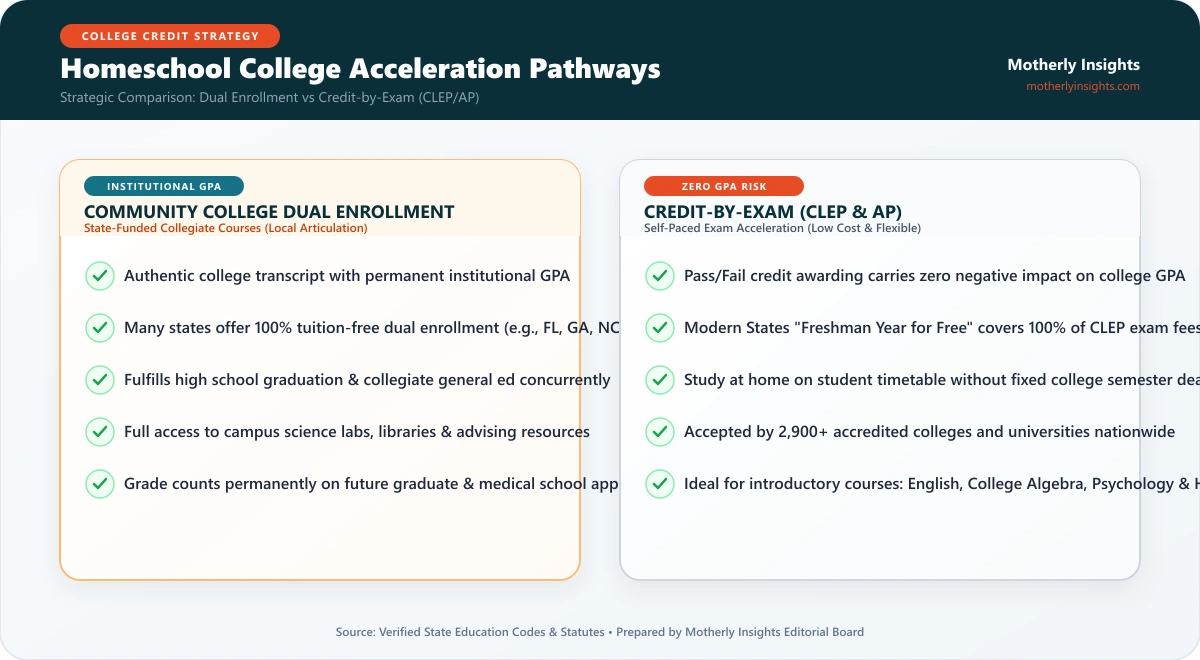
While dual enrollment offers authentic classroom experience, it carries GPA vulnerability: a low grade permanently mars the student’s undergraduate record. For families seeking college acceleration without GPA risk, Credit-by-Exam via CLEP (College-Level Examination Program) offers an exceptional parallel pathway.
How CLEP Acceleration Works
Administered by the College Board, CLEP comprises 34 computer-based, 90-minute multiple-choice exams covering introductory college subjects:
- Scoring: Scaled score of 20 to 80. A score of 50 (equivalent to a grade of “C”) earns 3 to 6 college credits at more than 2,900 accredited institutions nationwide.
- Pass/Fail Advantage: Colleges award credit without impacting collegiate GPA. If a student passes, they earn credit; if they fail, no record appears on any college transcript, and the exam can be retaken after 90 days.
- 100% Free via Modern States: The non-profit philanthropic organization Modern States Education Alliance (“Freshman Year for Free”) provides free online college prep lectures. Upon completing the free module, Modern States reimburses the $93 CLEP exam fee and local proctoring fees, allowing homeschoolers to earn up to 30 college credits completely free.
Ideal Starter CLEP Exams for Homeschoolers
- Analyzing & Interpreting Literature: Tests reading comprehension, poetry analysis, and literary devices without requiring specific memorized texts. Earns 3 to 6 humanities credits.
- College Composition: Includes two written essays and multiple-choice grammar; fulfills freshman composition at hundreds of universities.
- U.S. History I & II: Pairs naturally with high school history coursework.
- Introductory Psychology & Sociology: Intuitive introductory social science credits.
4. Transcript Strategy: Weighting, Honors, and Nomenclature
To ensure collegiate admissions committees recognize the rigor of your student’s dual enrollment, proper transcript notation is mandatory.
1. GPA Weighting (5.0 Scale)
Dual enrollment courses represent college-level academic rigor and should receive a full 1.0 GPA weighting bonus, equivalent to Advanced Placement (AP) courses:
- Grade A in Dual Enrollment = 5.0 Grade Points
- Grade B in Dual Enrollment = 4.0 Grade Points
- Grade C in Dual Enrollment = 3.0 Grade Points
2. Standardized Course Nomenclatures
Clearly designate the dual enrollment status and institution in your transcript course titles:
ENC 1101: English Composition I (Dual Enrollment - Valencia College)CHM 1045: General Chemistry I w/ Lab (Dual Enrollment - St. Petersburg College)
3. Submitting Dual Transcripts
When applying to four-year universities via the Common Application:
- The parent, acting as homeschool guidance counselor, submits the Official Homeschool High School Transcript showing the high school credits and weighted GPA.
- The student must request that the Registrar of the Partner College send an official, sealed collegiate transcript directly to each prospective university’s admissions office.
5. Potential Pitfalls and Strategic Precautions
Before enrolling your student in college-level courses, consider these essential guardrails:
1. Freshman Status vs. Transfer Status
A homeschool student who earns an Associate Degree while still in high school applies to four-year universities as an incoming freshman with advanced standing, NOT as a transfer student. This distinction is critical: incoming freshmen qualify for four-year institutional merit scholarships, honors college living communities, and freshman-only housing guarantees that are routinely denied to transfer students.
2. Satisfactory Academic Progress (SAP) & Financial Aid Maximums
Federal financial aid (FAFSA) enforces Satisfactory Academic Progress (SAP) guidelines, including maximum timeframe rules (Pell Grants and federal loans typically cover up to 150% of the credits required for a degree). Withdrawing from dual enrollment classes (W grades) or accumulating excessive unrelated credits can deplete financial aid eligibility before graduate school.
3. AMCAS / LSAC Professional School Recalculation
If your child aspires to attend medical school or law school, note that the American Medical College Application Service (AMCAS) and the Law School Admission Council (LSAC) recalculate undergraduate GPAs by pulling every postsecondary college grade ever earned, including dual enrollment courses taken at age 15 or 16. A grade of C in dual enrollment chemistry cannot be erased and will depress their medical school application GPA years later.
6. Actionable Enrollment Checklist for Homeschool Parents
To launch a successful dual enrollment pathway, follow this sequence:
- Verify State Statutes: Determine whether your state offers automatic tuition waivers (FL, WA, NC, GA, OH) or requires out-of-pocket tuition.
- Select Partner Institution: Contact the Dual Enrollment Coordinator at your local community college or regional university.
- Execute Articulation Agreement: Complete the required homeschool dual enrollment contract, providing proof of homeschool compliance (Notice of Intent).
- Complete Placement Testing: Schedule testing for the PERT, ACCUPLACER, SAT, ACT, or CLT to demonstrate collegiate reading and math readiness.
- Start Conservatively: Begin with a single college course (e.g., Public Speaking or Introduction to Psychology) during the first semester to calibrate the student’s time management before scaling up to full-time schedules.
Dual enrollment transforms high school from a passive milestone into an empowering springboard. With strategic planning and disciplined execution, your homeschooler can master college-level scholarship, conquer higher education costs, and enter university with insurmountable momentum.
*Disclaimer: This post is for informational and educational purposes only, accurate to the best of our knowledge at publication. It does not constitute advice. We do not guarantee accuracy or completeness and accept no liability for any decisions or losses resulting from reliance on this content.*