
As spring approaches each academic year, a wave of apprehension washes over thousands of homeschooling households across the United States[1].
In high- and moderate-regulation states, statutory compulsory education laws require home-educated students to undergo an annual educational assessment to verify that learning has taken place. For many families, the default assumption is that they must subject their seven-, ten-, or fourteen-year-old child to a multi-hour, high-stakes standardized exam—such as the Iowa Assessments (ITBS), Stanford 10, or TerraNova[2].
Yet, for creative, neurodivergent, or eclectic homeschoolers, standardized tests are often a terrible diagnostic match. Standardized tests measure conformity to institutional test-taking mechanics on a single anxious morning; they reveal almost nothing about a child’s deep critical thinking, artistic synthesis, scientific curiosity, or reading stamina[3].
Fortunately, major homeschooling statutes—including Florida (F.S. § 1002.41), Pennsylvania (24 P.S. § 13-1327.1), Maryland (COMAR 13A.10.01.01), Virginia (Va. Code § 22.1-254.1), Ohio, Maine, and New Hampshire—provide a superior, humane alternative: the Certified Teacher Portfolio Evaluation.
A portfolio review allows parents and children to showcase authentic, longitudinal growth over time. In this comprehensive 2026 guide, we deconstruct how to curate an elegant, unshakeable homeschool portfolio, organize work samples using the 3-Tier method, pass evaluator audits with flying colors, and satisfy state statutory requirements without stress.
1. Standardized Testing vs. Portfolio Evaluation: Which Is Right for Your Child?
Before collecting a single worksheet, parents must understand the legal and pedagogical trade-offs between annual standardized testing and certified teacher portfolio evaluations:
When Standardized Testing Makes Sense
- Predictable, Black-and-White Benchmarks: If your child tests well, thrives under quiet multiple-choice formats, and is not unsettled by bubbling scantrons, standardized testing is fast, impersonal, and inexpensive ($40–$65 via online testing services).
- High School College Prep: For high schoolers preparing for the SAT or ACT, regular testing builds crucial standardized test stamina.
- Minimal Parental Assembly: You do not have to assemble binders, write syllabi, or curate art projects; you simply submit the composite score percentile to the school district.
When the Portfolio Review Is Superior
- Neurodivergent Learners (ADHD, Dyslexia, 2e, Autism): Standardized test timers trigger acute executive dysfunction and panic in neurodivergent learners. A portfolio allows an evaluator to observe a dyslexic child’s brilliant oral narrations, audio projects, and hands-on science builds without testing bias.
- Non-Traditional Pedagogies (Charlotte Mason, Waldorf, Unschooling): If your family uses living books, oral discussions, and outdoor nature journals rather than fill-in-the-blank textbooks, standardized tests will test concepts you never taught while ignoring the rich intellectual work your child actually mastered.
- Celebration of Holistic Growth: A portfolio evaluation is a warm, celebratory conversation between a supportive educator, the parent, and the student—validating a full year of domestic life, literature, and intellectual wonder.
2. The 3-Tier Work Sample Selection Strategy
The number one mistake rookie homeschool parents make when building a portfolio is hoarding every scrap of paper.
Parents arrive at an evaluation with two bursting plastic storage crates containing 800 math worksheets, 200 spelling quizzes, and every grocery list their child scribbled on. This overwhelms the evaluator, exhausts the parent, and obscures the child’s real progress.
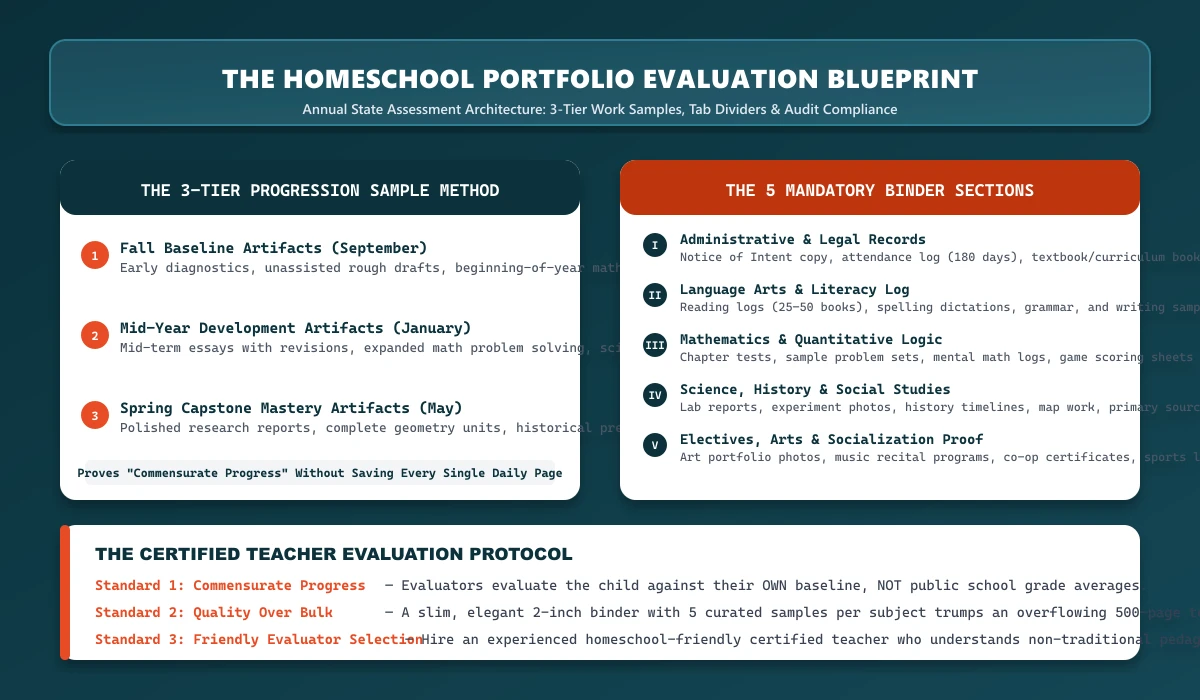
An expert portfolio does not prove that a child did thousands of hours of busywork; it proves progression. To achieve this, use the 3-Tier Sampling Method:
Tier 1: Fall Baseline Artifacts (September / October)
- The Purpose: Establishes where the student started at the beginning of the school year.
- What to Include:
- An early unassisted writing diagnostic (complete with developmental spelling errors, awkward sentence structure, and simple punctuation).
- A math diagnostic test or first-week worksheet showing initial struggles with a new concept (e.g., beginning double-digit regrouping or multi-digit multiplication).
- A short diagnostic phonics or reading fluency recording.
Tier 2: Mid-Year Development Artifacts (January / February)
- The Purpose: Demonstrates active instructional scaffolding and skill expansion.
- What to Include:
- A rough draft of an essay showing teacher or parent editing marks alongside the student’s second revision.
- A mid-term math test demonstrating increasing accuracy and problem-solving complexity.
- A mid-year science lab report or history project photo.
Tier 3: Spring Capstone Mastery Artifacts (April / May)
- The Purpose: Proves concrete mastery and intellectual growth relative to the fall baseline.
- What to Include:
- A polished, multi-paragraph typed report or creative story showing sophisticated vocabulary, varied sentence structure, and clean mechanics.
- A final math chapter exam demonstrating mastery of the year’s target mathematical concepts.
- A capstone project: a photo of a salt-dough topographical map, a completed nature journal entry with botanical watercoloring, or an audio recording of a foreign language presentation.
By selecting only three to five pristine artifacts per subject across these three chronological tiers, you create an undeniable visual trajectory of academic growth.
3. The 5 Essential Portfolio Tab Dividers
A professional portfolio should be housed in a clean, 2-inch or 3-inch D-ring binder with heavy-duty sheet protectors and five clear tab dividers:
Tab 1: Administrative & Legal Compliance Records
- Notice of Intent (NOI) Copy: A copy of your annual homeschool registration or acknowledgment letter from the local superintendent.
- Attendance Log: A simple calendar grid checking off the required statutory days (typically 180 days or 900/990 hours depending on state law).
- Curriculum Book List & Syllabi: A comprehensive bibliography listing all textbooks, living books, video courses, and online platforms used during the academic year.
Tab 2: Language Arts & Literacy Log
- The Annual Reading Log: A list of 25 to 50 books read by the student (or read aloud by the parent). Include author, title, genre, and approximate date completed. Evaluators adore rich reading lists.
- Writing Samples: 3 to 5 chronological writing pieces (personal narratives, book reviews, poetry, formal essays).
- Handwriting / Spelling: A sample of copywork, cursive practice, or spelling dictation.
Tab 3: Mathematics & Quantitative Logic
- Scope and Sequence: A printed copy of the table of contents from your math curriculum (e.g., Saxon, Singapore, Math-U-See, Beast Academy) with completed chapters highlighted.
- Chronological Work Samples: 3 to 5 graded chapter tests or problem sets showing progression from basic operations to advanced concepts.
- Living Math Artifacts: Photos of baking measurements, geometry art, budget spreadsheets, or math board game scorecards.
Tab 4: Content Subjects (Science, History, Geography)
- Science Labs: 2 to 3 lab experiment sheets with hypothesis, materials, data tables, and conclusions.
- Nature Journal Scans: Photos or original pages from outdoor nature field journals.
- History & Social Studies: Timeline entries, primary source analysis, historical fiction narrations, and map tracing work.
Tab 5: Electives, Physical Education & Socialization Proof
- Fine Arts: Photographs of pottery, canvas paintings, charcoal sketches, or museum visits.
- Music & Performing Arts: Sheet music, recital programs, or certificates of musical instrument completion.
- Physical Education: A log of swim team practice, soccer league schedules, martial arts belt promotions, gymnastics, or family hiking mileage.
- Extracurricular & Community Service: Homeschool co-op class certificates, library robotics club, 4-H projects, church youth group leadership, and volunteer hours.
4. The Legal Evaluation Standard: “Commensurate Progress”
One of the greatest fears haunting homeschool parents is that an evaluator will fail their child if they are reading “below grade level” or struggling with long division.
Statutory education codes across the United States do not mandate that a homeschooled child match public school grade-level medians. In nearly every state statute, the legal benchmark for passing an annual evaluation is:
“Demonstrating educational progress commensurate with the child’s ability.”
What This Means in Law
- Ability-Based Baseline: If your eight-year-old child has dyscalculia or processing delays and began the year unable to count past twenty, but finished the year confidently adding single digits using an abacus, that child has demonstrated tremendous commensurate progress.
- Individualized Growth: The law protects the right of parents to tailor education to the child’s unique developmental timeline. An evaluator’s job is not to measure the child against 25 public school students; it is to verify that the child did not remain intellectually stagnant over the preceding twelve months.
5. How to Select a Homeschool-Friendly Certified Evaluator
The certified teacher you hire to evaluate your child makes all the difference between a joyful celebration of learning and an antagonistic interrogation.
In states like Florida, Pennsylvania, and Virginia, statutory evaluations must be performed by a teacher holding a current, valid state teaching certificate (or a licensed psychologist). However, not all certified teachers understand home education.
| Evaluator Profile | The Antagonistic Institutional Evaluator | The Homeschool-Friendly Specialist |
|---|---|---|
| Pedagogical Philosophy | Expects strict adherence to state Common Core public school standards. | Values eclectic, classical, Charlotte Mason, and child-led learning. |
| Interaction with Student | Quizzes the child with flashcards and unexpected pop tests; induces anxiety. | Asks open-ended, encouraging questions: "What was your favorite book this year?" |
| View of Work Samples | Demands hundreds of graded worksheets; criticizes unconventional methods. | Celebrates authentic growth across 3-tier samples, photos, and project builds. |
| Review Location Options | Rigid office appointments; bureaucratic atmosphere. | Warm kitchen-table visits, local coffee shops, library study rooms, or secure Zoom calls. |
| Average Fee | $100 – $150 per student | $45 – $85 per student (often with sibling discounts) |
Questions to Ask Before Hiring an Evaluator
- “Are you currently or have you previously been a homeschooling parent yourself?”
- “How familiar are you with our specific educational approach (e.g., Charlotte Mason, Classical, unschooling, unit studies)?”
- “Do you conduct evaluations via video conference (Zoom), or do you require in-person meetings?”
- “What exact documents do you require in your portfolio review packet?”
6. Digital Portfolios: The Modern Alternative to Binders
While traditional physical three-ring binders remain the gold standard, modern home educators increasingly utilize digital portfolios.
In states where evaluators conduct reviews via Zoom or where portfolios are submitted electronically to school districts or umbrella oversight organizations (such as Maryland or Maine), a digital portfolio saves printer ink, storage space, and mailing costs.
Digital Portfolio Architectures
- Google Drive / Dropbox Folders: Create a clean folder structure (Year 2026 / Child Name / Subject). Use free phone scanning apps (e.g., CamScanner, Adobe Scan, Apple Notes) to snap crisp PDF scans of student papers and upload them directly.
- Notion or Google Sites: Build a private digital multimedia dashboard. Embed video clips of your child playing piano, audio recordings of poetry recitation, digital photo galleries of science projects, and links to reading logs.
- Compiled PDF E-Book: Use PDF merger tools to combine your administrative letter, reading log, and 15 curated work sample scans into a single, elegant 25-page PDF document that can be emailed to your certified evaluator with a single click.
Final Thoughts: A Portfolio Is a Family Treasure
When your annual portfolio evaluation concludes and your certified teacher signs off on your legal compliance letter, take a moment to look through that binder with your child.
That portfolio is not merely a bureaucratic shield against state scrutiny; it is a physical monument to a year of human flourishing. It captures the exact moment your daughter unlocked the mystery of long division, the poem your son memorized with tears and triumph, and the dried autumn maple leaf you gathered on an unhurried Tuesday afternoon in October.
Long after compulsory school requirements have passed and your children have graduated into adulthood, those portfolios will remain among your family’s most cherished possessions—testifying to the courage, dedication, and beauty of your homeschool journey.
Frequently Asked Questions
What happens if an evaluator says my child did not make adequate progress?
In virtually all portfolio-mandating states, a negative evaluation does not result in immediate truancy action or loss of homeschooling rights. State statutes typically establish a mandatory 30- to 90-day remediation period. The parent is given an opportunity to submit additional documentation, provide supplemental tutoring, or obtain a second opinion from an independent certified educational evaluator.
Do I have to turn in my entire portfolio to the public school district?
In most states (such as Florida, Ohio, and Virginia), NO. You do not submit your physical binder, work samples, or reading logs to the school district superintendent. You simply submit the one-page Certified Teacher Evaluation Letter signed by your evaluator confirming that the student demonstrated commensurate progress. You keep the physical portfolio in your domestic files for legal retention (typically 2 to 3 years). Always check your state’s specific statute.
Can I include photos of activities if my child hates worksheets?
Yes! Photographs are among the most respected and compelling portfolio artifacts. A photo of your child building an intricate motorized LEGO gearbox, measuring ingredients in the kitchen, planting an organic raised garden bed, or performing in a community theater production provides rich, undeniable proof of active learning. Pair the photo with a brief two-sentence caption written or dictated by the student.
Disclaimer: This post is for informational and educational purposes only, accurate to the best of our knowledge at publication. It does not constitute advice. We do not guarantee accuracy or completeness and accept no liability for any decisions or losses resulting from reliance on this content.