In traditional classroom settings, physics and mathematics are frequently taught as isolated, abstract formulas on a chalkboard. A student memorizes Newton’s laws of motion, calculates torque on paper, or completes textbook exercises on electrical resistance without ever feeling the mechanical failure of a stripped pinion gear or witnessing a proportional-integral-derivative (PID) control algorithm correct a motor’s drift.
Homeschool robotics completely bridges this chasm. By combining mechanical fabrication, sensor integration, software architecture, and team collaboration, robotics offers home educators one of the most powerful, cross-disciplinary STEM vehicles available.
Whether your goal is introducing an eight-year-old to motorized gears or coaching a competitive high school team in the FIRST Tech Challenge (FTC), this guide details hardware selection, league logistics, homeschool co-op team formation, and transcript accreditation.
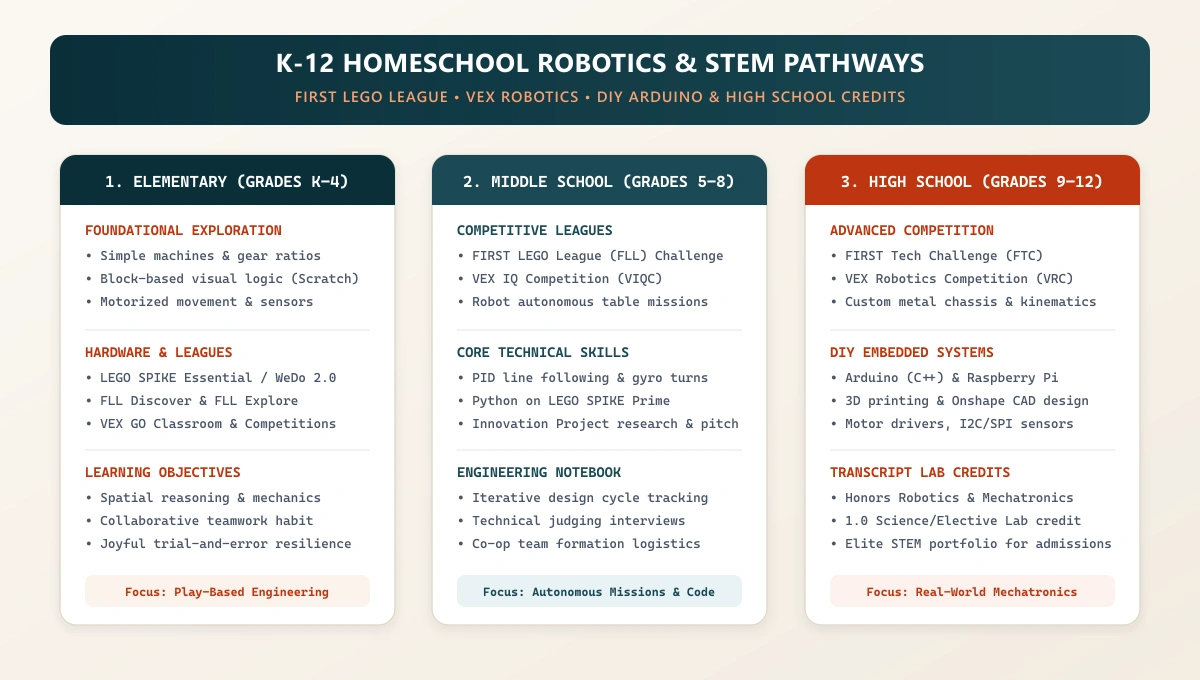
K-12 Homeschool Robotics Progression Architecture
1. Choosing the Right Platform: LEGO vs. VEX vs. Open-Source Arduino
Selecting the appropriate hardware ecosystem depends on your student’s developmental age, budget, and competitive aspirations:
1. LEGO Education (SPIKE Essential & SPIKE Prime)
- Target Age: Grades 1–8 (Ages 6–14)
- Strengths: Quick assembly with familiar Technic pins and beams; highly reliable ultrasonic, force, and color sensors; intuitive dual-programming interface (Scratch block-coding for beginners, embedded Python for advanced coders)[1].
- Competitions: FIRST LEGO League (FLL) Discover, Explore, and Challenge.
- Best For: Families seeking an all-in-one, highly polished introductory robotics curriculum with zero soldering or breadboarding.
2. VEX Robotics (VEX GO, VEX IQ & VEX V5)
- Target Age: VEX GO (Grades 1–4), VEX IQ (Grades 4–8), VEX V5 (Grades 9–12)
- Strengths: VEX IQ utilizes snap-together plastic structural components designed specifically for rapid mechanical prototyping, featuring smart motors that report real-time RPM, current draw, and encoder positions. VEX V5 transitions high schoolers into industrial aluminum/steel construction with high-torque brushless motors.
- Competitions: VEX IQ Robotics Competition (VIQC) and VEX V5 Robotics Competition (VRC) managed by the REC Foundation[2].
- Best For: Students focused heavily on mechanical drivetrains, competitive game strategy, and rapid physical mechanism iteration.
3. Open-Source Maker Robotics (Arduino, Raspberry Pi & ESP32)
- Target Age: Grades 8–12 (Ages 13–18)
- Strengths: Maximum engineering authenticity at minimal cost. Students design custom circuits on breadboards, solder connections, wire discrete motor drivers (e.g., L298N), program in C++ or MicroPython, and fabricate custom brackets using desktop 3D printers and free cloud CAD software (like Autodesk Fusion 360 or Onshape).
- Competitions: Science Olympiad, local Maker Faires, autonomous rover challenges.
- Best For: Self-directed high schoolers planning to major in mechanical, electrical, or computer engineering.
2. Navigating Competitive Leagues: FLL vs. VEX IQ vs. FTC
Joining a recognized competitive robotics league provides homeschoolers with external deadlines, rigorous peer benchmarks, and rich opportunities for public presentation and technical defense.
FIRST LEGO League (FLL) Challenge (Ages 9–14)
FLL Challenge is widely regarded as the premier middle school robotics competition in the world. Each August, FIRST releases a new global challenge centered around real-world scientific problems (e.g., ocean exploration, renewable energy, archaeological logistics).
An FLL team’s performance is judged across four equally weighted pillars:
- The Robot Game: An autonomous robot built with LEGO SPIKE Prime has 2.5 minutes on a 4x8-foot thematic mat to complete as many pre-set physical missions as possible. No remote control is allowed; students must write precise navigation code utilizing gyro sensors and color line-followers.
- The Innovation Project: The team identifies a real-world problem related to the season’s theme, researches current technologies, designs an innovative physical or digital solution, consults with professional engineers, and presents their findings to a panel of judges.
- Robot Design & Code Review: Students present their mechanical chassis, gear ratios, and modular software routines to engineer judges, explaining their testing logs and mathematical calculations.
- Core Values: The team is evaluated on gracious professionalism, discovery, inclusion, and team dynamics.
FIRST Tech Challenge (FTC) & VEX V5 (Grades 9–12)
In high school, students advance to FTC or VEX V5. Robots are built up to 18x18x18 inches using industrial metal channels, omnidirectional mecanum wheels, linear slide lifts, and pneumatic actuators. Matches feature a 30-second autonomous period driven by computer vision (AprilTags/OpenCV) followed by two minutes of driver-controlled tactical alliance gameplay.
3. How to Form an Independent Homeschool Robotics Team
One of the most persistent myths in home education is that students must attend a public school to participate in competitive robotics. In reality, thousands of the top-performing teams at regional, national, and world championships are independent homeschool teams.
Step-by-Step Formation Playbook:
- Assemble 4 to 8 Students: While teams can technically range from 2 to 10 members, the operational sweet spot for FLL or VEX IQ is 4 to 6 students. This ensures that every child has hands-on time with the robot and active roles in software coding and project research.
- Secure a Parent Coach & Workspace: You do not need an engineering degree to coach. The coach’s primary role is project management, facilitating the NASA Engineering Design Process, and ordering supplies. You need a dedicated basement, garage, or co-op classroom that can hold a 4x8-foot competition table.
- Register With the League: Register as a “Neighborhood / Non-School Team” on the FIRST (firstinspires.org) or RobotEvents (robotevents.com) portals. Registration opens each May for the upcoming fall/winter season.
- Budgeting and Sponsorships: An introductory FLL season typically costs $1,200–$1,800 (including the SPIKE Prime kit, annual challenge field setup kit, and regional tournament registration fees). Divided among 5 families, this equals approximately $250–$350 per student. Teams can also solicit micro-grants from local engineering firms, rotary clubs, or the national FIRST STEM grant database.
4. The Engineering Notebook: Documenting the Design Process
In competitive robotics, the physical robot is only half the story. The Engineering Design Notebook is the primary artifact evaluated by judges and serves as indispensable proof of rigorous STEM scholarship[4].
Students should document every session following the standard NASA Engineering Design Cycle:
- Ask: What is the mission requirement or constraint? (e.g., “We need to lift a 200g payload 14 inches without tipping the center of gravity.”)
- Imagine & Plan: Sketch alternative concepts, calculate theoretical gear torque ratios, and record why specific ideas were chosen.
- Create: Build the prototype mechanism and draft the initial sensor feedback script.
- Test & Measure: Record quantitative empirical data in tables. (“Test 1: Arm stalled at 30 degrees due to insufficient motor torque; Test 2: Doubled gear ratio to 1:5, arm lifted successfully in 1.4 seconds.”)
- Improve: Document what broke, what failed, and how the mechanism was redesigned.
5. High School Transcripts: Awarding Honors Mechatronics Credits
High school home educators can readily convert competitive robotics participation into official academic credit that strengthens university applications:
Course Title: Honors Robotics & Mechatronics Lab (1.0 Credit)
- Prerequisites: Algebra I, Introduction to Physics or Physical Science.
- Time Requirement: 150 logged hours of instruction, hardware fabrication, and competition.
- Core Topics Covered:
- Mechanical Power Transmission (spur gears, planetary gearboxes, chain drives, center of mass).
- Electrical Architecture (DC motor controllers, battery chemistry, voltage drop, wire gauge sizing).
- Software Control Systems (state machines, sensor interrupts, autonomous PID loop tuning).
- Computer-Aided Design (CAD modeling in Onshape/Fusion 360).
- Technical Communication & Project Management.
Admissions officers at institutions like MIT, Stanford, and Georgia Tech actively seek students with competitive robotics experience, recognizing that team robotics fosters real-world troubleshooting, rapid iteration, and resilience under pressure.
K-12 Homeschool Robotics Curriculum & Hardware Matrix
| Level | Hardware Platform | Primary Language | Recommended League | Estimated Annual Cost | Key Focus |
|---|---|---|---|---|---|
| Elementary (Grades K–3) | LEGO SPIKE Essential / VEX GO | Block Coding (Scratch) | FLL Explore / VEX GO | $300–$500 | Simple machines, levers, gear ratios |
| Upper Elem (Grades 4–5) | LEGO SPIKE Prime / VEX IQ | Blocks to Python | FLL Challenge / VEX IQ | $600–$1,200 | Sensor feedback, line following, basic chassis |
| Middle School (Grades 6–8) | SPIKE Prime / VEX IQ / Arduino | Python / C++ | FLL Challenge / VEX IQ | $800–$1,500 | Autonomous mission strategy, PID loops, CAD |
| High School (Grades 9–12) | FIRST Tech Challenge (REV/GoBILDA) | Java / Kotlin / C++ | FIRST Tech Challenge (FTC) | $1,500–$3,000 (Team) | Custom aluminum machining, vision AI, Honors Lab |
Frequently Asked Questions About Homeschool Robotics
Can a single homeschool student do robotics without joining a team? ↓
Does a parent coach need an engineering or computer science background? ↓
How much time commitment does a competitive robotics season require? ↓
Can robotics satisfy high school state lab science graduation requirements? ↓
Disclaimer: This post is for informational and educational purposes only, accurate to the best of our knowledge at publication. It does not constitute advice. We do not guarantee accuracy or completeness and accept no liability for any decisions or losses resulting from reliance on this content.