Raising a twice-exceptional (2e) child is an intense, awe-inspiring, and often disorienting journey[1].
A twice-exceptional child is one who demonstrates extraordinary intellectual capability, creative giftedness, or advanced abstract reasoning (often scoring in the top 2% to 5% of cognitive metrics), while simultaneously living with one or more neurodevelopmental differences—such as Attention-Deficit/Hyperactivity Disorder (ADHD), Autism Spectrum differences, dyslexia, dysgraphia, sensory processing differences, or executive function delays[2].
In institutional school environments, 2e learners are among the most misunderstood and underserved populations in modern education. Standardized classrooms are built for monolithic uniformity: children are grouped rigidly by the year of their birth, and every student is expected to read, write, calculate, and emotionally regulate at the exact same chronological pace[3].
When a twice-exceptional child enters this rigid model, educational tragedy frequently ensues. In this clinical and practical guide, we deconstruct the neurology of twice-exceptionality, examine why homeschooling is the premier intervention for 2e learners, and provide concrete instructional frameworks to nurture your child’s brilliant intellect without burning out their delicate nervous system.
1. Understanding Asynchronous Development: The “Many Ages in One” Paradox
To educate a twice-exceptional student successfully, parents must abandon the traditional concept of “grade levels” and embrace the clinical reality of asynchronous development.
Formulated in 1991 by the Columbus Group and championed by Dr. Linda Silverman of the Gifted Development Center, asynchronous development is the defining characteristic of giftedness:
“Giftedness is asynchronous development in which advanced cognitive abilities and heightened intensity combine to create inner experiences and awareness that are qualitatively different from the norm. This asynchrony increases with higher intellectual capacity.”
In practical terms, an eight-year-old 2e child does not operate at an eight-year-old level across the board. Instead, they operate at multiple different ages simultaneously:
- Intellectual Age: 14 years old (discussing black hole thermodynamics, complex geopolitical history, or solving high-school algebraic proofs).
- Chronological Age: 8 years old (with the physical body and biological sleep needs of a third grader).
- Fine-Motor / Handwriting Age: 6 years old (experiencing intense physical fatigue and muscle pain when forming letters due to dysgraphia).
- Emotional / Self-Regulation Age: 5 years old (experiencing full-body catastrophic meltdowns when a LEGO structure collapses or a pencil lead snaps).
When educators expect an asynchronous child to align all these disparate developmental timelines into a neat, synchronized line, the child internalizes intense shame. They wonder: “If I am so smart that I understand college physics, why can’t my hand write the letter ‘g’ without hurting? I must be broken.”
Homeschooling provides the only educational environment capable of holding all these disparate developmental ages in compassionate, simultaneous harmony.
2. The Dual-Masking Trap: Why Conventional Schools Fail 2e Learners
In public and private brick-and-mortar schools, twice-exceptional children routinely fall through bureaucratic cracks due to a phenomenon known as Dual-Masking:
- Giftedness Masks the Disability: Because the child is intellectually brilliant, they use raw cognitive horsepower to compensate for their learning deficit. A child with severe dyslexia might memorize thousands of words through visual context, scoring in the “average” range on reading tests and avoiding detection for years while suffering acute internal exhaustion.
- The Disability Masks the Giftedness: A child who cannot write legibly or sit still during a 45-minute lecture is deemed “unqualified” for the school’s Gifted and Talented pull-out program. Most gifted programs mandate grade-level compliance and neat handwriting as prerequisites for admission.
- The Average Illusion: When the giftedness and disability cancel each other out on standardized evaluations, the child appears dead-center average. Teachers report: “He is capable of doing the work, but he is lazy and lacks focus.”
In reality, the child is not lazy. They are working at 300% cognitive capacity just to survive the day, exhausting their executive functioning before morning recess.
When parents withdraw a 2e child from institutional schooling, the pressure of dual-masking evaporates. You can immediately feed their insatiable intellectual curiosity while giving their lagging skills the targeted accommodations they require.
3. The Three Golden Principles of 2e Homeschooling
To build a sustainable daily homeschool routine for a twice-exceptional child, structure your teaching around three non-negotiable principles:
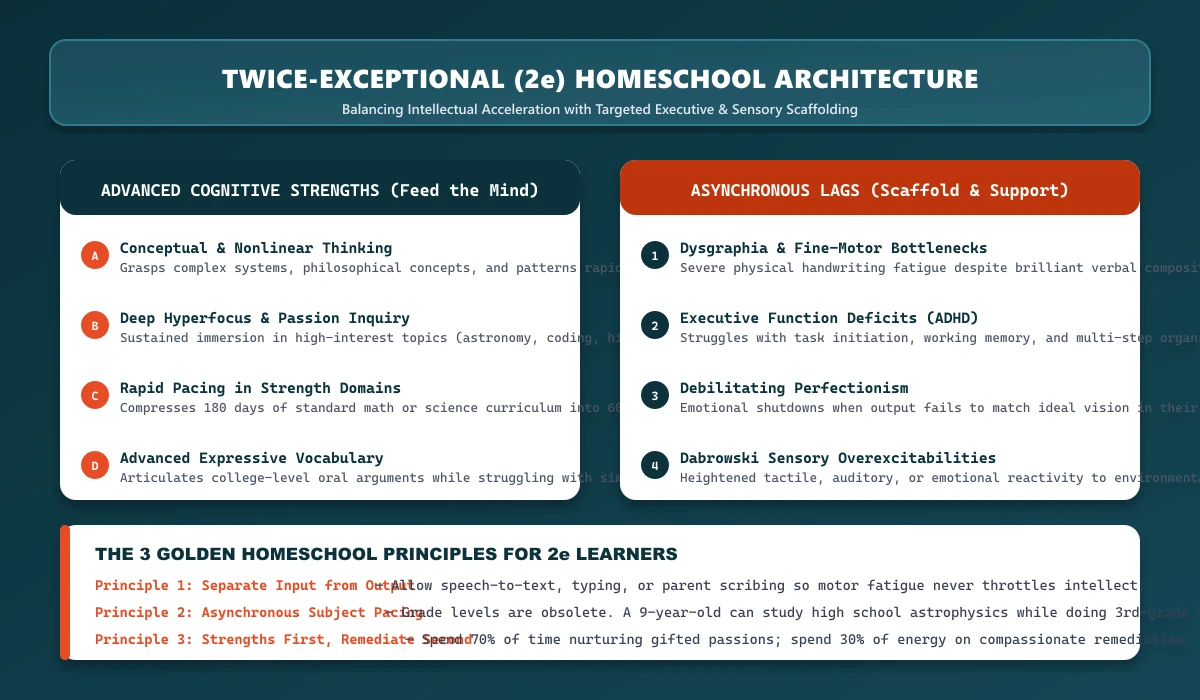
Principle 1: Separate Cognitive Input from Physical Output
The single most transformative modification you can implement in your homeschool is decoupling a child’s ability to absorb and analyze information from their ability to physically produce written work with a pencil.
In a standard classroom, if a student cannot write a five-sentence paragraph by hand, they are forbidden from studying complex history or science. This is pedagogical malpractice for a 2e learner.
- Oral Narration & Scribing: When your 8-year-old analyzes a historical battle or scientific hypothesis, let them pace around the living room and articulate their brilliant thoughts aloud while you act as their scribe at the keyboard.
- Assistive Speech-to-Text Technology: Introduce speech-to-text tools early (Google Voice Typing, Dragon NaturallySpeaking). This allows a child with dysgraphia to draft multi-page essays using their rich verbal vocabulary without motor roadblocks.
- Ergonomic Typing Instruction: Teach touch-typing using multisensory software designed for neurodivergent brains (e.g., Touch-Type Read and Spell or Nessy Fingers) rather than traditional gamified typing drills that induce anxiety.
- Oral Math & Whiteboards: Solve advanced math equations on a giant vertical whiteboard using dry-erase markers or verbally dictate problem steps to the parent. Eliminating tiny workbook boxes instantly relieves working memory strain.
Principle 2: Radical Asynchronous Subject Pacing
Forget monolithic grade levels. In a 2e homeschool, your student does not belong to a “grade”; they belong to an individualized constellation of academic trajectories:
| Academic Subject | Chronological Grade Level | Actual 2e Instructional Placement | Daily Homeschool Accommodation |
|---|---|---|---|
| Mathematics | Grade 4 (Age 9) | Grade 8 / Algebra 1 | Use Art of Problem Solving (AoPS) or Beast Academy; bypass repetitive drill. |
| Science & Astronomy | Grade 4 (Age 9) | High School / College Level | University lecture series, documentary deep-dives, lab kits, MIT OpenCourseWare. |
| Handwriting / Penmanship | Grade 4 (Age 9) | Grade 2 (Remedial Scaffolding) | 5 minutes daily using Handwriting Without Tears; emphasize motor mechanics only. |
| Spelling / Phonics | Grade 4 (Age 9) | Grade 3 (Targeted Phonograms) | Explicit Orton-Gillingham (All About Spelling / Logic of English). |
| Literature / Audiobooks | Grade 4 (Age 9) | Grade 9+ (Advanced Classics) | Unabridged audiobooks at 1.5x speed; sophisticated thematic discussions. |
When you allow a child to sprint in their strength areas, their behavioral frustration plummets. They no longer feel intellectually starved.
Principle 3: Strengths-First Pedagogy (70/30 Rule)
Traditional special education operates on a deficit model: it spends 80% of the day drilling the child’s weaknesses while ignoring their gifts until they “catch up.” For a gifted mind, this approach crushes academic self-esteem and triggers clinical depression.
Adopt the 70/30 Rule:
- 70% of Daily Energy: Dedicated to intellectual passions, deep inquiry, creative projects, high-level discussions, and strength acceleration.
- 30% of Daily Energy: Dedicated to short, compassionate, bite-sized remediation of lagging skills (10 minutes of handwriting, 15 minutes of spelling, targeted executive function coaching).
When a child spends the vast majority of their day feeling competent and intellectually exhilarated, they possess the emotional resilience to tackle difficult remedial tasks without shutting down.
4. Navigating Dabrowski’s Overexcitabilities in the Homeschool
Polish psychiatrist and psychologist Kazimierz Dabrowski identified that gifted and 2e individuals possess heightened neurological sensitivities called Overexcitabilities (OEs). These are not behavioral flaws; they are the physiological wiring of an intense nervous system.
Homeschooling allows you to accommodate these sensitivities rather than medicating or punishing them:
1. Psychomotor Overexcitability (The Physical Dynamo)
- The Manifestation: Rapid speech, perpetual physical motion, compulsive fidgeting, inability to sit still during lessons.
- Homeschool Solution: Ditch chairs. Let your child listen to literature while bouncing on a yoga ball, hanging upside down from an indoor sensory swing, jumping on a mini-trampoline, or pacing the hallway. Physical movement stimulates dopamine production, actively aiding neurodivergent focus.
2. Sensual Overexcitability (Sensory Hyper-Reactivity)
- The Manifestation: Extreme sensitivity to clothing tags, sock seams, bright fluorescent lights, ambient chewing noises, or food textures.
- Homeschool Solution: Complete environmental control. Your child can do school in their softest seamless pajamas, with natural sunlight instead of buzzing overhead lights, wearing noise-canceling headphones to block out appliance hums.
3. Intellectual Overexcitability (The Insatiable Quest)
- The Manifestation: Voracious appetite for truth, endless questioning (“Why? But why?”), deep moral concern for societal justice, obsession with theoretical logic.
- Homeschool Solution: Never say “Because that’s what the textbook says.” Partner with them in research. If a lesson on ancient Egypt turns into a two-week exploration of mummification chemistry, follow the rabbit hole.
4. Imaginational Overexcitability (The Vivid Creator)
- The Manifestation: Rich internal fantasy worlds, complex imaginary companions, vivid daydreaming, intense visual metaphors.
- Homeschool Solution: Allow creative project-based output. Let them build Minecraft historical civilizations, write and illustrate fantasy epics, or produce stop-motion animation videos instead of traditional book reports.
5. Emotional Overexcitability (The Deep Feeler)
- The Manifestation: Profound empathy, existential dread about climate change or war, intense emotional highs and devastating lows, extreme sensitivity to criticism.
- Homeschool Solution: Co-regulation over discipline. When emotional overwhelm occurs, pause academics immediately. Validate their deep emotional capacity and provide a calm, secure harbor until their nervous system resets.
5. Taming Debilitating Perfectionism
Perfectionism is the Achilles’ heel of the twice-exceptional learner. Because a 2e child can conceptualize a flawless, magnificent end product in their mind, they become paralyzed when their physical hands or executive functioning cannot execute that vision with identical perfection.
A crooked letter or an incorrect math calculation can trigger tears, self-loathing, or dramatic declarations: “I am stupid! I can never do anything right!”
Clinical Strategies for Deconstructing Perfectionism at Home
- Model Glorious Failure: Normalize errors. When you drop an egg on the kitchen floor or miscalculate a recipe, verbalize your internal self-talk aloud: “Oops! That didn’t go as planned. Mistakes are just data that teach my brain how to adapt next time.”
- Praise the Effort, Never the “Smartness”: Dr. Carol Dweck’s growth mindset research is critical here. Telling a child “You are so brilliant!” instills terror that making a mistake will prove they are not smart. Instead, praise tenacity: “I loved how you tested three different strategies when that physics problem didn’t work on the first try.”
- The “Draft 1 is Supposed to Stink” Principle: Teach that professional authors, engineers, and scientists never produce a perfect prototype on step one. Introduce iterative design thinking.
- Deliberate Error Spotting: Give your child a worksheet filled with deliberate mistakes made by you, and let them be the “detective” whose job is to find and celebrate the errors.
6. Recommended Curricula for Twice-Exceptional Learners
| Curriculum | Subject Area | Why It Works for 2e Learners |
|---|---|---|
| Beast Academy / Art of Problem Solving | Mathematics | Comic book visual delivery paired with deep, non-routine mathematical logic puzzles; eliminates rote computational repetition. |
| Michael Clay Thompson (MCT) Language Arts | Language Arts & Poetics | Intellectually stunning, story-driven linguistic architecture; treats grammar, poetics, and Latin roots as an art form rather than dry mechanics. |
| All About Spelling (AAS) | Remedial Spelling | Multisensory Orton-Gillingham with magnetic letter tiles; provides explicit logical rules that appeal to analytical 2e thinkers with dyslexia/dysgraphia. |
| History Quest / Story of the World (Audiobook) | World History | Rich narrative audio immersion that bypasses reading fatigue; allows hands to remain busy building models or drawing during lessons. |
| Touch-Type Read and Spell (TTRS) | Assistive Typing | Dyslexia/dysgraphia-friendly typing software that reinforces phonics patterns through muscle memory without stressful speed games. |
Final Thoughts: The Gift of Unhurried Development
Homeschooling a twice-exceptional child is not a sprint toward early college graduation, nor is it an endless emergency triage of their deficits.
It is a sacred opportunity to give a complex, beautifully wired human being the time, space, and unconditional acceptance they need to grow into their extraordinary potential. When you honor their intense curiosity, scaffold their asynchronous struggles, and celebrate their neurodivergent perspective, you give them the greatest gift a parent can bestow: the freedom to be fully, authentically themselves.
Frequently Asked Questions
How do I know if my child is twice-exceptional?
A comprehensive neuropsychological evaluation conducted by a clinical psychologist specializing in gifted and neurodivergent populations is the gold standard for formal diagnosis. The evaluation typically pairs cognitive assessments (such as the WISC-V) with achievement tests (WIAT-4) and executive function / behavioral measures to uncover significant discrepancies between verbal/spatial reasoning and processing speed or working memory.
Can a 2e child succeed in college and careers?
Absolutely. Many of history’s greatest innovators, scientists, artists, and entrepreneurs (including Albert Einstein, Thomas Edison, and Temple Grandin) exhibited classic twice-exceptional profiles. When 2e individuals are supported in environments that nurture their hyperfocus and conceptual genius while accommodating their motor and organizational quirks, they achieve groundbreaking contributions.
Should I tell my child that they are twice-exceptional?
Yes. Demystifying their neurology is one of the most empowering interventions you can provide. When children do not know why they struggle with simple tasks despite their high intelligence, they assume they are “broken” or “lazy.” Explaining asynchronous development helps them understand that their brain simply develops on different tracks—and that having challenges in one area does not diminish their brilliance in another.
Disclaimer: This post is for informational and educational purposes only, accurate to the best of our knowledge at publication. It does not constitute advice. We do not guarantee accuracy or completeness and accept no liability for any decisions or losses resulting from reliance on this content.