

Stepping into kindergarten as a home educator is an exhilarating, sacred milestone, but for many parents, it is also accompanied by acute performance anxiety[1].
Modern institutional kindergartens have transformed dramatically over the past two decades. Where early childhood education was once a joyful sanctuary of finger painting, imaginative dress-up, outdoor sandboxes, and midday naps, conventional classrooms have increasingly turned into “first grade light.” Five-year-olds are routinely subjected to standardized benchmark screening, timed phonics drills, computer-based adaptive tests, and hours of sedentary desk work[2].
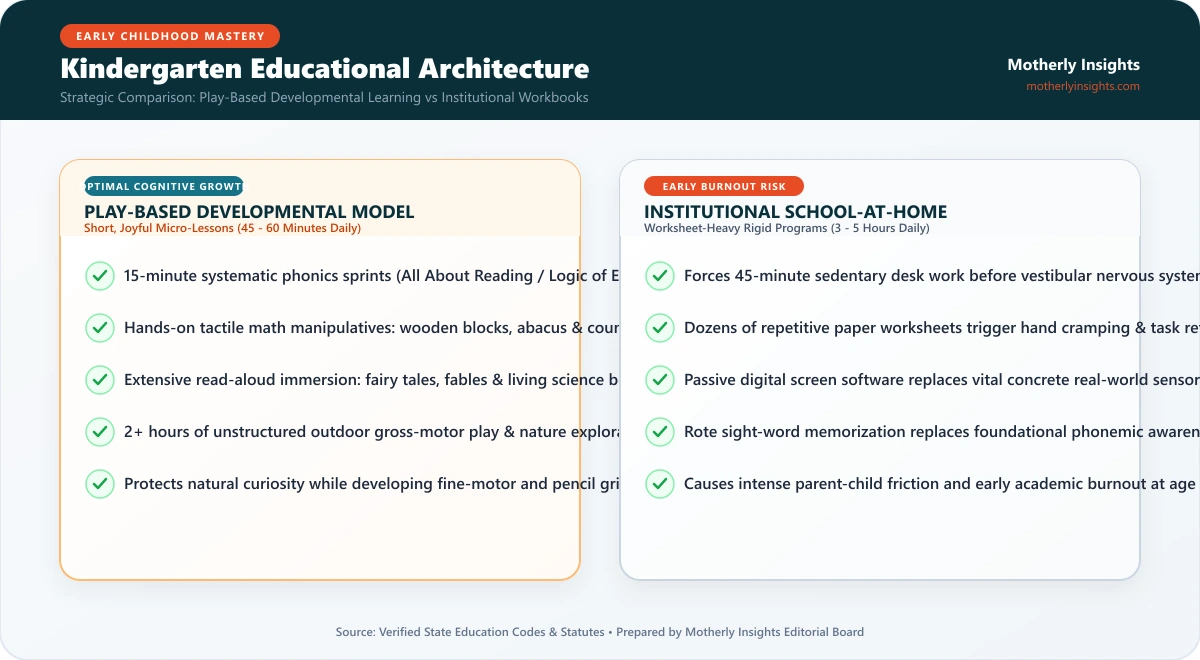
As a home educator, you have the profound legal and pedagogical freedom to reject this developmental mismatch. Homeschooling kindergarten does not mean bringing an institutional classroom into your kitchen; it means cultivating a rich, literature-infused, play-based environment where academic foundations unfold naturally through unhurried connection, sensory discovery, and focused tutorial mastery[3].
In this definitive guide, we explore legal compulsory age parameters, realistic daily instructional schedules, research-backed phonics and math strategies, and sustainable habits to make your kindergarten year an enduring success.
1. The Legal Reality: Compulsory School Age vs. Kindergarten Myths
The single greatest source of panic for new homeschool parents is the misconception that they will face legal scrutiny or truant officer intervention if their five-year-old is not officially enrolled in a certified state kindergarten program.
In reality, statutory compulsory attendance laws across the United States paint a very different picture:
Compulsory Age Breakdown by State Law
- Age Five Compulsory States: Only a handful of jurisdictions (e.g., Maryland, Virginia, Oklahoma, Delaware, Connecticut) require formal educational participation at age five, and even within these states, most provide standard parental kindergarten waiver provisions allowing families to delay formal schooling until age six.
- Age Six Compulsory States: Approximately twenty-six states (including California, Texas, Florida, New York, and Ohio) establish compulsory attendance at age six. If your child is five on September 1st, you have zero legal obligation to register, report, or notify school districts in these states.
- Age Seven & Eight Compulsory States: Several states (such as Pennsylvania, Washington, Idaho, and North Carolina) do not mandate formal educational reporting until a child reaches seven or eight years of age.
💡 Legal Best Practice: Always consult your state’s specific compulsory attendance statute. In states with an age-six or age-seven threshold, you can educate your five-year-old kindergarten student with 100% legal autonomy—no notice of intent, no curriculum pre-approval, and no standardized testing required.
2. The Real Time Equation: How Long Does Kindergarten Actually Take?
When parents envision homeschool, they often assume they must recreate a 6-hour institutional school day. Attempting to force a five-year-old to sit at a desk for six hours is not only biologically impossible; it is developmentally destructive.
In an elementary school classroom, the vast majority of the six-hour day is consumed by herd logistics: taking attendance, waiting in line for the restroom, distributing and collecting supplies, settling behavioral disruptions, walking through hallways, and waiting for 22 other children to complete a task.
In a one-on-one homeschool tutorial setting, direct instructional time averages only 45 to 60 minutes per day.
| Developmental Block | Daily Duration | Instructional Focus | Core Method |
|---|---|---|---|
| Morning Basket / Circle Time | 15 – 20 Minutes | Living Picture Books, Poetry, Character, Calendar & Weather | Communal snuggle on couch with oral discussion |
| Foundational Phonics & Reading | 10 – 15 Minutes | Phonemic awareness, explicit letter-sound decodable practice | Multisensory tiles, flashcards, decodable readers |
| Hands-On Concrete Mathematics | 10 – 15 Minutes | Subitizing, ten-frames, pattern blocks, counting games | AL Abacus, physical counters, dice, math games |
| Fine-Motor Pre-Writing / Tracing | 5 – 10 Minutes | Pencil grip posture, strokes, playdough sculpting, tracing | Sand trays, chalkboard wet-dry-try, copywork |
| Independent & Sensory Free Play | 3 – 5 Hours | Gross-motor exploration, imaginative role-play, nature study | Backyard mud kitchen, LEGOs, dress-up, outdoor parks |
If you complete 15 minutes of phonics and 15 minutes of hands-on math before 10:00 AM, your formal kindergarten academic requirements are complete. The remainder of the day belongs to curiosity, physical movement, sensory play, and family life.
3. Early Literacy: Grounding Kindergarten in the Science of Reading
Teaching a child to read is the centerpiece of the kindergarten year. Historically, American classrooms relied on “Balanced Literacy” and “Three-Cueing” methods—encouraging children to guess unfamiliar words based on pictures, first letters, or sentence context. Cognitive neuroscience has decisively proven that cueing strategies produce poor readers and dyslexic failure patterns.
Kindergarten home educators should ground their literacy instruction in the Science of Reading, following an explicit, systematic phonics progression:
Phase 1: Phonemic Awareness (The Auditory Engine)
Before a child ever touches a printed workbook, they must develop auditory phonemic awareness:
- Rhyme Recognition: Identifying rhyming word families (cat, bat, hat).
- Initial Sound Isolation: Hearing that “sun” begins with the /s/ sound.
- Oral Blending: Listening to segmented sounds (/c/ /a/ /t/) and mentally slamming them together to identify “cat.”
- Oral Segmenting: Hearing the word “mop” and breaking it down aloud into /m/ /o/ /p/.
Phase 2: Systematic Letter-Sound Correspondence (Grapheme-Phoneme Mapping)
Introduce letters not in alphabetical order, but in high-utility clusters that allow immediate word building (e.g., s, a, t, p, i, n). Once a child knows these six sounds, they can independently blend real words: sat, pat, tap, pin, tip, pan, pit.
Phase 3: Decodable Readers Only
Never give a beginning reader predictable “leveled” books containing words they have not learned the phonetic codes for (e.g., “The little monkey climbed up the tall banana tree”). When children cannot sound out words, they resort to guessing. Use 100% phonetically controlled decodable readers (e.g., Bob Books, All About Reading Decodables, Flyleaf Publishing) where every single word obeys phonics rules the child has already mastered.
4. Early Numeracy: Concrete Manipulatives Before Abstract Worksheets
In mathematics, young brains progress through three cognitive stages: Concrete → Pictorial → Abstract.
Traditional worksheets jump immediately to the abstract stage: presenting a five-year-old with the equation $3 + 2 = 5$ on a printed page. When a child’s brain has not yet formed a concrete mental map of quantity, they resort to inefficient finger-counting or memorizing meaningless shapes.
The Four Essential Kindergarten Math Pillars
- Subitizing (Instant Recognition): The ability to recognize quantities up to five without counting by ones. Use standard dice patterns, dominoes, and five-frames so your child recognizes a group of three dots as “three” instantly.
- Ten-Frames and Grouping: Use a double-row ten-frame egg carton or printed grid with colored glass gems. Placing seven gems on a ten-frame allows the child to visually grasp that 7 is composed of 5 on the top row and 2 on the bottom row, and is exactly 3 spaces away from 10.
- The AL Abacus or Rekenrek: A two-color bead rack (five yellow beads, five blue beads per wire) provides a tangible physical model for place value, eliminating finger-counting habits permanently.
- Real-World Living Math: Measuring ingredients for chocolate chip cookies, sorting laundry socks by color and pair, setting the dinner table with four forks and four plates, and playing board games like Chutes and Ladders or Count Your Chickens.
5. Fine Motor Readiness: Why You Must Delay Pencil Burnout
One of the most frequent reasons kindergarten boys and high-energy children develop an aversion to homeschooling is premature handwriting demands.
A five-year-old’s hand contains immature, cartilaginous bones and developing intrinsic hand muscles. Forcing an uncoordinated child to grip a standard pencil and fill out lines of small letters produces hand cramps, intense neurological fatigue, and emotional meltdowns.
Building Intrinsic Hand Strength Through Play
Before handing your child a pencil, spend the first half of kindergarten strengthening hand musculature through tactile play:
- Playdough and Modeling Clay: Squeezing, rolling, and pinching clay with rolling pins and plastic pizza cutters.
- Scissor Skills: Snipping strips of cardstock, cutting playdough snakes, and fringe cutting.
- Tweezers and Tongs: Transferring pom-poms or marbles from one container to another using giant plastic tweezers.
- Spray Bottles and Eyedroppers: Squeezing water spray bottles to water houseplants or using eyedroppers to drop watercolor droplets onto coffee filters.
Multisensory Letter Formation
When you do practice letter formation, utilize large gross-motor and sensory pathways:
- Sand or Salt Trays: Tracing letters with the index finger in a shallow wooden tray filled with colored craft sand.
- Chalkboard Wet-Dry-Try: Writing a letter with chalk, tracing over it with a tiny wet sponge, and drying it with a folded paper towel (pioneered by Handwriting Without Tears).
- Shaving Cream: Spreading a thin layer of shaving cream on a baking sheet and practicing letter strokes with tactile pleasure.
6. Curating Your Kindergarten Spine: Recommended Curricula
While you can easily homeschool kindergarten using public library books and dollar-store counters, structured curricula provide peace of mind for first-time parents. Here are the most respected, research-backed kindergarten programs:
| Curriculum | Subject Area | Instructional Style | Daily Parent Time |
|---|---|---|---|
| All About Reading (Pre-reading / Level 1) | Phonics & Reading | Multisensory Orton-Gillingham, letter tiles, decodables | 15 – 20 mins (1-on-1) |
| Logic of English: Foundations A | Comprehensive ELA | Science of Reading, phonograms, gross-motor games | 20 mins (1-on-1) |
| RightStart Mathematics: Level A | Math Foundation | AL Abacus, subitizing, mental math, math card games | 20 – 30 mins (1-on-1) |
| Math with Confidence: Kindergarten | Math Foundation | Kate Snow gentle conversational math, household counters | 15 mins (1-on-1) |
| Blossom and Root: Kindergarten | Nature, STEM, Art | Nature journaling, living books, hands-on science | 20 – 30 mins (Flexible) |
| Five in a Row (FIAR): Vol. 1 | Literature Unit Studies | Read one classic picture book 5 days, explore geography & art | 15 – 20 mins (Family) |
7. Sample Kindergarten Daily Schedules
Every family operates under unique domestic rhythms. Here are two practical schedules used successfully by real homeschooling households:
Schedule A: The Morning Flow Rhythm (Early Birds)
- 8:30 AM – 9:00 AM: Breakfast and Morning Basket (Read 2 picture books, sing weather song, recite nursery rhyme).
- 9:00 AM – 9:15 AM: Phonics & Decodable Reading (15 minutes focused decoding on the sofa).
- 9:15 AM – 9:45 AM: Outdoor Recess / Sensory Break (Running in backyard, chalk drawing on driveway).
- 9:45 AM – 10:00 AM: Hands-On Math (15 minutes playing a math game or using ten-frames).
- 10:00 AM – 10:10 AM: Fine-Motor Handwriting (5 minutes chalkboard tracing).
- 10:10 AM Onward: School is Complete! Unstructured imaginative play, library visits, parks, and lunch.
Schedule B: The Staggered Rhythm (Homeschooling with Toddlers)
- 7:45 AM – 8:15 AM: Focused 1-on-1 connection with toddler while kindergartener plays blocks.
- 9:00 AM – 9:20 AM: Kindergartener completes Phonics lesson while toddler explores a sensory water bin.
- 11:30 AM – 12:00 PM: Toddler naptime begins. Parent and kindergartener complete hands-on Math and read-alouds in quiet harmony.
- Afternoon: Communal nature walk and park playgroup.
Final Encouragement: Protect the Wonder of Childhood
If your kindergartener completes this year loving books, asking curious questions about the natural world, possessing confident spatial number sense, and feeling securely attached to their parents, your kindergarten homeschool is a resounding triumph.
Academic rigor has its place in the middle and high school years. In kindergarten, protect their wonder, safeguard their outdoor hours, and embrace the unhurried joy of learning alongside your child.
Frequently Asked Questions
What should a child know before starting kindergarten homeschool?
Before beginning formal kindergarten academics, a child should ideally demonstrate basic auditory listening skills, know how to hold a picture book right-side up, recognize common colors and shapes, be able to follow simple two-step verbal directions, and show curiosity about letters and numbers. There is zero requirement for a child to read or write prior to kindergarten.
How do I socialize a homeschooled kindergartener?
Homeschool socialization occurs organically in multi-age, real-world community settings. Local homeschool co-ops, weekly nature clubs, library story hours, church youth groups, gymnastics or swim lessons, martial arts, and neighborhood playground meetups provide rich, natural social interactions without the artificial age-segregation and peer pressure of institutional classrooms.
What if my kindergartener resists sitting still for lessons?
Kinesthetic restlessness is completely normal for five-year-olds. Eliminate desk work entirely. Deliver phonics lessons while your child bounces on a mini-trampoline, practices hopscotch on letter chalk outside, or holds letter beanbags. If tears occur, close the book immediately, hug your child, and head outside for fresh air. Connection always precedes education.
Disclaimer: This post is for informational and educational purposes only, accurate to the best of our knowledge at publication. It does not constitute advice. We do not guarantee accuracy or completeness and accept no liability for any decisions or losses resulting from reliance on this content.