

For parents of neurodivergent learners—including children diagnosed with ADHD, Autism Spectrum differences, Dyslexia, Auditory Processing Disorder, or Sensory Processing Disorder—the conventional classroom can often feel like an unyielding gauntlet of overstimulation, rigid standardized pacing, and bureaucratic exhaustion. Nationwide, special needs families represent one of the fastest-growing demographics transitioning to home education[1].
At home, the institutional adult-to-child ratio is replaced by 1-on-1 personalized instruction, transforming education from an environment of sensory survival into one of genuine academic acceleration and joyful discovery.
However, parents navigating this journey face complex legal and logistical questions: What happens to our public school IEP? Can homeschooled students still receive speech or occupational therapy from the local school district? How do we adapt curriculum for severe executive dysfunction or phonological processing delays?
This comprehensive clinical and legal guide details your rights under the Individuals with Disabilities Education Act (IDEA), strategies for converting a public school IEP into a private home education plan, evidence-based curricula (such as Orton-Gillingham for dyslexia and multi-sensory math), and practical sensory accommodations.
The Strategic Choice: Institutional Public IEP vs. Individualized Home Plan
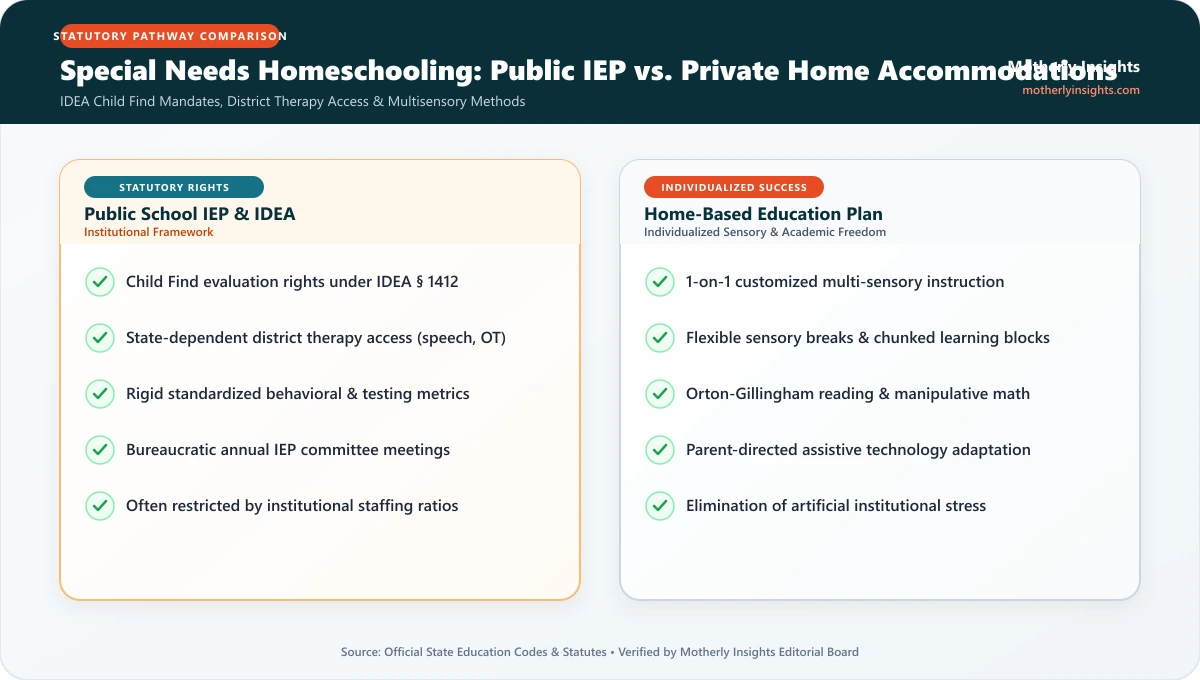
Understanding the operational differences between public special education and home-based modifications empowers parents to craft a customized learning blueprint.
1. Federal Law & Your Rights: IDEA Child Find Under 20 U.S.C. § 1412
Under the federal Individuals with Disabilities Education Act (IDEA), every public school district is bound by the Child Find mandate (20 U.S.C. § 1412(a)(3)):
- Free Comprehensive Evaluations: The local public school district is legally obligated to locate, identify, and evaluate all children residing within district boundaries who are suspected of having a qualifying disability—regardless of whether the child is enrolled in public school, a private school, or a homeschool[2].
- Independent Diagnostic Requests: Parents have the legal right to submit a formal written request to their local public school special education director for comprehensive psychoeducational testing, speech-language evaluations, or occupational therapy assessments at zero cost.
- No Obligation to Re-Enroll: Undergoing a district evaluation to obtain diagnostic clarity or clinical documentation does not obligate you to enroll your child in public school or accept a proposed public placement.
2. What Happens to Your IEP When You Withdraw to Homeschool?
When a parent files a homeschool notice of intent or private school affidavit, the student’s legal classification changes:
The Status of the IEP:
- Dormant Public Status: In the vast majority of states, an Individualized Education Program (IEP) is an institutional document that operates exclusively while enrolled in public school. When you withdraw, the IEP is placed into dormant status in your student’s cumulative file.
- District Service Plans: Under federal regulations governing “equitable services,” districts allocate a proportionate share of federal IDEA funds to provide limited services (such as itinerant speech therapy) to parentally placed private school students. Whether homeschooled students qualify depends entirely on how your state statutes define homeschooling:
- In Private School States (e.g., California, Texas, Illinois, Nebraska): Homeschoolers are legally classified as private schools and may be eligible for district Services Plans.
- In Dedicated Home Education States (e.g., Florida, Pennsylvania, Virginia): Access to district therapies is governed by state-specific dual-enrollment statutes. Many families choose to utilize private health insurance, Medicaid, or state ESA funds (such as Arizona ESA or Florida PEP) for clinical therapies.
3. Designing a Private Student Education Plan (SEP)
Rather than maintaining cumbersome 30-page bureaucratic documents, home educators author a streamlined Student Education Plan (SEP) tailored to their child’s unique cognitive profile:
Key Components of an Effective Home SEP:
- Present Levels of Performance: Baseline assessments in reading decoding, reading comprehension, computational math, and written expression.
- Target Accommodations & Sensory Diets:
- Visual schedules and color-coded task checklists to alleviate executive function bottlenecks.
- Frequent sensory resets (trampoline breaks, heavy work, resistance bands on chair legs).
- Auditory accommodations: Noise-dampening headphones, instrumental background music, or text-to-speech software.
- Modified Pacing Standards: Freedom to advance rapidly in areas of profound gift while slowing down to mastery pace in areas of challenge.
- Assistive Technology Protocols: Speech-to-text dictation tools (Dragon, Google Voice Typing), digital screen-reading software, and graphic organizer templates.
4. Evidence-Based Curricula for Neurodivergent Learners
Children with learning differences require structured, multi-sensory instructional methodologies rooted in scientific cognitive research[3]:
For Dyslexia & Phonological Processing (Orton-Gillingham Method):
The Science of Reading demonstrates that dyslexic students require explicit, systematic, multi-sensory phonics:
- All About Reading (AAR): A mastery-based, open-and-go Orton-Gillingham curriculum using color-coded tactile letter tiles, flashcards, and decodable phonetic readers.
- Barton Reading & Spelling System: A gold-standard clinical intervention designed specifically for parents of severely dyslexic children, featuring explicit phonemic awareness scripting.
- Logic of English (Foundations & Essentials): A comprehensive multi-sensory curriculum teaching all 74 basic phonograms and 31 spelling rules explicitly.
For Dyscalculia & Working Memory Challenges (Multi-Sensory Math):
- Math-U-See: Renowned for its color-coded manipulative integer blocks. Children physically construct concepts of addition, place value, multiplication, and fractions before translating them to paper.
- RightStart Mathematics: Emphasizes visualization through the AL Abacus, mental math strategies, and educational math card games rather than repetitive worksheets.
5. Daily Executive Function & ADHD Accommodations
Children with ADHD or executive dysfunction struggle with working memory, task initiation, and emotional regulation. Home education allows parents to implement therapeutic environmental designs:
- The Chunked Pacing Model (The Pomodoro Adaptation): Replace traditional 50-minute periods with 15 to 20 minutes of intense focused work, followed immediately by a 5-minute physical movement break.
- Externalizing Working Memory: Use dry-erase whiteboards, laminated daily checklists, and visible desktop analog timers (Time Timer) so the passage of time is concrete and visible.
- Body Doubling: Sit alongside your child during independent reading or written assignments. Parental presence provides passive neurological co-regulation, dramatically reducing task initiation paralysis.
- Flexible Posture: Permit learning while standing, bouncing on an exercise ball, laying on a rug, or pacing while practicing oral math facts.
6. High School, Transcripts & College Accommodations
Homeschooled special needs students graduate with full legal high school credentials and transition successfully into colleges, vocational trades, and independent living:
- Official High School Transcripts: Author a standard single-page transcript reflecting courses completed. You are not required to mark courses with stigmatizing “Special Education” labels on collegiate transcripts.
- College Board Accommodations (SSD): Homeschooled students can apply directly through the College Board’s Services for Students with Disabilities (SSD) office for accommodations on the PSAT, SAT, and AP exams (including 50% or 100% extended time, separate testing rooms, and frequent breaks). Documentation must show a history of psychoeducational evaluations and consistent accommodations used during home study.
Practical Action Checklist for Parents
- Request Comprehensive Evaluations: If un-diagnosed, submit a formal written request to your local school district under IDEA Child Find or schedule an independent neuropsychological evaluation.
- Collect Baseline Records: Gather previous IEPs, psychological reports, and therapy evaluations into a dedicated master file.
- Establish Sensory-Friendly Learning Zones: Minimize visual clutter, provide natural lighting, and equip the workspace with tactile fidgets and noise-canceling headphones.
- Select Multi-Sensory Curricula: Invest in evidence-based programs (Orton-Gillingham reading, manipulative-based math) that align with your child’s learning profile.
- Document Annual Accommodations: Maintain records of daily accommodations and work samples to support future standardized testing accommodation requests.
Frequently Asked Questions
Does a parent need a special education degree to homeschool a child with an IEP? ↓
How do homeschoolers handle state standardized testing requirements if their child has a learning disability? ↓
Can homeschooling cure sensory meltdowns and school refusal? ↓
Disclaimer: This post is for informational and educational purposes only, accurate to the best of our knowledge at publication. It does not constitute legal, medical, or clinical advice. We do not guarantee accuracy or completeness and accept no liability for any decisions or losses resulting from reliance on this content.