One of the greatest misconceptions deterring prospective families from home education is the belief that homeschooling requires immense wealth. Glossy homeschool catalogs and social media influencers frequently promote comprehensive “all-in-one” boxed curriculum packages costing $800 to $1,500 per child per year. For a family with three or four children, purchasing pre-packaged kits can feel like paying private school tuition.
In reality, academic excellence is not correlated with commercial price tags. Today’s home educators have access to an unprecedented wealth of Open Educational Resources (OER), free downloadable high-rigor curricula, digitized public domain libraries, and philanthropic educational foundations.
With strategic planning, a multi-child family can deliver a superior, university-preparatory education for under $100 to $250 per child annually. This guide provides an actionable blueprint for frugal homeschooling: top-tier free curricula, public library hacks, hardware print economics, and used marketplace procurement strategies.
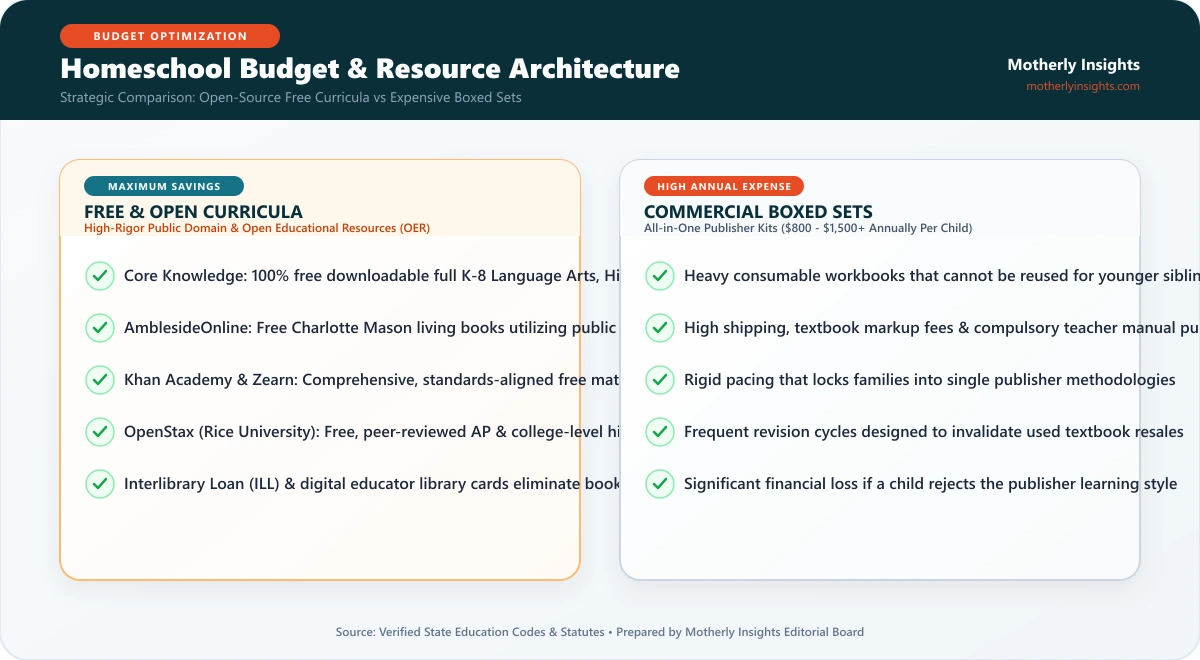
1. The Real Cost Equation: Commercial Boxed Sets vs. Frugal Homeschooling
Before budgeting, parents should evaluate where commercial curriculum companies spend their revenue: heavy full-color marketing catalogs, proprietary software lock-ins, and annual workbook revisions specifically engineered to destroy used-curriculum resale value.
| Budget Category | Commercial Boxed Set (e.g., Sonlight, Abeka, BJU) | Frugal / Open-Source Homeschooling |
|---|---|---|
| Curriculum Costs | $800 – $1,600 / child | $0 (Free OER & Public Domain) |
| Consumable Workbooks | $150 – $300 / child (non-reusable) | $30 – $60 (Self-printed or digital) |
| Literature & Living Books | $250 – $400 (Bought new) | $0 (Public Library & Interlibrary Loan) |
| Science Lab Equipment | $100 – $250 (Specialized kit) | $25 – $50 (Household items & raw supplies) |
| Total Annual Cost Per Child | $1,300 – $2,550 | $55 – $170 |
By decoupling your homeschool from commercial publishers, you free up financial resources for enriching real-world experiences: museum memberships, sports, music lessons, and high-impact travel.
2. Premier 100% Free Full-Scope Curricula
The following resources are not fragmented worksheets or light “taster” trials; they are complete, rigorous, multi-year academic curricula available to the public at zero cost.
1. Core Knowledge (Core Knowledge Foundation / E.D. Hirsch)
- Scope: Grades K–8 (Comprehensive).
- Subjects: Language Arts (CKLA), World History & Geography, Science (CKSci).
- Worldview: Strictly secular, classical, content-rich.
- Why It Dominates Frugal Homeschooling: Founded by educational theorist Dr. E.D. Hirsch, the Core Knowledge Foundation provides its entire K–8 curriculum online as 100% free, full-color downloadable PDF files.
- Each unit includes comprehensive Teacher Guides, Student Readers, Activity Books, and Mid-Unit Assessments.
- The Language Arts program is deeply rooted in the Science of Reading, phonemic awareness, and classical cultural literacy (Greek myths, Roman history, world biomes).
- How to Use on a Budget: Download the Student Readers to an iPad or Kindle tablet, and view Teacher Guides on a laptop, printing only the consumable student activity pages.
2. AmblesideOnline (AO)
- Scope: Grades K–12.
- Subjects: Literature, History, Natural History, Poetry, Artist & Composer Study.
- Worldview: Christian Charlotte Mason (easily adapted for secular families).
- Why It Works: Created by a volunteer advisory board of veteran home educators, AmblesideOnline is a world-class Charlotte Mason curriculum designed from the ground up to utilize free public domain living books.
- Complete 36-week schedules, booklists, and examination prompts are posted free online.
- Over 80% of assigned historical narratives and classic literary works can be read for free via Project Gutenberg, LibriVox audiobooks, or borrowable on the Internet Archive.
3. Khan Academy & Zearn Mathematics
- Scope: Grades Pre-K–12+.
- Subjects: Math (Early Math through AP Calculus & Linear Algebra), Sciences, Computing, Economics.
- Why It Works: Funded by philanthropic grants, Khan Academy provides standards-aligned video tutorials, immediate feedback practice sets, and mastery-based progression tracking. Paired with Zearn (free for individual home accounts in elementary math), children receive interactive, conceptually rigorous math instruction with zero parent prep.
4. OpenStax (Rice University)
- Scope: Grades 9–12 & AP Courses.
- Subjects: AP Biology, AP Chemistry, College Physics, Anatomy & Physiology, US History, Psychology.
- Why It Works for High School: High school science and humanities textbooks frequently cost $120–$200 each. OpenStax publishes peer-reviewed, college-level digital textbooks written by university professors. Texts can be read online, downloaded as high-resolution PDFs, or purchased as bound paperbacks for a fraction of traditional publishing costs.
5. Easy Peasy All-in-One Homeschool
- Scope: Preschool through Grade 12 (EP / Easy Peasy High School).
- Subjects: Complete 180-day school year (Math, Language Arts, History, Science, Bible, Electives).
- Worldview: Conservative Christian.
- Why It Works: Built by veteran homeschooling mother Lee Giles, Easy Peasy links to free educational games, readings, and videos structured into daily, numbered assignments. Perfect for families needing an open-and-go digital curriculum without upfront expenditures.
3. The Public Library Power-User Strategy
Your local municipal library is the most valuable educational partner in your homeschool ecosystem. Most families only scratch the surface of library capabilities.
1. The Educator Card Advantage
In most states and municipal library districts, homeschooling parents qualify for an Institutional Educator Card (identical to public school teachers). Benefits include:
- Extended checkout limits (e.g., 50 to 100 books simultaneously).
- Extended lending periods (6 to 9 weeks instead of 3 weeks).
- Fine Forgiveness / Zero Overdue Fines on children’s educational materials.
2. Interlibrary Loan (ILL) Mastery
Never limit your curriculum to what is currently sitting on your neighborhood branch shelves. Through state Interlibrary Loan (ILL) networks (such as WorldCat, LINKcat, or OhioLINK), you can request rare, out-of-print Charlotte Mason living books, university laboratory manuals, and expensive historical biographies from academic and regional libraries statewide, delivered directly to your neighborhood branch for free.
3. Digital Media Platforms (Libby, Hoopla & Kanopy)
- Libby: Access thousands of free audiobooks and e-books. Audiobooks allow children with dyslexia or auditory learners to listen to complex classic literature during quiet afternoons.
- Hoopla: Immediate, waitlist-free access to graphic novels, audiobooks, and educational music albums.
- Kanopy: Stream high-caliber PBS documentaries, BBC historical series, and Criterion Collection films for free using your library barcode.
4. Hardware Print Economics: Escaping the Inkjet Trap
When utilizing free digital curricula like Core Knowledge, printing costs can quickly erase digital savings if using traditional cartridge printers.
The Math Behind Continuous Ink Tank Printers (EcoTank / MegaTank)
Traditional inkjet printers sell the hardware cheaply ($50–$80) but charge astronomical rates for ink cartridges:
- A standard black-and-color cartridge set costs $40–$60 and prints only 200–300 pages (Cost per page: 15¢ to 20¢).
- Printing a 300-page Core Knowledge Teacher Guide on a standard cartridge printer costs $45 to $60 in ink alone.
The Solution: Continuous Ink Tank Printers (e.g., Epson EcoTank or Canon MegaTank):
- Initial printer investment: $200 to $280.
- Instead of tiny cartridges, the printer uses large, refillable liquid ink wells.
- A $30 set of replacement ink bottles prints 6,000 to 7,500 full-color pages.
- Cost per page drops to approximately 0.3¢ (less than one-third of a penny).
- Over three years of homeschooling, an EcoTank saves a family between $600 and $1,200 in ink costs.
Smart Digital-First Strategies
- Never Print Teacher Manuals: View instructor guides, answer keys, and scripts on a laptop, tablet, or secondary monitor. Only print consumable student activity sheets.
- Double-Sided Duplex Printing: Set printer defaults to auto-duplex, cutting copy paper consumption by 50%.
- Black-and-White Grayscale Defaults: Keep color printing reserved for biology diagrams and geography maps; print math worksheets and spelling lists in draft grayscale.
5. Used Curriculum Marketplaces & Community Swaps
When you require a specific commercial curriculum (such as Math-U-See integer blocks or All About Reading tiles), never buy new from the publisher.
Top Secondary Marketplaces
- Homeschool Classifieds (homeschoolclassifieds.com): The oldest and largest online classifieds board dedicated strictly to used home education books and manipulative kits.
- Facebook Curriculum Buy/Sell/Trade Groups: Search for curriculum-specific groups (e.g., “Math-U-See Swap,” “All About Reading Buy Sell”). Parents routinely sell complete sets for 50% to 70% off retail prices.
- Local Co-op End-of-Year Book Sales: In May and June, local homeschool co-ops hold massive used curriculum sales where parents sell textbooks, science glassware, and historical readers for $2 to $10.
The “Buy Used, Resell at Par” Rule
Non-consumable homeschool materials (such as math manipulative sets, hardback literature anthologies, and teacher manuals) retain remarkable value. If you purchase a used Math-U-See Alpha set for $60, use it gently for nine months, and resell it to another family for $55, your net curriculum cost for that entire academic year of math was only $5.
Homeschooling on a tight budget does not mean compromising on your child’s intellectual development. By leveraging open-source curriculum foundations, maximizing public library infrastructure, optimizing home print economics, and tapping into thriving secondhand markets, you build an academically rigorous, culturally rich home education that leaves your family financially secure.
*Disclaimer: This post is for informational and educational purposes only, accurate to the best of our knowledge at publication. It does not constitute financial advice. We do not guarantee accuracy or completeness and accept no liability for any decisions or losses resulting from reliance on this content.*