
Home instruction in the Pine Tree State operates under a clear, supportive statutory framework codified in Maine Revised Statutes Annotated (20-A M.R.S.A. § 5001-A)[1]. Maine law balances parental instructional freedom with annual accountability, ensuring families enjoy wide curricular choices while maintaining measurable academic progress.
Compulsory education in Maine applies to all children between the ages of six (6) and seventeen (17) under 20-A M.R.S.A. § 5001-A(1).
Maine Homeschool Legal Pathways: Statutory Overview
1. Filing Your Notice of Intent with MDOE
Under 20-A M.R.S.A. § 5001-A(3)(A)(4), parents initiating home instruction must submit a formal Notice of Intent to both the local school superintendent and the Maine Department of Education (MDOE)[2]:
- Initial Notice Window: Must be filed within 10 calendar days of beginning home instruction (or withdrawing from a public school).
- Subsequent Annual Letters: For each following academic year, submit a subsequent notice by September 1, accompanied by your annual assessment results.
- MDOE Online Portal: Parents can submit notifications seamlessly via the official Maine DOE Home Instruction Portal or via certified postal mail with a return receipt.
2. Mandatory Instructional Days and Subject Requirements
Maine statute mandates that home instruction programs deliver at least 175 days of organized educational instruction each year across two distinct grade bands:
- Elementary School Subjects (Grades 1-6): English language arts, reading, writing, spelling, grammar, mathematics, science, American history, Maine studies, civil government, health, physical education, and fine arts.
- Secondary School Subjects (Grades 7-12): English, mathematics, science (including laboratory experiences), social studies (American history, Maine history, and civil government), health, physical education, fine arts, and library skills.
3. Four Statutory Assessment Pathways
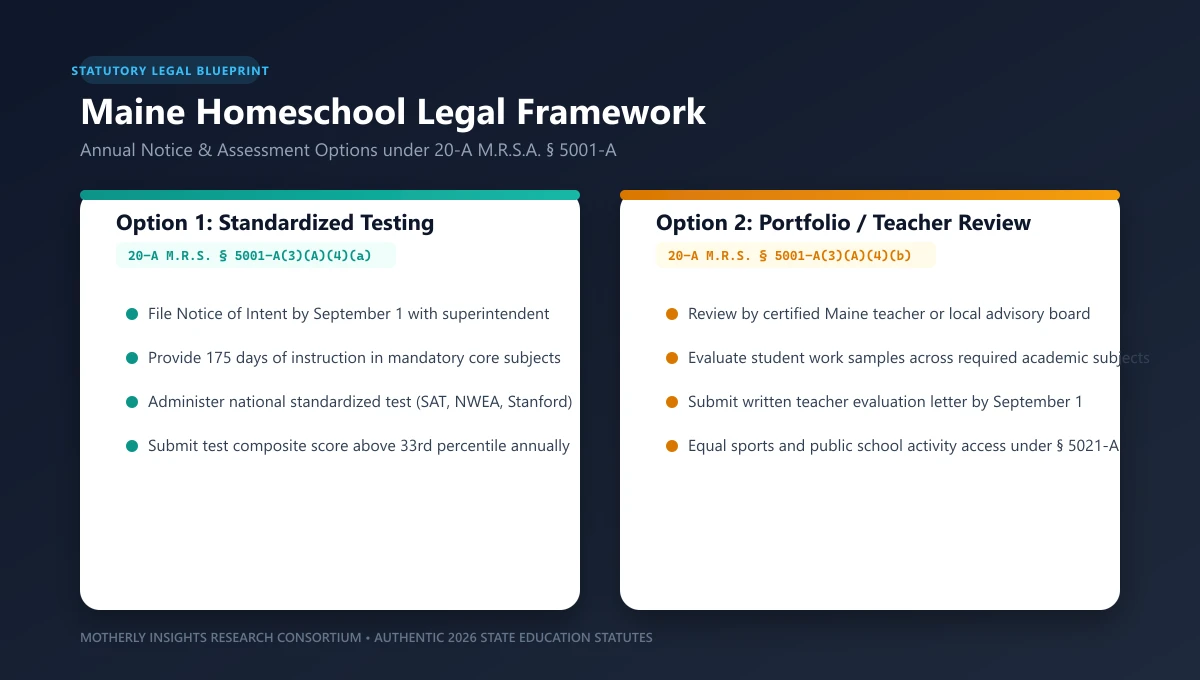
To satisfy the annual accountability requirement, Maine home educators must submit evidence of academic progress with their September 1 subsequent notice using one of four recognized options[3]:
- Option A - Standardized Achievement Test: A commercially published norm-referenced test (such as NWEA MAP, Iowa Assessments, Stanford 10, TerraNova, or SAT) administered by an authorized proctor. The composite score must rank at or above the 33rd national percentile.
- Option B - Certified Teacher Portfolio Review: A thorough review of student work samples conducted by a certified Maine teacher. The teacher writes a formal signed letter affirming that the student is demonstrating adequate progress.
- Option C - Local Advisory Board Review: A portfolio assessment reviewed by an advisory board selected by the local superintendent, which must include one homeschool parent.
- Option D - Approved Nonpublic School Assessment: Evaluation results from an accredited private school, umbrella academy, or correspondence institution.
4. Public School Sports and Extracurricular Access
Under Maine’s landmark equal access statute (20-A M.R.S. § 5021-A), homeschooled students have guaranteed legal rights to participate in local public school offerings[4]:
- Interscholastic Athletics: Eligible to try out for varsity and junior varsity sports teams governed by Maine Principals’ Association (MPA) rules.
- Extracurricular Activities: Free to participate in school bands, theater productions, robotics teams, debate clubs, and field trips.
- Part-Time Academic Classes: Entitled to enroll in specialized public school courses (such as advanced laboratory sciences, foreign languages, or vocational technology).
5. High School Graduation and Official Transcripts
In Maine, home educators possess sovereign legal authority over secondary credentials:
- Parent-Issued Diplomas: Parents establish graduation credit criteria, calculate grade point averages, and issue official high school diplomas.
- Maine College Admissions: Institutions such as the University of Maine System, Bowdoin College, Bates College, and Colby College accept homeschool diplomas and transcripts without requiring a state GED or HiSET credential.
6. Neurodivergent Learners and Special Education Services
Maine home instruction affords exceptional flexibility for neurodivergent students, including those diagnosed with dyslexia, ADHD, autism spectrum conditions, or executive functioning differences:
- Curricular Customization: Under 20-A M.R.S.A. § 5001-A, parents have full legal liberty to select multi-sensory reading curricula (such as Orton-Gillingham, All About Reading, or Barton), hands-on manipulative mathematics, and untimed learning blocks.
- Federal IDEA and Public School Services: Homeschooled students in Maine may access special education consultation, speech therapy, and occupational therapy evaluations through their local public school district under dual-enrollment provisions and Child Find statutory mandates.
- Adapted Assessment Standards: When completing annual evaluations, certified teacher reviewers are statutorily permitted to evaluate progress based on the student’s individual abilities and learning plans rather than rigid age-based standardized percentiles.
7. High School Course Credits, Transcripts, and Graduation Matrix
Home educators directing high school students in Maine possess sovereign authority to design graduation requirements and issue official transcripts. The recommended college-preparatory credit distribution includes:
| Academic Discipline | Recommended High School Credits | Course Examples and Laboratory Components |
|---|---|---|
| English / Language Arts | 4 Credits | American Literature, British Literature, Rhetoric, Composition & Research |
| Mathematics | 4 Credits | Algebra I, Geometry, Algebra II, Pre-Calculus, Financial Literacy |
| Natural Sciences | 3 - 4 Credits | Biology with Lab, Chemistry with Lab, Physics, Marine Biology |
| Social Studies | 3 Credits | United States History, Maine Studies & Local Government, World History |
| World Languages | 2 - 3 Credits | French, Spanish, Latin, or American Sign Language |
| Physical Education & Health | 1.5 Credits | Wilderness Survival, Team Athletics, Personal Fitness, Nutrition |
| Fine Arts & Electives | 3 - 4 Credits | Classical Music Theory, Studio Art, Computer Science, Robotics |
8. Military Families and Mid-Year Relocations to Maine
Maine is home to active military communities, including Naval Air Station Brunswick alumni networks and Portsmouth Naval Shipyard personnel:
- Smooth Educational Continuity: Military families transferring to Maine under the Interstate Compact on Educational Opportunity for Military Children can initiate home instruction immediately upon arrival without administrative waiting periods.
- Expedited Documentation: Notice of Intent can be filed within 10 days of establishing local residency, allowing military children to maintain their established academic trajectory without interruption.
9. Step-by-Step Public School Withdrawal Protocol
If withdrawing your child from a Maine public or charter school during the active academic year, follow these protective legal procedures:
- Submit Formal Written Withdrawal: Deliver a certified withdrawal letter to the school principal and superintendent stating that your child is being withdrawn to receive equivalent instruction under 20-A M.R.S.A. § 5001-A(3)(A)(4).
- File Notice of Intent: Submit your initial Notice of Intent to the superintendent and MDOE within 10 calendar days of withdrawal.
- Request Cumulative Student Records: Secure copies of official transcripts, health records, standardized test score archives, and IEP/504 documentation for permanent home archiving.
10. Frequently Asked Maine Homeschool Questions
When is the subsequent homeschool notice due in Maine?
Subsequent notices of intent and annual assessment results are legally due by September 1 of each school year.
What happens if my child scores below the 33rd percentile on a standardized test?
If an annual test composite falls below the 33rd percentile, the parent and superintendent collaborate on an academic remediation plan allowing the student time to demonstrate progress in the following year.
Does Maine require parents to hold a teaching degree?
No. Maine law does not require parents to hold a high school diploma, college degree, or teaching certificate to educate their own children at home.
Can Maine homeschoolers take advanced classes at the local high school?
Yes. Under Maine’s equal access statute (20-A M.R.S. § 5021-A), homeschoolers have the statutory right to enroll part-time in specialized public school courses such as Advanced Placement (AP) sciences, vocational tech programs, and foreign languages.
💡 Related Educational Pathways: To compare related legal frameworks and recommended study programs, explore our detailed reviews on California homeschool legal guidelines, Ohio homeschool notification regulations, Pennsylvania Act 169 requirements.