
Montana stands as one of the nation’s most favorable states for independent home education. Under Montana Code Annotated (MCA § 20-5-109), home schools are legally defined as nonpublic schools operated by parents or guardians with minimal state administrative intrusion[1].
Compulsory school attendance in Big Sky Country applies to all children between the ages of seven (7) and sixteen (16) (or until high school completion) under MCA § 20-5-102.
Montana Homeschool Legal Pathways: Statutory Overview
1. Annual Notification to County Superintendent
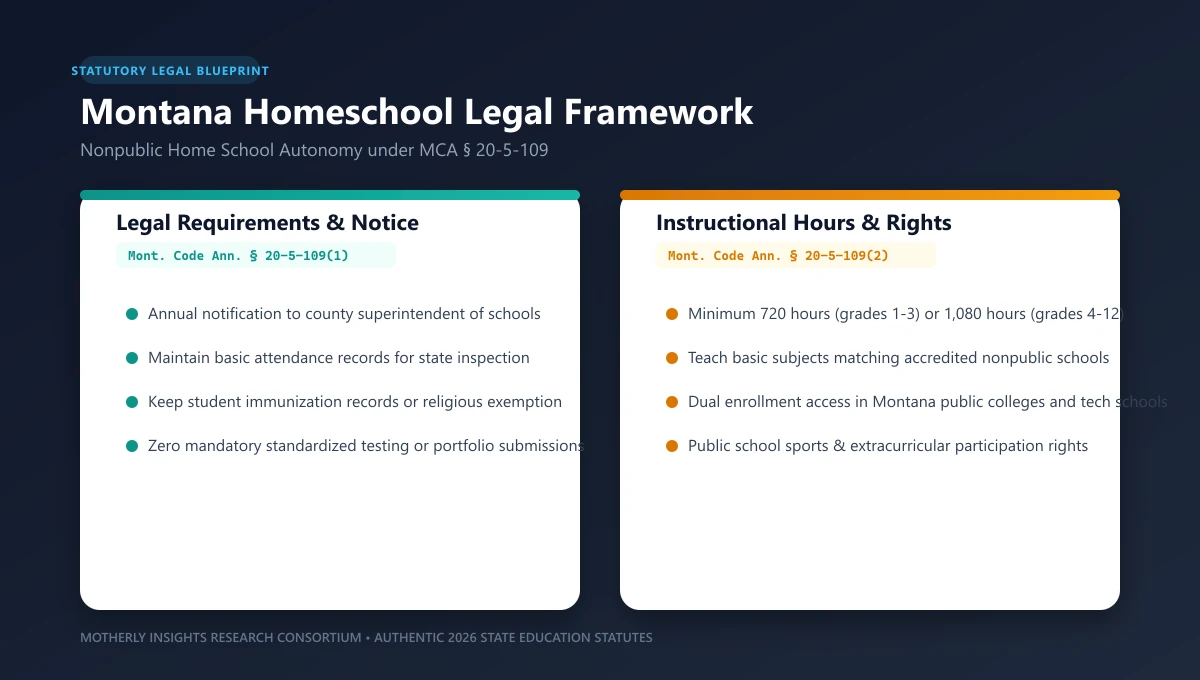
Under MCA § 20-5-109(1), parents must submit an annual notice of intent to the county superintendent of schools in the county where their home school is located[2]:
- Filing Window: The notification is submitted annually at the beginning of each school year (or at the time home education begins).
- Simple Content: The notice simply identifies the names, ages, and grade levels of the students being instructed and affirms compliance with state hour requirements.
- Zero District Approval: The county superintendent acts solely as an administrative recordkeeper. They have no legal authority to review, approve, or reject your educational plans.
2. Instructional Hours and Subject Guidelines
Montana statute establishes specific cumulative instructional hour minimums matching public school schedules under MCA § 20-5-109(2):
- Grades 1 through 3: Minimum of 720 aggregate hours of instruction per school year.
- Grades 4 through 12: Minimum of 1,080 aggregate hours of instruction per school year.
- Required Basic Curriculum: Instruction must cover the foundational branches of learning commonly taught in public schools, including reading, language arts, mathematics, science, history, and social studies.
3. Attendance, Immunization, and Recordkeeping Protocols
Montana law requires home schools to maintain two essential sets of records[3]:
- Attendance Records: A simple calendar or log documenting student attendance to verify completion of the statutory 720 or 1,080 annual instructional hours.
- Immunization Documentation: A copy of the student’s immunization records or a notarized religious exemption form (Affidavit of Exemption on Religious Grounds).
- No Testing or Evaluations: Montana imposes zero standardized testing mandates, zero portfolio submissions, and zero teacher credential requirements.
4. Public School Interscholastic Sports and Extracurricular Access
Under Montana High School Association (MHSA) Bylaws, homeschooled students have clear pathways to participate in extracurricular athletics and fine arts[4]:
- Local District Participation: Students can try out for football, track, basketball, cross-country, and speech/debate teams at their zoned public high school.
- Academic Eligibility: Homeschool parents verify that their student satisfies standard MHSA academic passing requirements during each grading period.
- Dual Enrollment: Montana high schoolers can enroll in college courses through the Montana University System’s ‘OneMSU’ dual enrollment initiatives, earning simultaneous high school and college credits.
5. Montana High School Graduation and College Pathways
Home educators in Montana maintain full authority to confer high school graduation credentials:
- Parent-Issued Transcripts: Parents define graduation requirements, issue official transcripts, and confer state-recognized high school diplomas.
- Higher Education Admissions: Montana State University (Bozeman), the University of Montana (Missoula), and Montana Tech warmly welcome homeschool applicants based on parent transcripts and ACT/SAT scores.
6. Neurodivergent Learners and Individualized Montana Instruction
Montana’s hands-off home education statutes provide exceptional freedom for families teaching children with learning differences, including dyslexia, dyscalculia, ADHD, and sensory processing variations:
- Flexible Daily Pacing: Parents are free to adjust daily instruction to match student focus rhythms, integrating Montana’s magnificent natural outdoors, wildlife studies, and physical activity into core learning blocks.
- Parent-Selected Therapies: Families choose specialized therapeutic curricula, speech-to-text assistive technology, and manipulative-based math programs without requiring prior district committee approvals.
- Alternative Documentation: Because Montana mandates zero state testing, parents of neurodivergent learners evaluate academic progress privately without subjecting children to stressful standardized testing environments.
7. High School Graduation, Transcripts, and University Credit Matrix
Montana home educators maintain exclusive authority over high school diplomas and transcripts. Leading universities, including Montana State University and the University of Montana, recommend the following secondary course breakdown:
| Subject Area | Recommended Credits | Recommended Coursework & Laboratory Experiences |
|---|---|---|
| English / Communication | 4 Credits | Literature Analysis, Expository Writing, Speech & Debate, Classical Rhetoric |
| Mathematics | 3 - 4 Credits | Algebra I, Geometry, Algebra II, Pre-Calculus, Consumer Mathematics |
| Science | 3 Credits | Earth Science, Biology with Lab, Chemistry, Environmental Ecology |
| Social Studies | 3 Credits | Montana History, United States History, American Government, Economics |
| Health & Physical Education | 1 - 2 Credits | Outdoor Recreation, Equine Studies, Wilderness First Aid, Nutrition |
| Electives & Career Studies | 4 - 6 Credits | Agriculture, Automotive Mechanics, Computer Programming, Fine Arts |
8. Montana University System Dual Enrollment: The ‘OneMSU’ Advantage
Montana provides robust dual-enrollment opportunities for homeschooled high school juniors and seniors:
- Tuition Waivers for High Schoolers: Through the Montana University System, high school students can take their first two college courses (up to 6 credits) completely tuition-free through local community colleges and four-year universities.
- Dual-Credit Flexibility: Homeschooled students earn college credits transferable across all Montana public higher education institutions while simultaneously satisfying secondary graduation requirements.
9. Rural and Homestead Homeschooling in Big Sky Country
Montana’s vast geography makes home education a natural, deeply practical choice for ranching, farming, and remote rural families:
- Agricultural Science Integration: Students actively apply animal husbandry, botany, seasonal meteorological tracking, and agricultural economics directly into their official school hours.
- Community Co-ops and Regional Leagues: Rural homeschool families frequently form county-wide academic co-ops, drama troupes, and ski clubs that convene weekly in regional community centers.
10. Public School Withdrawal Procedures in Montana
When transitioning a student from a Montana public school into home education mid-year:
- Provide Written Notice to School: Send a polite letter of withdrawal to the school principal stating that your student is entering nonpublic home schooling under MCA § 20-5-109.
- Submit County Notification: File your annual homeschool notification with your county superintendent of schools.
- Request Cumulative Records: Obtain official copies of immunization records, report cards, and standardized test results for your home file.
💡 Related Educational Pathways: To compare related legal frameworks and recommended study programs, explore our detailed reviews on California homeschool legal guidelines, Ohio homeschool notification regulations, Pennsylvania Act 169 requirements.
💡 Related Educational Pathways: To compare related legal frameworks and recommended study programs, explore our detailed reviews on Georgia homeschool compliance framework, Michigan homeschool statutory rules, Indiana homeschool attendance laws.