
Parents seeking a holistic, child-centered alternative to conventional schooling frequently weigh two world-renowned early childhood and elementary philosophies: the Montessori method and Waldorf education. Both approaches share a profound reverence for child development, reject premature standardized testing, and value hands-on immersion over commercial worksheets[1].
However, their underlying philosophies regarding fantasy, practical independence, early academic introduction, and classroom architecture are polar opposites.
While Dr. Maria Montessori designed an ordered, reality-grounded “prepared environment” where children achieve early academic mastery through self-correcting sensorial apparatus, Rudolf Steiner designed Waldorf education around predictable bodily rhythms, folklore, artistic handwork, and the deliberate postponement of formal academics until age seven.
This comprehensive guide analyzes core developmental premises, learning environments, academic timelines, daily rhythms, and leading home curricula to help you determine which educational philosophy aligns best with your family values.
Pedagogical Comparison: Montessori vs. Waldorf Foundations
Before designing your home learning space, review the fundamental divergence between each philosophy’s worldview.
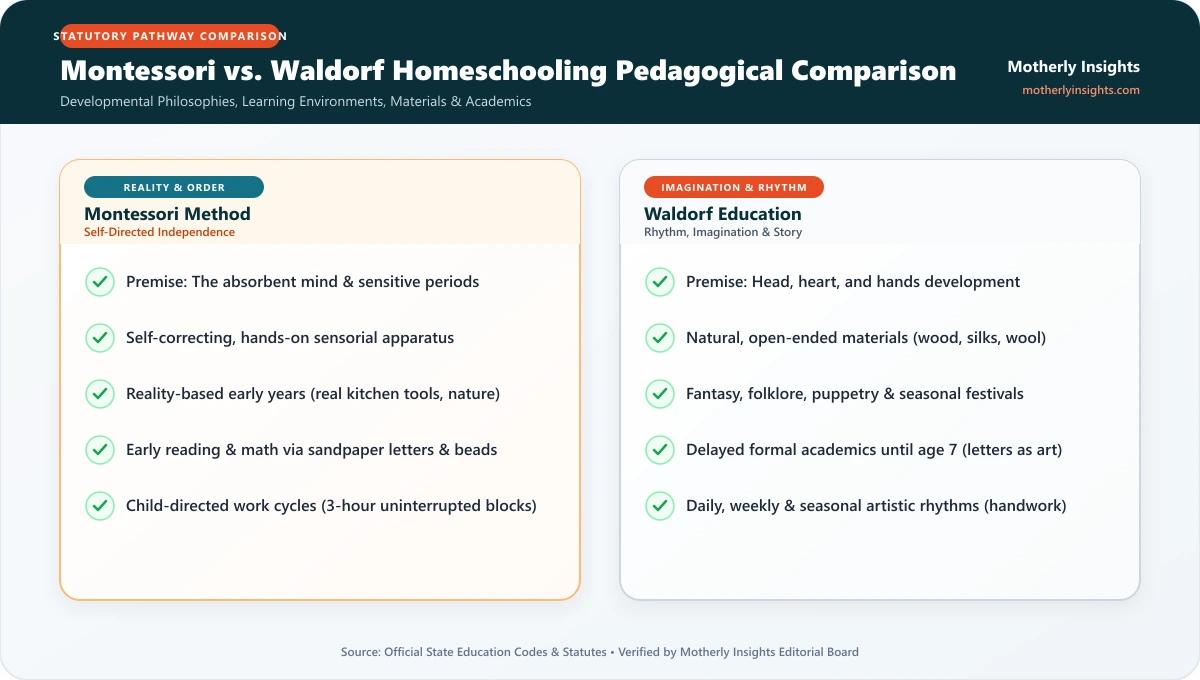
1. Philosophical Worldviews: The Absorbent Mind vs. The Tripartite Child
The divergence between Montessori and Waldorf begins with each founder’s spiritual and biological view of childhood:
The Montessori Premise: Self-Constructed Independence
- Developed in 1907 by Italy’s first female physician, Dr. Maria Montessori, the method views the child through the lens of scientific observation.
- The Absorbent Mind: From birth to age six, the child’s mind unconsciously absorbs impressions from the environment effortlessly.
- Sensitive Periods: Children pass through windows of profound developmental intensity for order, movement, language, and math. If supported with the proper materials, children joyfully master reading and arithmetic between ages 3 and 5.
- Reality Grounding: Montessori insisted on anchoring early childhood in the real, tangible physical world. Young children prefer real work—such as slicing cucumbers with a child-safe knife, sweeping the floor, or scrubbing shells—over imaginary play. Fantasy and fairy tales are reserved for the second plane of development (ages 6 to 12), when the child’s reasoning mind is fully established[2].
The Waldorf Premise: Head, Heart, and Hands
- Developed in 1919 by Austrian philosopher Rudolf Steiner, Waldorf is grounded in Anthroposophy—a spiritual worldview that sees child development unfolding in three distinct seven-year cycles:
- Early Childhood (Ages 0–7): Focused on physical development, motor will, and unconscious imitation. The child learns entirely through experiential sensory play and purposeful adult modeling (baking, sweeping, gardening).
- Middle Childhood (Ages 7–14): Focused on the feeling life, emotional imagination, and aesthetic storytelling. Formal academic concepts are introduced artistically through mythological folklore, drama, and painting.
- Adolescence (Ages 14–21): Focused on independent intellectual discernment, scientific analysis, and philosophical synthesis.
- Delayed Academics: Waldorf deliberately postpones reading, formal math, and writing instruction until after the child experiences second dentition (losing their primary baby teeth around age 6 to 7), believing that premature intellectualization depletes vital physical forces needed for bodily growth.
2. Daily Rhythms & Environment Architecture
How each philosophy shapes the physical homeschooling home illustrates their divergent approaches to daily life:
| Feature | Montessori Homeschool | Waldorf Homeschool |
|---|---|---|
| Room Aesthetic | Neutral, orderly, minimal. Low open shelves with materials arranged left-to-right from simple to complex. Child-sized furniture. | Warm, cocoon-like atmosphere with soft lighting, pastel silk canopies, and seasonal nature tables celebrating natural cycles. |
| Play Materials | Purposeful didactic materials: pink tower, cylinder blocks, binomial cube, sandpaper letters, golden beads. | Open-ended natural toys: unfinished tree branches, wool felt animals, unspun fleece, knitted dolls with minimal facial features to stimulate imagination. |
| Daily Rhythm | Uninterrupted 3-Hour Work Cycle: Children choose their own work independently, complete it on a work rug, and return it to the shelf. | Inhalation & Exhalation Rhythm: Teacher-led circle time, movement songs, story time, free imaginative play, and shared cooking. |
| Role of the Parent | The Observer & Guide: The parent steps back, observes without interfering, and introduces lessons with quiet precision only when invited. | The Model & Storyteller: The parent actively leads songs, recites verses, acts out puppetry, and models artistic domestic arts (baking, sewing). |
3. Academics: Sensorial Mastery vs. Storybook Artistry
The approach to reading, mathematics, and writing highlights the sharpest contrast between the two models:
Montessori Early Literacy & Concrete Math:
- Phonics via Sensorial Touch: Children trace textured sandpaper letters while verbalizing phonetic sounds. Before writing with a pencil, they use the Moveable Alphabet to compose complex phonetic stories on a rug.
- Concrete Mathematical Concepts: Mathematical quantities are introduced tangibly using the Golden Bead Material. A 4-year-old child physically holds a single wooden unit bead, a 10-bar, a 100-square, and a heavy 1,000-cube, grasping the physical volume of place value before ever seeing written decimal numerals[3].
Waldorf Artistic Letters & Living Math:
- Letters as Living Images: Alphabet letters are never taught as arbitrary abstract symbols. A child learns the letter “W” by listening to a dramatic fairy tale about a winding winter wave, subsequently painting waves in a main-lesson book until the letter shape emerges organically from the artwork.
- Whole-Body Math & Handwork: Arithmetic is experienced through rhythm, beanbag tossing games, skipping rhymes, and movement. Learning complex fine-motor handcrafts—such as knitting and finger-crocheting—is viewed as the essential neurological precursor to analytical mathematical thinking.
4. Leading Curricula Comparison
If you choose to purchase an established curriculum framework, here are the benchmark providers for each philosophy:
Premier Montessori Curricula & Platforms:
- Monti Kids: An AMI-certified subscription service delivering authentic wooden Montessori materials and video coaching tailored to birth through age 3.
- ShillerLearning: A hands-on Montessori math and language arts curriculum for ages 4 to 12, including multi-sensory physical manipulatives and diagnostic lesson books.
- Keys of the World / Keys of the Universe: Comprehensive primary and elementary Montessori manuals providing exact pedagogical presentations for home educators.
Premier Waldorf Curricula & Guides:
- Oak Meadow: An accredited, gentle Waldorf-inspired curriculum integrating nature journaling, arts, literature, and social sciences from kindergarten through 12th grade.
- Blossom and Root: A creative, nature-based homeschool curriculum blending Waldorf nature study and storytelling with gentle early childhood exploration.
- Live Education: A classic Waldorf curriculum providing beautifully illustrated main-lesson guides, painting tutorials, and anthroposophical foundations for grades K–8.
5. Can You Blend Montessori and Waldorf?
While strict purists debate their philosophical differences, many experienced homeschool parents create a harmonious hybrid environment:
- Infancy & Toddlerhood (Ages 0–3): Embrace Montessori’s practical life skills (self-feeding, child-height coat hooks, independent dressing) to foster physical capability and confidence.
- Early Childhood (Ages 3–6): Blend Montessori’s concrete sandpaper letters and math beads with Waldorf’s daily outdoor nature immersion, seasonal rhythm tables, and open-ended wooden play.
- Elementary Years (Ages 6+): Use Montessori’s “Great Lessons” to spark curiosity in cosmic history, geology, and astronomy, while utilizing Waldorf main-lesson books for illustrated, artistic notebooking.
Decision Matrix: Which Method Fits Your Family?
Choose Montessori if:
- You want your child to develop strong personal independence, self-care skills, and internal self-discipline.
- Your child thrives on clear order, tangible puzzles, and self-directed activity.
- You want to introduce early reading, phonetic writing, and concrete mathematics naturally between ages 3 and 5.
- You prefer a tidy, minimalist, accessible home environment with low open shelving.
Choose Waldorf if:
- You treasure imaginative fantasy, folklore, fairytales, and seasonal holiday festivals.
- You believe in protecting childhood innocence by postponing formal academic pressure until after age seven.
- You love creative arts, knitting, woodwork, watercolor painting, baking, and musical instruments.
- You thrive on a predictable, comforting family rhythm rooted in seasonal nature cycles.
Frequently Asked Questions
How does screen time fit into Montessori and Waldorf homes? ↓
Are Waldorf children behind in reading when they enter traditional schools? ↓
Can Montessori be done at home without spending thousands on official materials? ↓
Disclaimer: This post is for informational and educational purposes only, accurate to the best of our knowledge at publication. It does not constitute legal or financial advice. We do not guarantee accuracy or completeness and accept no liability for any decisions or losses resulting from reliance on this content.