
Disclaimer: This post is for informational and educational purposes only, accurate to the best of our knowledge at publication. It does not constitute advice. We do not guarantee accuracy or completeness and accept no liability for any decisions or losses resulting from reliance on this content.
For homeschooled student-athletes aspiring to compete at the collegiate level—whether chasing a Division I scholarship in soccer, basketball, track and field, or swimming, or competing in Division II or III—navigating the NCAA Eligibility Center (formerly known as the NCAA Initial-Eligibility Clearinghouse) can feel intimidating.
Unlike public and private high school athletes whose guidance counselors upload standardized, pre-approved transcripts with a single click, home-educated athletes are evaluated by the NCAA Home School Review Committee.
Under NCAA Bylaw 14.3, the responsibility rests entirely on the homeschool parent-administrator to maintain academic documentation, prove compliance with state homeschooling statutes, complete detailed Core Course Worksheets, and curate a collegiate dossier that withstands rigorous collegiate athletic scrutiny.
Every year, talented homeschool athletes find their collegiate eligibility delayed or forfeited—not due to lack of athletic prowess or academic failure, but due to avoidable administrative errors: unapproved digital curricula, missing laboratory science documentation, or failing the critical Division I “10/7” core-course lock-in rule.
This legal and collegiate admissions blueprint provides a step-by-step roadmap to achieving full NCAA Division I and Division II academic qualification as a homeschooled athlete.
1. NCAA Division I vs. Division II: The Core Academic Framework
The NCAA evaluates student-athletes across three competitive divisions. While Division III does not utilize the NCAA Eligibility Center (delegating academic admissions entirely to individual member institutions), Division I and Division II require full clearinghouse certification.
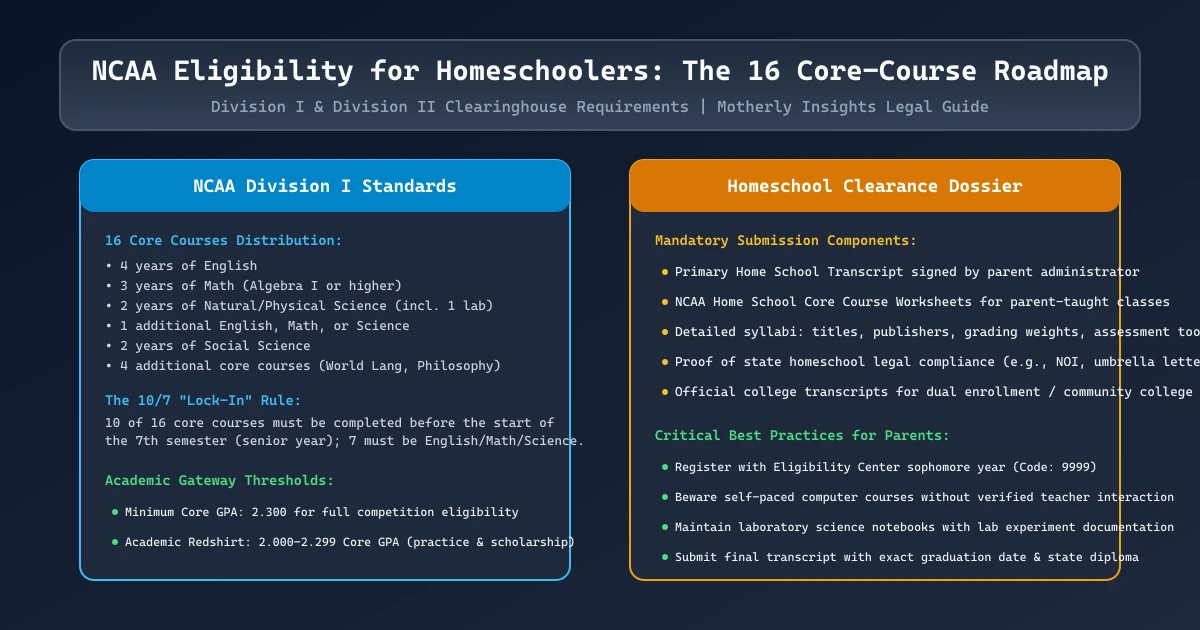
Both Division I and Division II demand the completion of exactly 16 NCAA-approved Core Courses across grades 9 through 12, but their distribution and GPA thresholds diverge significantly:
| Subject Area | Division I Requirement | Division II Requirement | Homeschool Academic Notes |
|---|---|---|---|
| English / Language Arts | 4 years | 3 years | Must include rigorous literature, composition, and rhetoric. Remedial or conversational English does not qualify. |
| Mathematics | 3 years (Algebra I or higher) | 2 years (Algebra I or higher) | Courses like Consumer Math, Business Math, or Pre-Algebra are rejected by the NCAA as core courses. |
| Natural / Physical Science | 2 years (including 1 lab) | 2 years (including 1 lab) | Must include documented experimental lab work (Biology, Chemistry, Physics). Forensic Science or Anatomy qualifies if lab-based. |
| Additional Core (Eng/Math/Sci) | 1 year | 1 year | Advanced calculus, statistics, second lab science, or creative writing. |
| Social Science | 2 years | 2 years | US History, World History, Civics/Government, Economics, European History. |
| Additional Core Courses | 4 years | 4 years | Foreign language (highly recommended), comparative religions, philosophy, or additional academic electives. |
| Total Core Courses | 16 Core Courses | 16 Core Courses | Must be high school level (Grades 9–12) or pre-approved middle school acceleration. |
| Minimum Core GPA | 2.300 Core GPA | 2.200 Core GPA | Calculated strictly across the 16 approved core courses, not overall transcript GPA. |
| Standardized Testing (SAT/ACT) | Test-Optional / Score-Free | Test-Optional / Score-Free | Effective 2023–2026, the NCAA eliminated the standardized test score requirement for initial eligibility. |
2. The Division I “10/7” Lock-In Rule: The Fatal Pitfall
The single most common reason homeschoolers run into Division I eligibility denials is the 10/7 Lock-In Rule (NCAA Bylaw 14.3.1.2.1).
Under this mandate, a student-athlete must complete at least 10 of their 16 core courses before the start of their seventh semester (the first day of their senior year of high school).
Furthermore, 7 of those 10 courses must be in English, Mathematics, or Natural/Physical Science.
Why the 10/7 Rule Impacts Homeschoolers
In a conventional school, students are funneled through standard four-year tracks. In homeschooling, families often embrace flexible pacing—delaying formal high school English or geometry until junior/senior year, or front-loading arts, physical education, and community service.
If a homeschool athlete enters their senior year with only 8 core courses completed, they are mathematically barred from full Division I competition as a freshman, even if they earn straight A’s in 8 core courses during senior year. Those initial 10 courses are permanently “locked in” for GPA calculation purposes; they cannot be repeated or replaced during the senior year to boost eligibility.
3. What Qualifies as an NCAA “Core Course”?
The NCAA maintains strict definitions of what constitutes an acceptable core course. Under NCAA regulations, a core course must:
- Be an academic, four-year college preparatory course.
- Be taught at or above the high school’s regular academic level.
- Be taught by an instructor, parent-educator, or accredited institution providing regular, substantive instructional interaction.
- Cover four-year collegiate prerequisite material in English, mathematics, natural/physical science, social science, foreign language, or philosophy.
Courses That DO NOT Count as NCAA Core Courses:
- Physical education, health, driver’s education, or weight training.
- Remedial, foundational, or special education courses designed below grade level.
- Non-academic electives: personal finance, typing/keyboarding, home economics, drama/theatre acting, woodworking, agriculture, or auto shop.
- Fine arts courses: band, choir, studio art, pottery, or graphic design.
- Religion or theology courses that focus on denominational doctrine, devotional study, or faith formation rather than academic comparative religion or church history.
4. The Homeschool Dossier: What Parents Must Submit
When registering with the NCAA Eligibility Center (using homeschool school code 9999), families must upload a comprehensive Home School Evaluation Dossier directly to the clearinghouse portal. This package consists of four critical items:
1. The Signed Official Homeschool Transcript
The transcript is the foundational legal document. It must include:
- Student’s full legal name, date of birth, home address, and NCAA ID.
- Exact course titles (matching the core course worksheets).
- Grade levels (9, 10, 11, 12) and academic school years (e.g., 2023–2024).
- Grades earned (A, B, C) and credits awarded (typically 1.0 credit per year-long course; 0.5 for semester).
- Cumulative GPA calculated on a standard 4.0 unweighted scale.
- Official graduation date (or anticipated graduation date).
- Physical or digital signature of the primary homeschool administrator (parent) with date.
2. NCAA Home School Core Course Worksheets
For every single core course that was taught at home by the parent (rather than taken through an accredited college or approved online academy), the parent must submit an individual Core Course Worksheet detailing:
- Course title and credit value.
- Primary textbook/materials: Title, author, publisher, publication year, and ISBN.
- Course syllabus and description: Scope and sequence of topics covered.
- Assessment methodology: Percentage breakdown of grades (e.g., 40% exams, 30% written papers, 20% lab experiments, 10% daily problem sets).
- Teaching format: In-person parent instruction, co-op class, private tutor, or correspondence.
3. Proof of State Legal Compliance
To ensure the home education program was conducted legally, the NCAA requires documentation verifying compliance with your state’s homeschool statutes. Depending on your state, this includes:
- A copy of your filed annual Notice of Intent (NOI) with school district receipt or acknowledgment.
- Umbrella school / cover school enrollment verification letter.
- Annual standardized test scores or certified teacher portfolio review sign-off.
- In low-regulation states (e.g., Texas, Oklahoma, Illinois), a signed affidavit certifying compliance with state compulsory attendance and curriculum laws.
4. Official Outside Transcripts
If your student completed courses outside your kitchen table—such as community college dual enrollment, university extension, or an accredited online academy (e.g., Stanford Online High School, Laurel Springs, Keystone)—you must order official, sealed transcripts sent directly from those institutions to the NCAA. Do not simply copy their courses onto your home transcript.
5. Non-Traditional & Online Curriculum Warnings
In recent years, the NCAA has cracked down heavily on non-traditional instruction, including self-paced computer programs, credit recovery modules, and asynchronous digital software.
The “Substantive Teacher Interaction” Mandate
Under NCAA Bylaw 14.3.1.2.2, for an online, software-based, or correspondence course to count as an NCAA core course:
- The course must provide regular, ongoing instructional interaction between the student and a qualified teacher (evaluating work, answering questions, providing personalized written feedback).
- The course cannot be entirely automated where a student clicks through video slides and takes automated multiple-choice quizzes without instructor oversight.
- The student must complete the curriculum within a standard timeframe (not compressed into 3 days for “credit recovery”).
If you use platforms like Time4Learning, Acellus, or self-paced Khan Academy without an instructor of record, the NCAA will reject those credits unless you document that you, the parent, served as the primary instructor utilizing the software as a supplementary textbook and grading all written assessments personally.
6. The Step-by-Step NCAA Roadmap: 9th Through 12th Grade
To prevent senior-year panic, follow this grade-by-grade timeline:
| High School Grade | Academic & NCAA Priority Actions |
|---|---|
| Freshman Year (9th) | • Map out the 4-year plan ensuring 16 core courses (4 Eng, 3 Math, 2 Sci, 1 Add’l, 2 SocSci, 4 Other). • Ensure all lab sciences include hands-on physical experiments and written lab logs. • Retain all course syllabi, textbook ISBNs, and sample graded exams in a physical binder. |
| Sophomore Year (10th) | • Create an account at eligibilitycenter.org (select Option 3: Academic and Amateurism Certification account). • Audit courses against the 10/7 rule: ensure 7 core courses are on track before junior year ends. • Submit initial sophomore transcript to establish your NCAA student portal. |
| Junior Year (11th) | • Critical 10/7 checkpoint: complete at least 10 core courses (with 7 in Eng/Math/Sci) before the first day of senior year. • Order official transcripts for any college dual enrollment courses completed to date. • Upload updated Core Course Worksheets for all parent-taught 11th-grade subjects. |
| Senior Year (12th) | • Complete remaining 6 core courses. • Request final amateurism certification in the NCAA portal (opens April 1 for fall enrollees). • Upon graduation, submit final official transcript with graduation date, state diploma, and proof of graduation. |
7. Laboratory Science Best Practices for Homeschoolers
The NCAA requires at least one full academic year of laboratory science for Division I and II. In institutional schools, wet labs are taken for granted; for homeschoolers, the NCAA frequently audits science courses to confirm genuine laboratory rigor.
To guarantee NCAA approval of high school Biology, Chemistry, or Physics:
- Maintain a Lab Notebook: The student should keep a bound, handwritten or typed formal lab report notebook detailing: hypothesis, materials, experimental procedure, quantitative data tables, error analysis, and scientific conclusions.
- Minimum 20% Lab Allocation: Your syllabus should explicitly state that laboratory experiments constitute at least 20% to 25% of the total course grade.
- Hands-On vs. Virtual: While virtual lab simulations (e.g., PhET) are useful supplements, the NCAA strongly favors physical, hands-on wet labs (dissections, chemical titration, optics benches) using specialized home lab kits (such as Quality Science Labs or Carolina Biological).
8. Summary: Empowering Your Student-Athlete
Homeschooling provides athletic teens with an unmatched competitive advantage: flexible training hours, targeted recovery time, and personalized academic pacing.
By treating your homeschool administration with the same discipline your athlete brings to the track, court, or pool—maintaining meticulous syllabi, respecting the 10/7 lock-in milestone, and submitting an unimpeachable clearinghouse dossier—you ensure that when college coaches call on National Signing Day, your student’s NCAA academic eligibility is guaranteed.
Sources & Regulatory Citations
- National Collegiate Athletic Association (NCAA): NCAA Division I and Division II Initial-Eligibility Brochures & Guidelines.
- NCAA Eligibility Center: Home School Students: High School Portal and Non-Traditional Coursework Policies.
- NCAA Home School Review Committee: Core-Course Worksheet Evaluation Protocols and Non-Traditional Course Guidelines.
- Higher Education Act & Title 34 CFR: Accreditation, State Homeschool Compliance, and Secondary School Completion Standards.