

Home education in the Granite State is governed by one of the nation’s most respected and liberty-focused statutory frameworks. Under New Hampshire Revised Statutes Annotated (RSA) Chapter 193-A, homeschooling is recognized as an autonomous parental right supported by clear procedural safeguards[1].
Compulsory school attendance in New Hampshire applies to children between the ages of six (6) and eighteen (18) under RSA 193:1.
New Hampshire Homeschool Legal Pathways: Regulatory Blueprint
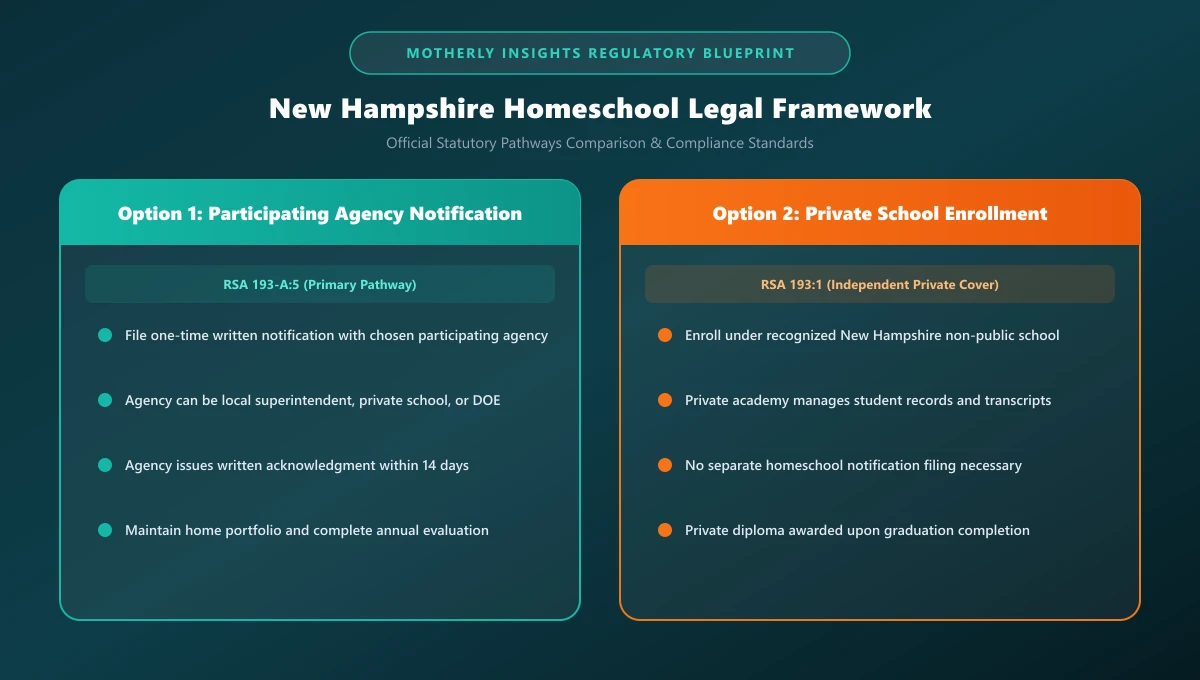
1. Choosing a Participating Agency and Submitting Notification
Under RSA 193-A:5, parents submit a one-time written notification to a Participating Agency of their choice[2]:
Who Can Serve as Your Participating Agency:
- The superintendent of your local resident school administrative unit (SAU).
- The headmaster of a participating approved non-public private school.
- The Commissioner of the New Hampshire Department of Education (NHED).
Key Notification Guidelines:
- Timeline: Submit notification within five (5) business days of starting home instruction or withdrawing from school.
- Filing Frequency: The notification is one-time per participating agency. No annual renewals are required.
- Written Acknowledgment: The agency must provide a written acknowledgment of receipt within 14 business days. Keep this receipt in your home records binder as official proof of exemption.
2. Subject Areas and Portfolio Requirements
New Hampshire law requires instruction in science, mathematics, language, government, history, health, reading, writing, spelling, the history of the constitutions of New Hampshire and the United States, and art and music appreciation.
Parents maintain a home portfolio consisting of:
- A log of reading materials.
- Representative samples of student writings, worksheets, workbooks, and creative projects. The portfolio remains in the parent’s custody and does not need to be turned over to the state or local district.
3. Annual Educational Evaluation Options
Under RSA 193-A:6, parents ensure their child demonstrates educational progress through an annual evaluation kept on file at home[3]:
- Standardized Testing: Administering any nationally recognized standardized achievement test (scoring at or above the 40th percentile composite).
- Certified Teacher Evaluation: A written review by a certified teacher or non-public school teacher, confirming the student has made progress commensurate with their age and ability.
- Alternative Assessment: Any evaluation method mutually agreed upon between parent and the participating agency.
4. Equal Access to Public School Sports and Programs (RSA 193:1-c)
Under RSA 193:1-c, New Hampshire provides exemplary equal access protections. Homeschooled students have the statutory right to participate in any curricular course or cocurricular activity (sports, drama, orchestra) offered by their local public school district[4].
5. New Hampshire Education Freedom Accounts (EFA)
New Hampshire offers an Education Freedom Account (EFA) program under RSA 194-F:
- Eligible Expenses: Income-qualified families can direct state education grants toward private school tuition, tutoring, specialized curricula, dual enrollment fees, and educational therapies.
- Relationship to Home Education: Families participating in the EFA program operate under RSA 194-F oversight rather than independent RSA 193-A home education.
6. Dual Enrollment and Early College Credit
Granite State high school homeschoolers have broad access to dual credit through the Community College System of New Hampshire (CCSNH):
- Running Start & Early College: High school students can complete college coursework at Manchester Community College, Nashua Community College, Great Bay Community College, and NHTI.
- Credit Articulation: Credits transfer into the University System of New Hampshire (UNH, Keene State, Plymouth State) or apply toward high school diploma requirements.
7. Special Education Services and IDEA Child Find
Under RSA 186-C and federal IDEA regulations, New Hampshire school administrative units (SAUs) must provide Child Find evaluations for homeschooled students. Parents may request multidisciplinary evaluations to diagnose dyslexia, dyscalculia, or speech impairments without enrolling in public school.
8. Organizing the Granite State Academic Portfolio
Under RSA 193-A:6, parents maintain a home portfolio for at least two years:
- Reading Log: Maintain a running list of books and educational materials.
- Work Samples: Preserve representative samples of student work illustrating academic growth in required subject areas.
- Annual Evaluation Results: Keep teacher letters or standardized test reports safely archived.
9. Homeschooling Neurodivergent Learners in New Hampshire
New Hampshire’s individualized evaluation standards empower parents of neurodivergent learners to customize education to their child’s strengths:
- Flexible Annual Reviews: Under RSA 193-A:6, parents can select a certified teacher who specializes in dyslexia, ADHD, or autism to evaluate progress through authentic portfolio discussions rather than standardized tests.
- Accommodated Pacing: Parents design sensory-friendly learning spaces and implement movement-based lessons that reduce frustration and cultivate confidence.
10. Driver Education and New Hampshire DMV Licensing
New Hampshire teens can obtain their driver’s license by completing an approved driver education course. Parents verify enrollment by presenting:
- A copy of their original Participating Agency Written Acknowledgment.
- Standard proof of state residency and birth certificate. No public school principal signatures are needed.
11. Frequently Addressed New Hampshire Homeschool Inquiries
Can participating agencies demand curriculum approval?
No. Under RSA 193-A, participating agencies are legally restricted to acknowledging receipt of notification. They have no statutory authority to approve or reject curriculum choices.
How long must portfolios be preserved?
Parents must preserve their portfolio of reading materials and student work for at least two years.
12. Public School Withdrawal Procedures in New Hampshire
If your student is currently enrolled in a New Hampshire public school, complete the following formal withdrawal steps to ensure clean legal transition:
- Send Formal Withdrawal Letter: Submit a letter to the principal indicating that your child is withdrawing to pursue home education under RSA 193-A.
- Submit Notification to Participating Agency: File your notification with your chosen participating agency within five business days.
- Request Cumulative Student Files: Obtain past academic transcripts, standardized test history, and health records for your permanent homeschool file.
💡 Related Educational Pathways: To compare related legal frameworks and recommended study programs, explore our detailed reviews on California homeschool legal guidelines, Ohio homeschool notification regulations, Pennsylvania Act 169 requirements.
💡 Related Educational Pathways: To compare related legal frameworks and recommended study programs, explore our detailed reviews on Georgia homeschool compliance framework, Michigan homeschool statutory rules, Indiana homeschool attendance laws.