Observe a typical high school or college graduate in our modern media landscape, and a disturbing paradox emerges. They possess immediate fingertip access to the accumulated factual sum of human history, yet they struggle to evaluate whether an argument is logically valid. They can regurgitate complex terminology from textbooks, yet when confronted with a persuasive op-ed or social media post, they are helpless to detect blatant logical fallacies, emotional manipulation, or unexamined premises.
In 1947, Oxford scholar Dorothy L. Sayers stood before an educational conference and delivered an essay that would ignite the modern classical homeschooling renaissance: “The Lost Tools of Learning.”[1]
Sayers pointed out that medieval universities, for all their technological limitations, produced thinkers of extraordinary intellectual rigor because they began with the Trivium—a three-fold pedagogical discipline designed to teach children how to think before demanding what to think.
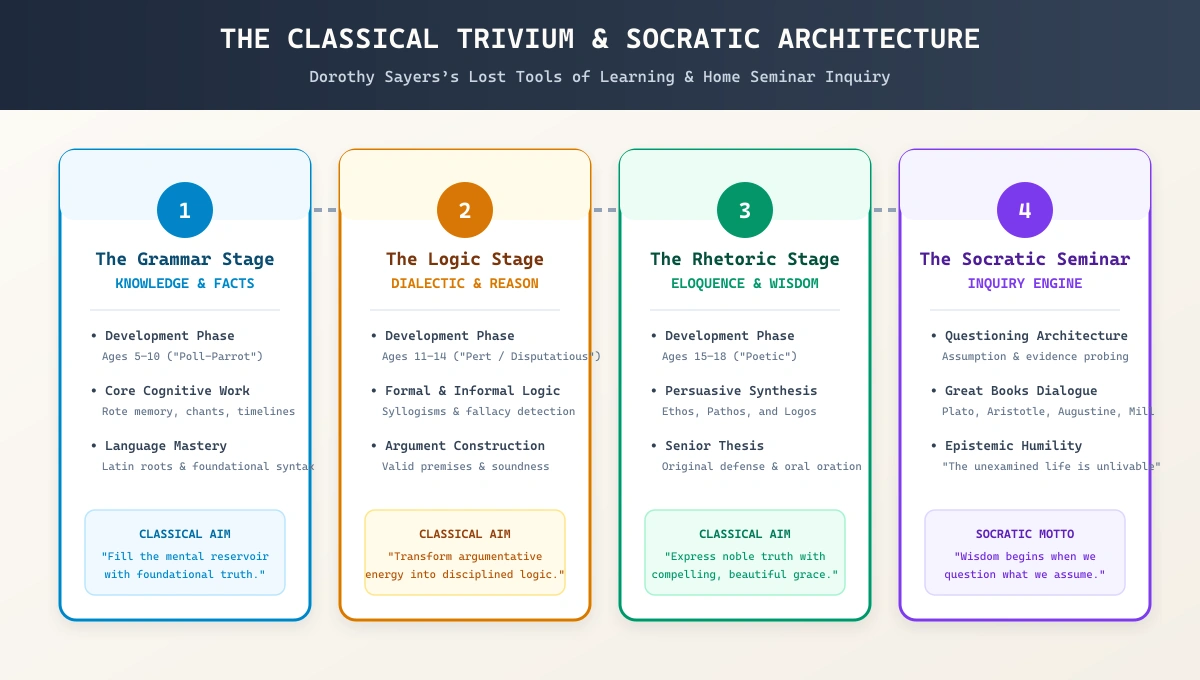
Within the home education sanctuary, classical homeschooling resurrects these ancient tools. By marrying the developmental stages of the Trivium (Grammar, Logic, Rhetoric) with the transcendent art of the Socratic Dialogue, parents transform their dining room tables into the philosophical academies of Athens.
1. Dorothy Sayers & The Trivium: Cognitive Stages of Childhood
The foundational genius of Dorothy Sayers was recognizing that the medieval Trivium corresponds directly to the natural developmental psychology of the growing child[1]:
| Trivium Stage | Developmental Nickname | Age Bracket | Natural Cognitive Drive | Instructional Method |
|---|---|---|---|---|
| 1. The Grammar Stage | “The Poll-Parrot” | Ages 5–10 | Loves chanting, memorizing, cataloging facts, collecting trivia, and rhymes. | Chants, timeline songs, Latin vocabulary, mental math facts, memorized poetry. |
| 2. The Logic Stage | “The Pert” | Ages 11–14 | Loves arguing, catching adults in contradictions, debating rules, asking “Why?” | Formal syllogisms, fallacy detection, causal historical analysis, debate mechanics. |
| 3. The Rhetoric Stage | “The Poetic” | Ages 15–18 | Desires personal expression, beauty, originality, social justice, and creative autonomy. | Original oration, persuasive thesis defense, Great Books seminars, elegant essays. |
When modern schools force creative personal essays onto seven-year-olds who have no vocabulary reservoir, or demand passive factual memorization from rebellious fourteen-year-olds who are desperate to argue, they work against the grain of human nature. Classical homeschooling aligns instruction with the natural developmental grain.
2. The Socratic Method at Home: Intellectual Midwifing
Socrates described himself not as a teacher who pours knowledge into empty vessels, but as a midwife of the mind (maieutic method)[3]. He believed that truth already resides within the human capacity for reason; the role of the questioning dialogue is to deliver that truth by systematically peeling away contradictions, unproven dogmas, and superficial assumptions.
A home Socratic dialogue is not an interrogation or a lecture disguised as questions. It is a shared, collaborative quest for truth between parent and child.
The 6 Types of Socratic Questions (Richard Paul Taxonomy):
| Socratic Question Dimension | Instructional Objective | Actionable Home Prompt |
|---|---|---|
| 1. Clarification Questions | Demands precise definition of terms. | “When you say Brutus was ‘evil,’ what exact definition of evil are you using?” |
| 2. Probing Assumptions | Uncovers unexamined underlying beliefs. | “Are you assuming that any leader who wages war is automatically unjust?” |
| 3. Probing Evidence & Reasons | Distinguishes between feelings and logical proof. | “What specific passage in the Constitution supports your claim that this act was illegal?” |
| 4. Exploring Alternative Perspectives | Forces epistemic empathy and counter-arguments. | “How would an Athenian general view the Peloponnesian War differently from a Spartan farmer?” |
| 5. Probing Implications & Consequences | Traces the logical trajectory of an idea to its conclusion. | “If we accept that individual property rights are absolute, what happens to public roads in a famine?” |
| 6. Meta-Questions (Questioning the Question) | Reflects on the inquiry process itself. | “Why is this question so difficult to answer? What makes this ethical dilemma intractable?” |
3. Teaching Formal & Informal Logic: The Intellectual Armor
Without formal training in logic, teenagers are helpless against deceptive modern advertising, partisan political theater, and emotional rhetoric[2]. In the Logic stage (ages 11–14), home educators should introduce two distinct disciplines:
A. Informal Fallacies (The Everyday Defenses)
Informal logic deals with flaws in reasoning found in everyday language. Children take immense delight in hunting down fallacies in newspaper headlines, advertisements, and family discussions:
- Ad Hominem (To the Man): Attacking the speaker’s character rather than answering their argument (“You only oppose this tax cut because you’re greedy”).
- Straw Man: Distorting, caricaturing, or exaggerating an opponent’s position to make it easier to attack (“Homeschoolers just want to isolate their children from the modern world”).
- Post Hoc Ergo Propter Hoc (False Cause): Assuming that because B followed A, A caused B (“I wore my lucky socks, and we won the soccer match”).
- Appeal to False Authority (Verecundiam): Citing a celebrity or irrelevant expert to validate a complex scientific or ethical claim.
B. Formal Aristotelian Logic (The Deductive Skeleton)
Formal logic strips language down to its algebraic validity. Students learn to construct and test categorical syllogisms:
Major Premise: All men are mortal.
Minor Premise: Socrates is a man.
Conclusion: Therefore, Socrates is mortal.
Through Euler circles and Venn diagrams, students learn the profound difference between validity (whether the logical structure holds) and soundness (whether the premises are factually true in reality).
4. The Family Dinner Table Seminar: Step-by-Step Architecture
You do not need a mahogany boardroom or a co-op classroom to conduct a transformative Socratic seminar. Your dining room table—paired with evening dinner or Sunday tea—is the most potent philosophical setting in existence.
| Seminar Phase | Timing | Parent Role | Student Role |
|---|---|---|---|
| Phase 1: The Textual Anchor | 24 Hours Prior | Assign a short, rich primary source (e.g., Abraham Lincoln’s Gettysburg Address, Plato’s Allegory of the Cave, Martin Luther King Jr.’s Letter from Birmingham Jail). | Read with pen in hand; underline confusing phrases; formulate two questions. |
| Phase 2: The Opening Question | First 5 Minutes | Pose an open-ended interpretive question that has no simple factual answer (“Does Lincoln believe the Union dead died for national preservation, or for universal human liberty?”). | Listen silently; refer directly to specific line numbers in the printed text. |
| Phase 3: The Collaborative Inquiry | 20–30 Minutes | Guide the discussion using Socratic probes; never pronounce who is ‘right’ or ‘wrong’; summarize emergent insights. | Challenge sibling viewpoints with polite textual evidence; refine initial hypotheses. |
| Phase 4: The Epistemic Synthesis | Final 5 Minutes | Ask the concluding takeaway question (“How does this historical principle challenge our modern definition of citizenship?”). | Articulate what belief they revised or deepened during the conversation. |
5. Converting Classical Humanities into High School Transcript Credits
When preparing high school transcripts for university admissions or NCAA eligibility, classical education provides an extraordinary competitive advantage. Admissions officers at elite universities are inundated with generic transcripts listing standard AP English or Social Studies.
A classical transcript featuring accredited Trivium nomenclature immediately signals intellectual depth, advanced writing capability, and rigorous analytical training:
| Classical High School Course Title | Carnegie Unit Value | Core Literature & Texts | Recommended Transcript Description |
|---|---|---|---|
| Classical Rhetoric & Oration | 1.0 English Credit | Aristotle’s Rhetoric, Cicero’s De Oratore, Shakespeare’s Julius Caesar. | Advanced study of classical persuasive discourse, argumentative composition, and public oration. |
| Formal Logic & Deductive Reasoning | 0.5 or 1.0 Math/Philosophy | Peter Kreeft’s Socratic Logic, Copi’s Introduction to Logic. | Rigorous examination of categorical syllogisms, propositional calculus, and informal fallacy analysis. |
| Ancient Greek Philosophy & Ethics | 1.0 Social Studies/Humanities | Plato’s Republic, Aristotle’s Nicomachean Ethics, Marcus Aurelius’s Meditations. | Seminar-style primary source investigation into classical political theory, virtue ethics, and civic virtue. |
| Senior Capstone Thesis & Defense | 1.0 Independent Scholarship | Original 25-page research dissertation defended before a 3-member panel of mentors. | Culminating scholarship project demonstrating mastery of classical research, rhetoric, and oral defense. |
Practical Implementation: The 4-Week Classical Kickstart
| Week | Focus Area | Actionable Family Milestone |
|---|---|---|
| Week 1: Fallacy Safari | Informal Logic at Home | Introduce 3 fallacies (Ad Hominem, Straw Man, Red Herring). Challenge kids to spot them in commercials; award points. |
| Week 2: Socratic Dinner | Dinner Table Inquiry | Choose a 1-page fable (Aesop’s The Boy Who Cried Wolf). Ask: “Was the boy bored, lonely, or testing his community?” |
| Week 3: Syllogism Building | Deductive Validity | Write 5 valid syllogisms and 2 invalid syllogisms on index cards. Have your children identify the structural errors. |
| Week 4: The Friendly Debate | The Art of Rhetoric | Stage a 15-minute structured debate on a family topic (“Should bedtime be tied to age or demonstrated morning energy?”). |
When you bestow the classical Trivium and the Socratic habit upon your children, you give them the ultimate intellectual sovereignty. They cease to be passive consumers of modern cultural narratives; they become discerning scholars, fearless truth-seekers, and eloquent leaders who know how to anchor their lives to what is timeless, good, and true.
Disclaimer: This post is for informational and educational purposes only, accurate to the best of our knowledge at publication. It does not constitute advice. We do not guarantee accuracy or completeness and accept no liability for any decisions or losses resulting from reliance on this content.