
Home education in the Mount Rushmore State offers parents what is among the most streamlined and family-friendly legal structures in the United States. Codified under South Dakota Codified Laws (SDCL § 13-27-3), alternative instruction provides families with broad instructional sovereignty while satisfying compulsory attendance mandates[1].
Compulsory school attendance in South Dakota applies to children between the ages of six (6) and eighteen (18) under SDCL § 13-27-1.
South Dakota Homeschool Legal Pathways: Statutory Overview
1. Filing Alternative Instruction Notification under SDCL § 13-27-7
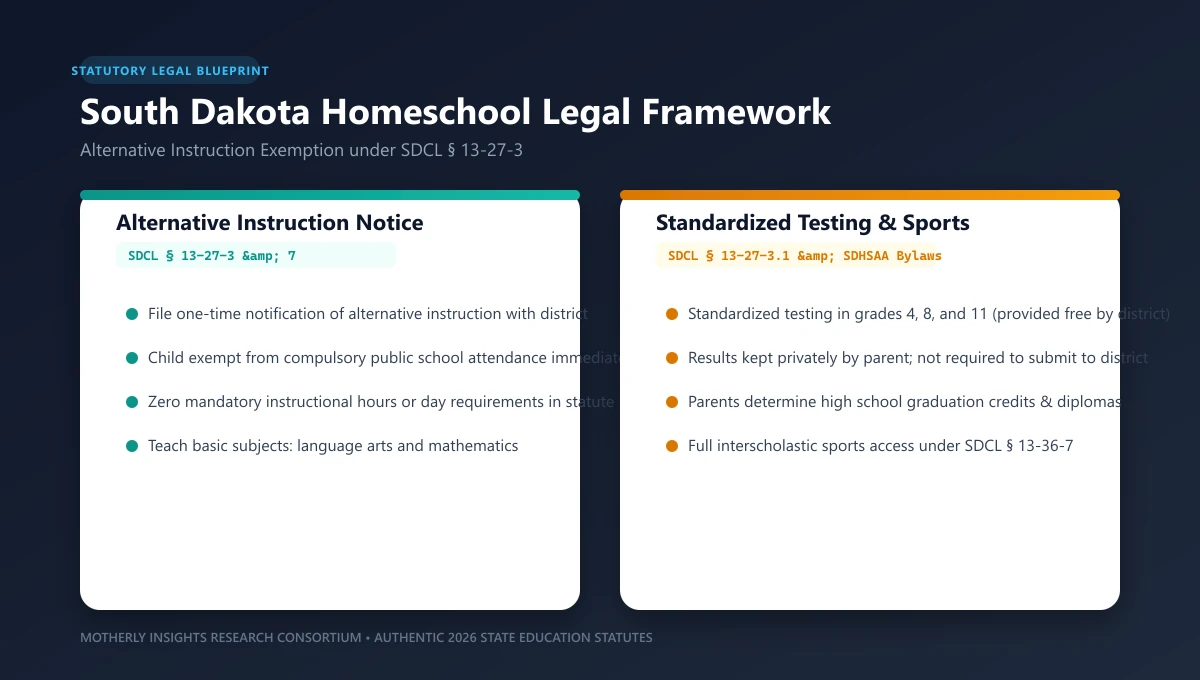
Under legislative reforms codified in SDCL § 13-27-7, starting a home school in South Dakota is simple and permanent[2]:
- One-Time Notification: Parents submit an initial notification of alternative instruction to the local public school district superintendent or the South Dakota Department of Education (SDDOE).
- No Annual Re-filing: Once submitted, the notification remains legally valid for the child’s entire educational career until they graduate, relocate to another school district, or enroll in a public or private school.
- Immediate Exemption: Upon filing, the child is immediately exempt from compulsory public school attendance without requiring school board approval.
2. Core Curricular Mandates and Academic Freedom
South Dakota statute maintains a strictly minimalist curriculum mandate:
- Mandatory Subject Areas: Instruction must provide basic competency in language arts (reading, writing, spelling, grammar) and mathematics.
- Zero Hour or Day Mandates: South Dakota law does not specify a minimum number of school days (such as 180 days) or daily instructional hours. Families teach according to student mastery and family schedules.
- Zero Teacher Credentials: Parents do not need a high school diploma, college degree, or teaching certificate to instruct their children.
3. Standardized Testing and Privacy Protections
South Dakota respects family educational privacy under SDCL § 13-27-3.1[3]:
- Testing Benchmarks: Nationally normed standardized achievement testing is administered in grades 4, 8, and 11.
- Free District Provision: Parents have the statutory right to request that their resident public school district provide the test free of charge, or parents may administer an approved national exam privately (such as Stanford 10, Iowa Assessments, or TerraNova).
- Score Privacy: State law protects parental privacy; test results are kept in the parent’s home files and are not submitted to local school districts or state databases.
4. Guaranteed Public School Sports and Activities Access
Under South Dakota’s landmark equal access statute (SDCL § 13-36-7), homeschooled students have guaranteed legal rights to participate in public school extracurricular activities[4]:
- Interscholastic Athletics: Homeschoolers can try out for any varsity or junior varsity sport governed by the South Dakota High School Activities Association (SDHSAA) at their resident public high school.
- Fine Arts and Academic Clubs: Students may join school marching bands, orchestra, theater productions, oral interpretation, and debate teams.
- Dual Enrollment: High school students can access dual-credit college courses through the South Dakota Board of Regents (SDBOR) High School Dual Credit program for just $48.33 per credit hour.
5. South Dakota High School Graduation and College Pathways
Parents directing alternative instruction possess full legal authority to grant high school graduation credentials:
- Parental Transcripts & Diplomas: Parents set graduation requirements, calculate cumulative GPA, and issue official high school diplomas.
- University Acceptance: South Dakota State University (SDSU), the University of South Dakota (USD), and South Dakota Mines admit homeschooled graduates based on parental transcripts and ACT/SAT scores.
- South Dakota Opportunity Scholarship: Homeschool graduates who achieve a composite score of 24+ on the ACT and complete rigorous college-prep coursework can earn the state’s premier $6,500 scholarship.
6. Teaching Neurodivergent Learners in South Dakota
South Dakota’s flexible statutes create an ideal environment for students with ADHD, dyslexia, dyscalculia, or autism:
- Pacing Freedom: Daily schedules can be adjusted to match attention spans, incorporating prairie exploration, ranching activities, and multi-sensory math manipulatives.
- Specialized Curricula: Parents choose multi-sensory reading and speech programs without needing district approvals.
7. South Dakota High School Credit Distribution Matrix
The recommended secondary academic course matrix includes:
| Discipline | Recommended Credits | Core Course Sequences |
|---|---|---|
| English / Language Arts | 4 Credits | English I, English II, American Literature, Speech & Composition |
| Mathematics | 3 - 4 Credits | Algebra I, Geometry, Algebra II, Advanced Math |
| Science | 3 Credits | Physical Science, Biology with Lab, Chemistry |
| Social Studies | 3 Credits | US History, World History, Civics & Government, Economics |
| Physical Education & Health | 1 Credit | Physical Fitness, Nutrition, Health Education |
| Electives & Career Tech | 8 - 9 Credits | Agriculture, Computer Science, Fine Arts, Foreign Languages |
8. Step-by-Step Public School Withdrawal Protocol
If withdrawing from a South Dakota public school mid-year:
- Submit Alternative Instruction Notification: Deliver your notification form to the local school district.
- Submit Withdrawal Letter: Provide a polite written withdrawal letter to the principal.
- Collect Records: Request cumulative academic records, health files, and standardized test archives.
9. Rural and Homestead Education Across the Great Plains
South Dakota’s open agricultural landscapes make alternative instruction an enduring and deeply practical tradition for ranching, farming, and prairie communities:
- Agricultural Science & Practical Economics: Students integrate livestock genetics, veterinary care, crop agronomy, machinery maintenance, and financial commodity accounting directly into their homeschool studies.
- Community Co-ops & Regional Enrichment: Rural families across the Black Hills, Sioux Falls, Rapid City, and Aberdeen convene weekly for cooperative science labs, competitive 4-H leadership projects, and regional athletic meets.
10. Frequently Asked South Dakota Alternative Instruction Questions
Do I need to submit attendance records to the school district in South Dakota?
No. Under SDCL § 13-27-3, parents are not required to submit attendance records, lesson plans, or portfolios to local school districts. Attendance records should be kept privately in your home files.
Are parent-issued diplomas legally valid in South Dakota?
Yes. Parent-issued high school diplomas and transcripts are legally binding educational credentials accepted by colleges, vocational trade schools, the Armed Forces, and employers throughout South Dakota.
💡 Related Educational Pathways: To compare related legal frameworks and recommended study programs, explore our detailed reviews on California homeschool legal guidelines, Ohio homeschool notification regulations, Pennsylvania Act 169 requirements.
💡 Related Educational Pathways: To compare related legal frameworks and recommended study programs, explore our detailed reviews on Georgia homeschool compliance framework, Michigan homeschool statutory rules, Indiana homeschool attendance laws.