
Utah established one of the nation’s most substantial universal education choice programs with the passage of House Bill 215. Codified under Utah Code § 53F-6-401 through § 53F-6-414, the Utah Fits All Scholarship Program provides eligible K-12 students with an annual scholarship of up to $8,000 per student deposited into an Education Savings Account (ESA) administered by ACE Scholarships[1].
The scholarship empowers Utah parents to customize their children’s education outside the traditional public school framework, covering accredited home-study curricula, private tutoring, instructional software, microschooling co-ops, and specialized therapies.
However, parents exploring the program must understand how the scholarship interacts with Utah’s long-standing home instruction statutes: A student receiving Utah Fits All funds is legally classified as a scholarship student whose parent directs their education, distinct from an independent affidavit homeschooler under Utah Code § 53G-6-204.
This comprehensive operational guide details eligibility priority tiers, application windows, ClassWallet direct-pay mechanisms, eligible curriculum expenses, and annual assessment reporting standards.
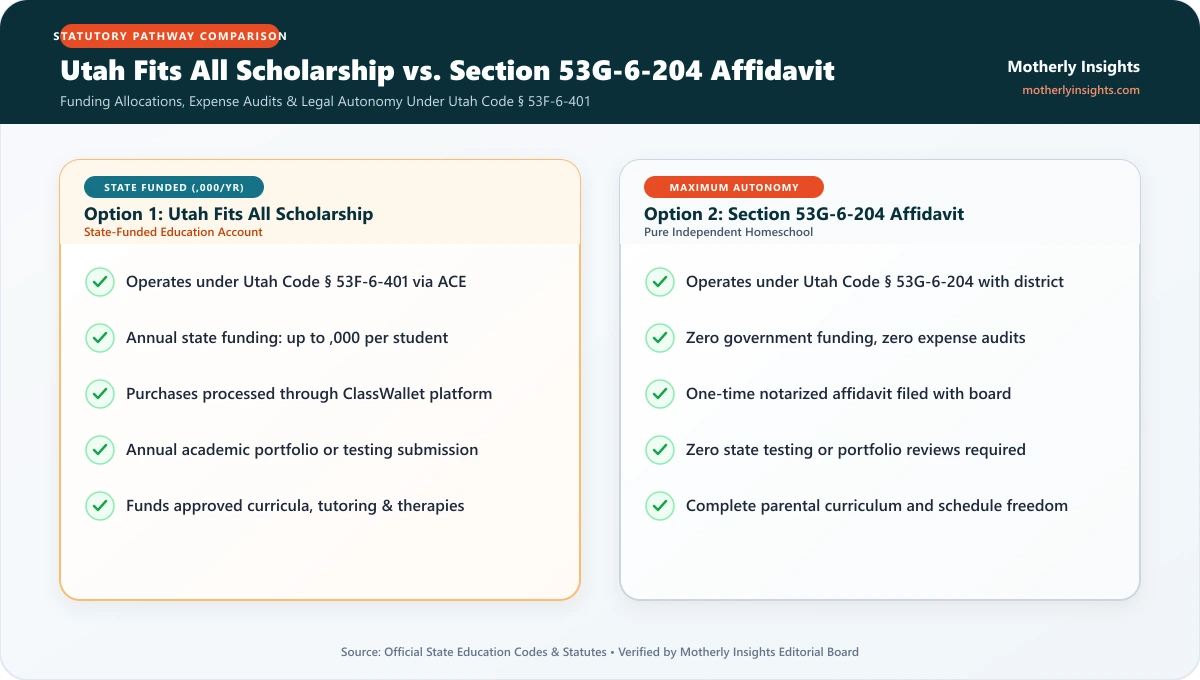
Legal Comparison: Utah Fits All Scholarship vs. Section 53G-6-204 Affidavit
Before applying for state scholarship funds, Utah families must evaluate the balance between financial assistance and administrative reporting requirements.
1. Statutory Foundations: Utah Code § 53F-6-402 & Eligibility Tiers
The Utah Fits All Scholarship is open to all Utah residents eligible to attend a public K-12 school. To ensure equitable access, the Utah State Legislature established statutory prioritization categories during initial application processing:
- Tier 1 (First Priority): Students whose family income does not exceed 200% of the federal poverty guideline ($62,400 for a family of four).
- Tier 2 (Second Priority): Students whose family income falls between 200% and 555% of the federal poverty guideline ($62,400 to $173,160 for a family of four).
- Tier 3 (General Universal Access): All other Utah K-12 students, allocated on a first-come, first-served basis as remaining legislative funding permits.
- Sibling Priority: Siblings of current scholarship recipients receive priority matching within each respective funding window[2].
2. Compulsory Attendance & District Notification
Under Utah Code § 53F-6-402(3), accepting a Utah Fits All Scholarship satisfies the state’s compulsory education mandate under Utah Code § 53G-6-202:
- No Public Enrollment: A scholarship recipient cannot be enrolled full-time in a Utah public school district or public charter school.
- Affidavit Status: If you previously filed a notarized homeschool affidavit with your local school district under Utah Code § 53G-6-204, you should notify your local district board of your transition to the Utah Fits All Scholarship to maintain clean attendance rosters.
- Parental Instructional Control: Utah statute expressly prohibits the state or the program manager from regulating the religious content, instructional philosophy, or daily schedule of home educators utilizing the scholarship.
3. Allowable Educational Expenses: ClassWallet Protocol
Scholarship funds are disbursed directly into digital accounts managed via the ClassWallet financial platform. All purchases must adhere to qualified educational expense definitions established under Utah Code § 53F-6-401(6).
Permitted Qualifying Expenses:
- Curricula & Instructional Texts: Complete boxed curriculum packages, textbooks, consumable workbooks, and instructional literature across core subjects (math, language arts, science, and history).
- Tuition & Program Fees: Tuition at eligible private academies, hybrid microschools, homeschool co-ops, and community college concurrent enrollment courses.
- Certified Tutoring: Instructional services provided by tutors who hold an active teaching license or demonstrate verified expertise in a specific academic discipline.
- Diagnostic & Achievement Testing: Nationally standardized achievement assessments, AP examinations, PSAT, SAT, ACT, and specialized psychoeducational evaluations.
- Hardware & Educational Technology: Laptops, desktop computers, or tablets, subject to program lifetime caps and device refresh frequency limits (typically one computer device every three school years).
- Clinical Therapies: Speech-language therapy, occupational therapy, and physical therapy administered by licensed practitioners for neurodivergent or special needs learners.
Prohibited Expenses:
- Entertainment, theme park tickets, and vacation travel.
- Athletic uniforms, club team travel leagues, and general sports apparel.
- Food, beverages, snacks, and consumable household supplies.
- Capital improvements, home remodeling, or classroom construction costs.
4. Annual Progress Assessment & Portfolio Verification
To protect program integrity while respecting parental sovereignty, Utah statute requires home-based scholarship recipients to verify ongoing academic progress annually[3].
The Two Annual Verification Pathways:
- Option A: Nationally Standardized Assessment:
- The student completes a nationally norm-referenced test (such as the Iowa Assessments, Stanford 10, TerraNova, or Classic Learning Test).
- Test score summaries are submitted digitally to ACE Scholarships prior to the close of the scholarship year. Testing fees are fully reimbursable through your ClassWallet account.
- Option B: Academic Portfolio Review:
- Parents maintain an educational portfolio containing samples of student work, reading logs, and course completion summaries demonstrating growth in mathematics, language arts, science, and social studies.
- The portfolio is evaluated by a certified educator or submitted directly to the program manager’s academic review team.
5. Interscholastic Athletics & UHSAA Sports Access
Utah provides exceptional statutory protections for home-based learners seeking to participate in public high school athletics and extracurricular activities:
- Utah Code § 53G-6-702 (Dual Enrollment & Activities): Utah Fits All scholarship students have the legal right to try out for athletic teams, musical ensembles, theater productions, and debate clubs at their designated boundary public school.
- Eligibility Compliance: The student must pay standard school activity fees (which can be covered using scholarship funds) and satisfy the academic eligibility criteria enforced by the Utah High School Activities Association (UHSAA).
Step-by-Step Application Checklist for Utah Families
- Verify Household Income Eligibility: Prepare your previous year’s federal tax return (Form 1040) to establish your statutory priority tier.
- Create ACE Scholarships Account: Register through the Utah Fits All Scholarship Portal during the annual application window.
- Upload Required Documentation: Provide your child’s birth certificate and verification of Utah residency (state ID, mortgage statement, or recent utility bill).
- Establish ClassWallet Dashboard: Once approved, activate your digital ClassWallet account and review pre-approved direct-pay educational merchants.
- Select Curricula & Assessment Plan: Plan your academic course materials and decide whether you will utilize an annual standardized assessment or a portfolio review.
Frequently Asked Questions About Utah Fits All
Can a family use faith-based or religious curriculum with scholarship funds? ↓
Do unspent scholarship funds rollover to the following school year? ↓
Can a student return to public school after receiving the scholarship? ↓
Disclaimer: This post is for informational and educational purposes only, accurate to the best of our knowledge at publication. It does not constitute legal or financial advice. We do not guarantee accuracy or completeness and accept no liability for any decisions or losses resulting from reliance on this content.