

The single most common source of despair among parents homeschooling neurodivergent children—whether diagnosed with ADHD, Autism Spectrum conditions, Dyslexia, Dysgraphia, or Twice-Exceptional (2e) profiles—is the Curriculum Inversion Fallacy. Parents invest hundreds of dollars in acclaimed, award-winning boxed curricula, open the teacher’s manual, and attempt to enforce every single workbook page, timed drill, and scripted essay prompt.
Within days, the kitchen table becomes a battleground of tears, sensory shutdowns, and behavioral refusal. The parent concludes that their child is unteachable, or that they themselves have failed as an educator.
Both conclusions are clinically false. Commercial curricula are manufactured for institutional batch processing: thirty neurotypical children seated in rows who must be kept uniformly occupied for 45 minutes to maintain classroom control. The extensive problem sets, rigid writing prompts, and high-density page layouts are administrative crowd-control mechanisms, not biological learning necessities.
The golden axiom of neurodivergent home education is simple: The curriculum is your tool; you are not the curriculum’s servant. When you learn the clinical frameworks of cognitive load reduction, input/output decoupling, and multi-tier modification, any commercial curriculum can be transformed into a joyful, high-retention instructional instrument tailored to your child’s unique neurological wiring.
The Clinical Neurobiology of Learning Overwhelm
Children with ADHD, autism, or sensory processing differences process environmental and visual stimuli differently than neurotypical learners. Understanding this neurological architecture allows parents to modify curricula with clinical precision rather than trial-and-error frustration.
The Visual Crowding Phenomenon in Neurodivergence
Neurodevelopmental research demonstrates that children with executive dysfunction and sensory sensitivities experience acute visual crowding. When presented with a workbook page featuring thirty closely spaced math problems, cartoon illustrations in margins, and tiny answer blanks, the prefrontal cortex experiences cognitive saturation before reading a single problem. The resulting refusal or meltdown is not defiance; it is a neurological threat response to sensory overwhelm.
To restore learning, the environment and the page must be redesigned to lower the baseline cognitive load, freeing mental bandwidth for actual conceptual reasoning.
Visual Architecture: The Neurodivergent Adaptation Model
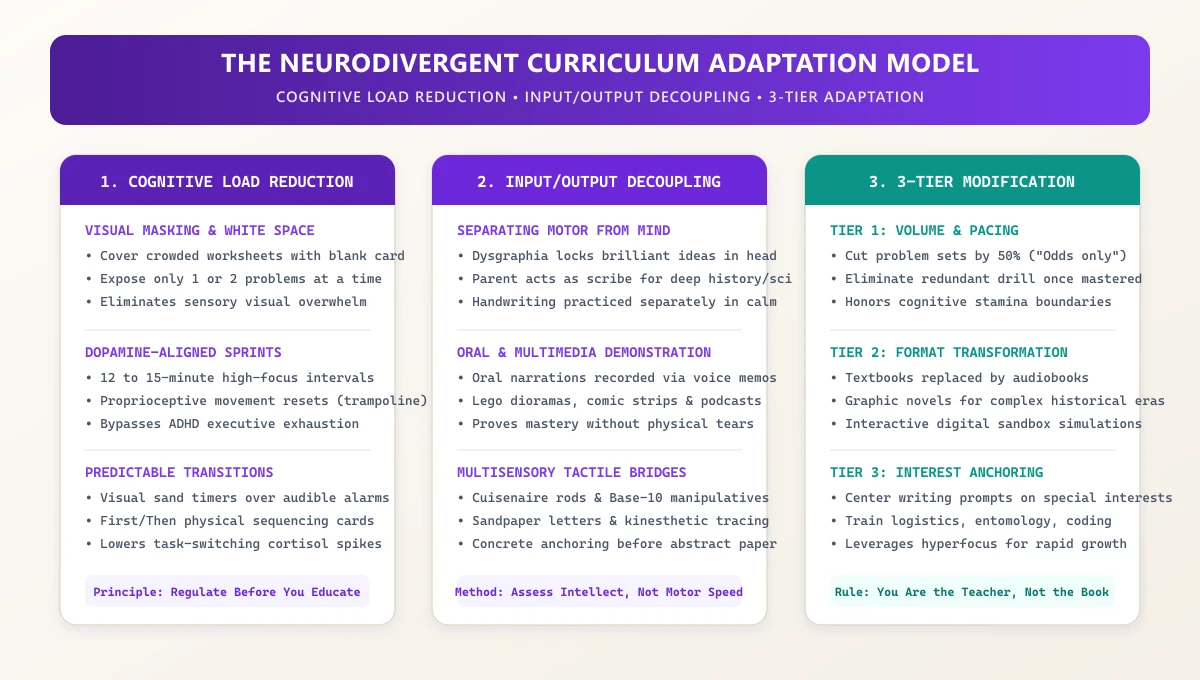
Pillar 1: Cognitive Load Reduction & Sensory Pacing
Modifying a curriculum begins before your child ever touches a pencil. Implement these environmental and structural interventions to eliminate artificial cognitive friction:
1. Visual Masking and White Space Restoration
Never place a dense, 30-problem worksheet in front of an ADHD or autistic learner. Instead:
- The Window Card: Take an 8.5x11 sheet of colored cardstock and cut a small rectangular “window” in the center. Place it over the workbook so only one math problem or one reading sentence is visible at any given moment.
- The Fold Technique: Fold the workbook page in half or quarters so the child only perceives three problems on a clean page.
- Enlarged Reproduction: Photocopy the page at 130% zoom or rewrite four selected problems on a clean, oversized whiteboard using colored dry-erase markers. White space communicates safety to the neurodivergent nervous system.
2. Dopamine-Aligned Micro-Sprints
The standard 45-minute institutional lesson is an arbitrary administrative convention. Children with ADHD and executive dysfunction produce maximum cognitive retention in 12 to 15-minute high-intensity sprints, followed by physical sensory resets.
- The Sprint: 12 minutes of laser-focused math problem solving with parent co-regulation.
- The Sensory Reset: 3 minutes of heavy proprioceptive work: jumping on an indoor mini-trampoline, doing wall push-ups, or swinging on a sensory hammock.
- The Return: By alternating cognitive effort with nervous system regulation, students complete higher quality work in 25 total minutes than in two hours of agonizing kitchen-table battles.
3. Transition Priming: Visual Timers Over Audible Alarms
Auditory alarm buzzers trigger acute startle responses and fight-or-flight reactions in sensory-sensitive children. Replace phone alarms with silent visual sand timers or Time Timer visual disks that show the physical passage of time through an shrinking colored wedge. Give calm verbal reminders at 5 minutes and 2 minutes before task transitions to allow the brain to switch cognitive tracks peacefully.
Pillar 2: Decoupling Input from Output
The most transformative strategy for twice-exceptional and learning-different homeschoolers is Input/Output Decoupling.
In conventional schools, academic subjects are artificially fused with fine motor handwriting and mechanical reading speed. A fifth grader with brilliant historical analysis skills will receive a failing grade simply because their severe dysgraphia makes handwriting a three-paragraph summary agonizingly slow and physically painful.
The Golden Rule of Decoupling
Never test two developmental bottlenecks simultaneously. If the objective of the lesson is history comprehension, do not make it a test of handwriting endurance. If the objective is math reasoning, do not make it a test of decoding complex paragraph word problems. Isolate the core cognitive concept and scaffold away the motor or sensory bottleneck.
Scaffolding Modalities: How to Decouple in Practice
| Academic Subject | Conventional Institutional Expectation | Decoupled Neurodivergent Adaptation |
|---|---|---|
| History & Literature | Read 20 pages silently; write a 2-page essay | Listen to professional audiobook; dictate oral narration recorded on voice memo or scribed by parent |
| Elementary Math | Write answers to 30 worksheet problems | Solve problems using Cuisenaire rods or Base-10 blocks; write answers on whiteboard or state answers orally |
| Science & Nature | Fill in vocabulary blanks in textbook | Build a 3D Lego biome diorama, conduct hands-on lab experiment, or record a video documentary presentation |
| Spelling & Vocabulary | Repetitive paper-and-pencil word lists | Tactile sandpaper letters, magnetic alphabet tiles, or typing on a mechanical keyboard with spelling feedback |
By serving as your child’s scribe for history and science, you liberate their intellectual brilliance. Handwriting can then be practiced as a separate, stress-free 10-minute fine motor skill exercise later in the day.
Pillar 3: The 3-Tier Modification Blueprint
When auditing any curriculum (such as Saxon Math, Rod and Staff, Story of the World, or All About Reading), apply this systematic 3-tier modification framework:
Tier 1: Volume & Pacing Modification (Zero Preparation Required)
- The Rule of Evens and Odds: In math curricula containing 30 practice problems, assign only the odd-numbered problems. If the child achieves 85%+ accuracy on the first ten, stop immediately. Additional repetition generates executive fatigue without increasing conceptual mastery.
- Demonstrated Mastery Exemption: If a student demonstrates thorough comprehension of multi-digit division on problem 4, do not force them to complete problems 5 through 15. Acknowledge mastery and advance.
Tier 2: Modality Transformation (Low Preparation)
- Graphic Novels & Living Documentaries: Replace dry, monochrome textbooks with rich visual non-fiction (such as DK Eyewitness volumes, Nathan Hale’s Hazardous Tales, or BBC nature documentaries).
- Physical Manipulatives: Convert abstract fraction formulas into concrete fraction tiles, measuring cups in the kitchen, or sliced pizza models before ever introducing paper worksheets.
Tier 3: Special Interest Anchoring (High Leverage)
Autistic and ADHD learners possess an extraordinary neurological superpower: the capacity for hyperfocus when engaged with deep special interests. Rather than fighting this focus, harness it as an instructional engine:
- If your child is obsessed with commercial aviation, convert all percentage and distance word problems into flight trajectory calculations and fuel-load ratios.
- If your child is passionate about reptiles, make their composition research project an authoritative encyclopedia of herpetology.
- When curricula are anchored in authentic passions, resistance evaporates and reading levels surge.
Legal Compliance & Special Education Documentation
Parents often ask: “Will my modified curriculum be accepted during annual state homeschool evaluations or future college board accommodation reviews?”
The answer is an emphatic yes. Under state homeschool statutes and federal disability frameworks (including Section 504 and the Americans with Disabilities Act), customized accommodations, oral narrations, and untimed testing are recognized best practices.
Documenting Accommodations for Your State Portfolio:
- State the Adaptation Transparently: In your annual homeschool portfolio or letter of progress, document accommodations as standard pedagogical scaffolds: “Student completed fifth-grade mathematics concepts utilizing multi-sensory manipulatives, modified problem volume, and untimed mastery demonstrations.”
- Preserve Authentic Work Samples: Include photographs of tactile projects, transcripts of oral narrations, and copies of completed whiteboards alongside traditional written work. Certified homeschool evaluators and educational psychologists consistently view these individualized records as superior evidence of authentic mastery.
Psychological Healing: Shifting from Deficit to Strengths
Many neurodivergent children enter home education carrying deep psychological wounds from traditional classrooms where they were labeled lazy, disruptive, or behind.
Your greatest responsibility as a homeschooling parent is not the completion of an arbitrary workbook; it is the restoration of your child’s belief in their own intellectual dignity. When you adapt a curriculum to fit their mind, you send a profound subconscious message: You are not broken. You learn differently, and your unique mind is worthy of an education designed for you.
When you discard rigid conformity and embrace individualized, clinical flexibility, home education becomes the transformative sanctuary your child needs to thrive.
Disclaimer
Disclaimer: This post is for informational and educational purposes only, accurate to the best of our knowledge at publication. It does not constitute advice. We do not guarantee accuracy or completeness and accept no liability for any decisions or losses resulting from reliance on this content.