

When parents withdraw a child from compulsory brick-and-mortar schooling, their immediate impulse is almost always compensatory. Anxious about falling behind or failing to replicate the school’s authority, parents purchase comprehensive boxed curricula, erect whiteboards in the dining room, print rigid hourly schedules, and demand that learning begin promptly at 8:30 AM.
Within three to six weeks, this approach almost invariably produces catastrophic domestic burnout. Children resist workbooks with tears and defiance; parents experience acute panic, questioning their competence; and the household descends into chronic power struggles.
What these families are experiencing is not an educational failure, but a failure to deschool.
Coined by social philosopher Ivan Illich in his seminal 1971 work Deschooling Society and expanded by educator John Holt, deschooling is the deliberate, necessary period of psychological decompression that both parent and child must undergo to dismantle the institutional conditioned responses of traditional schooling: that learning only happens when forced by an authority figure, that knowledge must be divided into artificial 45-minute bell intervals, that curiosity requires external grading rewards, and that boredom is a defect rather than an intellectual catalyst.
The Rule of Thumb: How Long Does Deschooling Take?
The classical home education guideline established by veteran educators is one month of active deschooling for every consecutive year a child spent in an institutional classroom.
A child who leaves school in the fourth grade requires approximately four months of decompression. A high school sophomore who spent ten years in compulsory institutions may require an entire academic semester or full year to unlearn institutional compliance and rediscover internal motivation.
The Psychological Decompression Timeline
Deschooling is not "doing nothing." It is neurological recovery. Institutional schooling conditions children into extrinsic motivation dependencies: they work for gold stars, letter grades, teacher praise, or to avoid detention. When those external carrots and sticks are removed, children often enter a temporary phase of apathy or lethargy. This apathy is not laziness; it is the brain recalibrating after years of institutional hyper-regulation.
During this period, children will often sleep longer, read for pleasure without answering reading comprehension quizzes, tinker with mechanical objects, play outdoors for hours, or stare out the window. This mental stillness is the essential soil from which genuine intellectual curiosity emerges.
Visual Architecture: The Deschooling Framework
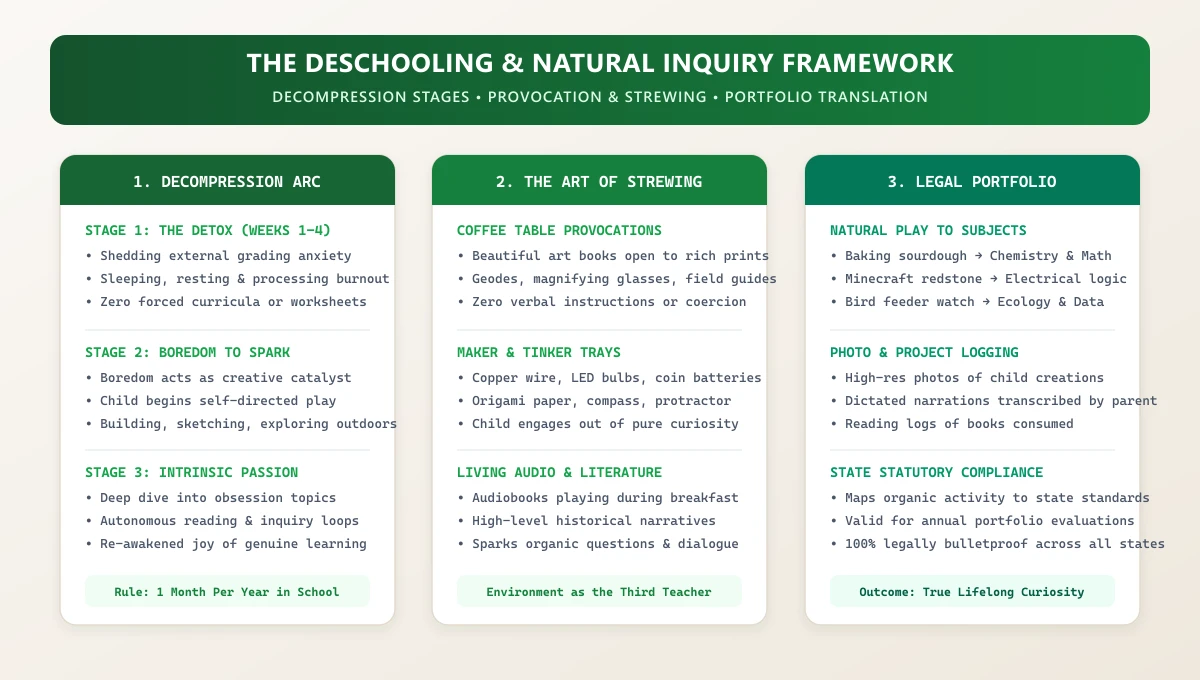
Pillar 1: The Three Stages of Decompression
Deschooling unfolds across three predictable, non-linear developmental stages. Understanding these stages prevents parental panic when children appear unmotivated:
Stage 1: The Institutional Detox (Weeks 1 to 4)
In the first month, children frequently express profound relief mixed with behavioral disorientation. They may ask for permission to use the bathroom, show physical stress when clock times shift, or binge on escapist media.
The parent’s task in Stage 1 is radical nervous system down-regulation:
- Eliminate all alarms and compulsory morning schedules.
- Cook wholesome meals together and spend extensive time in nature.
- Provide comforting physical touch, conversation, and unhurried sleep.
- Do not assign a single worksheet, quiz, or formal lesson.
Stage 2: The Boredom Crucible (Weeks 4 to 8)
Once the initial novelty of being home fades, children encounter genuine boredom. In modern culture, boredom is treated as an emergency to be extinguished with screens. In deschooling, boredom is the holy grail of creative reawakening.
When children complain, “I’m bored, what should I do?”, the deschooled parent resists the temptation to become an entertainment director. Instead, offer calm empathy: “Boredom is just your brain getting ready to create something exciting. I can’t wait to see what you discover.”
Within hours or days of uninterrupted boredom, the magic occurs: the child begins building elaborate cardboard cities, sketching wildlife in the backyard, dismantling an old mechanical toaster, or reading three volumes of historical fiction under a blanket fort.
Stage 3: The Emergence of Intrinsic Inquiries (Month 3 and Beyond)
As internal curiosity reignites, children begin pursuing deep, sustained self-directed passions. A ten-year-old might spend three weeks obsessively researching medieval siege engines, calculating trajectory ratios, and building functional wooden catapults in the driveway.
This is not “play” as an alternative to education; it is deep, multi-disciplinary learning executed with genuine intellectual passion.
Pillar 2: The Art of Strewing: Environmental Provocation
In a deschooling household, the parent transitions from a lecturing instructor to an environmental architect. This pedagogical technique, widely practiced in Reggio Emilia and child-led unschooling environments, is known as Strewing.
Strewing involves leaving interesting, provocative, and tactile materials in the child’s living environment without issuing an assignment, expectation, or command.
High-Impact Strewing Provocations
- The Coffee Table Invitation: A lavishly illustrated atlas opened to the Marianas Trench, placed next to a high-powered magnifying glass and a notebook with colored pencils.
- The Tactile Physics Station: Several lengths of clear vinyl tubing, funnels, food coloring, and measuring beakers left on the kitchen counter near a sink.
- The Mechanical Autopsy: An old discarded rotary telephone, mechanical clock, or broken keyboard placed on a tray with a set of small screwdrivers.
- The Audio Provocation: A breathtaking historical audio dramatization (such as Jim Weiss reciting Greek myths) playing quietly in the living room while children sketch or build Lego.
The critical rule of strewing is zero parental attachment to the outcome. If a child ignores the strewn item, you quietly put it away three days later without guilt or reprimand. If the child engages, you observe, listen, and offer supportive resources only when requested.
Pillar 3: Translating Natural Inquiries into State Compliance
One of the greatest anxieties for parents undergoing deschooling is state legal compliance. Parents fear that unless a child completes a numbered workbook curriculum, they cannot legally document instructional hours or satisfy state portfolio reviews.
In reality, natural learning maps directly to state academic standards. You simply need to learn how to translate child-led exploration into conventional educational terminology:
| Real-World Child-Led Activity | Conventional Academic Subject | Statutory Portfolio Documentation Entry |
|---|---|---|
| Baking artisanal sourdough bread | Chemistry & Mathematics | “Measurement, proportional fractions, biochemical yeast fermentation, and thermal thermodynamics.” |
| Designing an automated redstone farm in Minecraft | Computer Science & Logic | “Boolean logic gates (AND/OR/NOT), binary sequencing, resource optimization, and algorithmic architecture.” |
| Identifying backyard songbirds with a field guide | Biological Science | “Avian taxonomy, ornithological field identification, behavioral observation, and habitat ecology.” |
| Planning and executing a budget for a yard sale | Economics & Applied Math | “Unit pricing, currency transactions, profit/loss ledger management, and interpersonal communication.” |
| Researching Greek mythology to write an epic comic book | Language Arts & World History | “Comparative narrative structure, classical mythology analysis, character arc development, and illustrated literacy.” |
Assembling the Bulletproof Deschooling Portfolio
To satisfy annual superintendent evaluations or portfolio reviews under state homeschooling statutes (such as Pennsylvania Act 169, Ohio Administrative Code, or Florida Statute 1002.41):
- Photographic Evidence: Take candid, high-resolution photographs of your child engaged in projects—measuring lumber, soldering circuits, sketching botanical specimens, or reading in the library.
- The Comprehensive Reading Ledger: Keep a running chronological list of every living book, audiobook, field guide, and graphic novel your child reads or listens to during the year.
- Audio or Transcribed Narrations: When your child explains why a Roman aqueduct was engineered at a specific gradient, record a 2-minute voice memo or transcribe their words into their portfolio notebook. Evaluators and state officials value authentic oral narrations far higher than multiple-choice fill-in-the-blank worksheets.
The Parent’s Internal Deschooling: Healing Your Own Conditioned Mindset
The most difficult aspect of deschooling is almost never the child; it is the parent’s own unexamined educational baggage.
Adults who spent twelve to sixteen years in conventional academic institutions possess deep-seated subconscious biases:
- We believe that if a child is smiling and laughing, they cannot be doing serious learning.
- We fear judgment from extended family members asking, “What grade level are you in?”
- We feel insecure unless we have a stack of completed worksheets to validate our worth as educators.
To successfully mentor a child through deschooling, parents must deschool themselves:
The Parent's Deschooling Affirmation
Human beings are born natural learning machines. A baby learns to walk, talk, and decode complex social dynamics without a single worksheet or letter grade. School did not create your child's intelligence; school merely attempted to standardize it. When you remove institutional coercion, you do not abandon education—you liberate the child's natural, lifelong thirst for mastery.
When and How to Reintroduce Structured Academics Harmoniously
Deschooling is not necessarily a permanent commitment to radical unschooling; for many families, it is a crucial transition bridge toward a customized, rigorous home education.
You will know your child has completed their deschooling journey when:
- They display calm, self-directed enthusiasm for waking up and starting projects.
- They ask deep, sophisticated questions about how the world works.
- They express genuine interest in acquiring technical skills: “Mom, I need to understand algebra so I can program this game,” or “Dad, can you teach me how to write a persuasive essay so I can pitch this community project?”
When a child asks to learn a discipline because it serves their own intrinsic goals, learning happens at ten times the speed of forced instruction. A teenager can master two years of high school algebra in six months when they want to learn it for computer engineering.
By honoring the deschooling process, you give your family the ultimate gift: a peaceful transition away from academic anxiety and into a rich, curiosity-driven life where learning and living are seamlessly, joyfully unified.
Disclaimer
Disclaimer: This post is for informational and educational purposes only, accurate to the best of our knowledge at publication. It does not constitute advice. We do not guarantee accuracy or completeness and accept no liability for any decisions or losses resulting from reliance on this content.