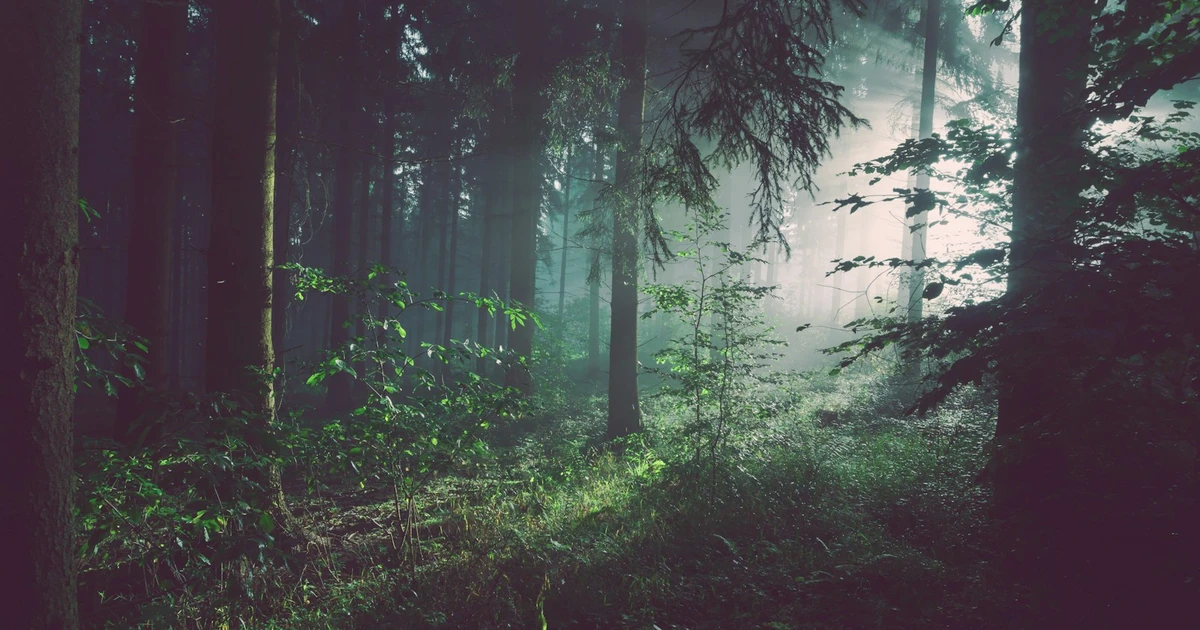
The Scandinavian proverb “Det finnes ikke dårlig vær, bare dårlige klær” (There is no bad weather, only bad clothes) has become a popular slogan on parenting social media. Yet translating that philosophy into a sustainable, week-in, week-out home education practice requires far more than buying rain boots. Authentic Forest School—formalized in the United Kingdom in the 1990s following observations of Danish Udeskole and Skovbørnehaver—is not an occasional outdoor field trip or a nature walk with clipboards. It is a specialized, long-term pedagogical ethos built upon regular immersion in a natural woodland space, child-led emergent inquiry, and calculated risk-taking.
For homeschooling families with toddlers, preschoolers, and early elementary learners, establishing a home forest school delivers profound developmental benefits that indoor curricula cannot replicate. Longitudinal research in pediatric occupational therapy and neuropsychology reveals that navigating uneven terrain, manipulating unstandardized loose parts (mud, logs, rocks), and regulating body temperature in varying weather conditions builds vestibular stability, sensory integration, executive function, and intrinsic self-efficacy.
This comprehensive guide outlines the six core principles of authentic Forest School, breaks down the pedagogical taxonomy of risky play, provides an all-weather gear layering blueprint, and establishes a structured weekly rhythm to bring the forest kindergarten model into your home homeschool routine.
The Six Foundational Principles of Forest School
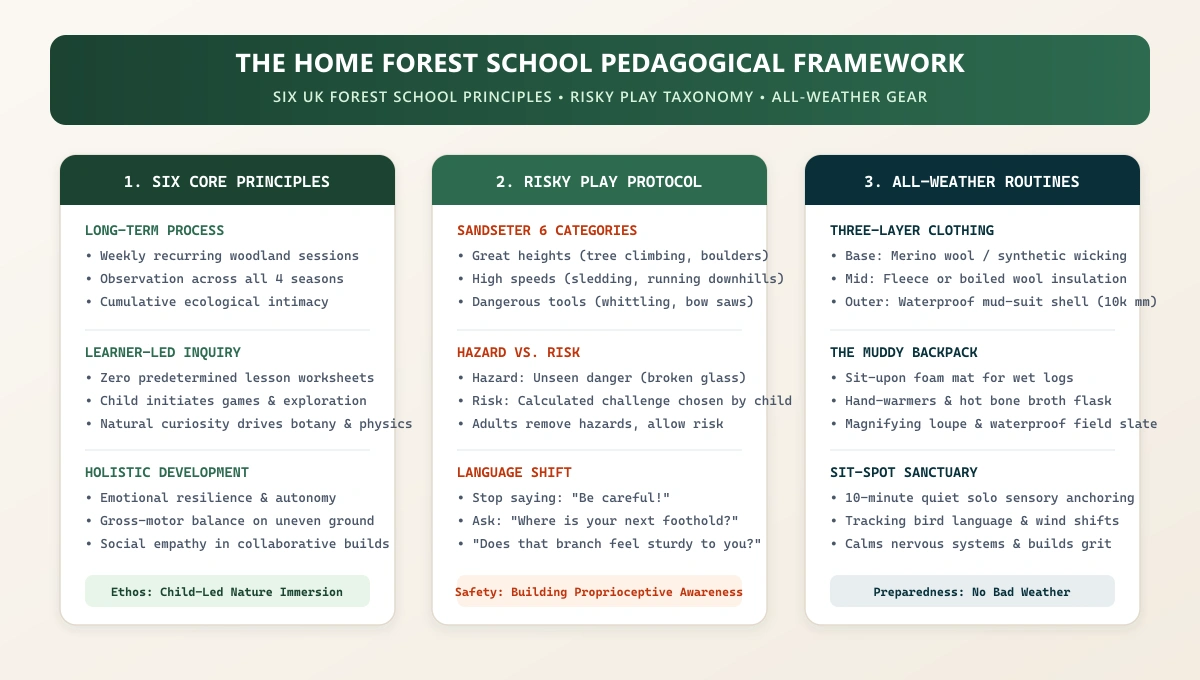
To prevent the dilution of nature-based education into superficial outdoor craft sessions, the UK Forest School Association (FSA) established six foundational principles. Home educators can adapt each of these benchmarks directly into family-scale rhythms:
1. Long-Term Process in a Natural Woodland Setting
Forest School cannot be completed in a one-off weekend workshop. It requires repeated visits to the same wild location across autumn, winter, spring, and summer. By observing a single patch of woodland or creek corridor over twelve months, young children develop an intimate ecological literacy. They observe the decomposition of leaves into fungal mycelium, track seasonal shifts in bird song, and develop an intuitive sense of place and environmental stewardship.
2. Learner-Led Inquiry and Emergent Pedagogy
Traditional schooling imposes adult agendas: worksheets, structured craft templates, and predetermined objectives. In contrast, authentic Forest School is 90% child-initiated. If an adult plans an elaborate lesson on acorn classification, but the five-year-old discovers an icy puddle with air bubbles beneath the surface, the curriculum instantly pivots to the puddle. The educator acts as a co-investigator, facilitator, and safety anchor—scaffolding curiosity through open-ended questions rather than top-down lectures.
3. Holistic Physical and Emotional Development
Forest education nurtures what educational theorists term the “whole child”:
- Physical Gross Motor: Balancing across fallen logs strengthens the vestibular system and proprioceptive feedback mechanisms far more effectively than manufactured plastic playground equipment.
- Physical Fine Motor: Peeling birch bark, tying jute twine around stakes, and picking up tiny insect larvae refine pincer grasps required for subsequent pencil grip and handwriting.
- Emotional Regulation: Nature presents real, non-arbitrary boundaries. Rain is cold, wind pushes back, and mud is slippery. Learning to tolerate physical discomfort within a secure attachment relationship builds emotional grit and distress tolerance.
4. Supported, Calculated Risk-Taking
Children possess an innate evolutionary drive to explore the outer edges of their competence. When adults systematically eliminate risk, children are deprived of the opportunity to calibrate their own physical limits. Forest School provides a supportive scaffold where children learn to assess hazards, test branch stability, work with fire, and handle real tools under measured supervision.
5. Qualified, Reflective Practitioner Mindset
While home educators do not necessarily need a formal FSA Level 3 certification, adopting the mindset of a Forest School leader is critical. This involves continuous pedagogical observation: taking mental or written field notes on what captivates the child, observing play schemas (transporting, enveloping, connecting), and reflecting on adult anxieties before intervening in safe play.
6. Nature as an Active Learning Partner
The environment itself serves as the third educator (a concept shared with Reggio Emilia). Natural loose parts—pinecones, sticks, stones, mud, seed pods—possess infinite affordances. Unlike single-purpose plastic toys, a dry branch can become a fishing rod, a walking cane, a measuring rod, a balance beam, or an imaginary horse within twenty minutes.
Ellen Sandseter’s Risky Play Taxonomy: Re-Framing Danger
A major hurdle for modern home educators is overcoming the reflexive urge to shout, “Be careful!” In 2011, Norwegian researcher Dr. Ellen Beate Hansen Sandseter published a landmark categorization of children’s risky play that reshaped European early childhood education. Understanding these six categories transforms parental anxiety into clinical awareness:
| Risky Play Category | Examples in Nature | Developmental Benefit | Adult Facilitation Shift |
|---|---|---|---|
| 1. Great Heights | Climbing trees, balancing on high boulders, scrambling up steep ravines | Depth perception, height habituation, fall-risk calibration, vestibular activation | Replace “Get down!” with “Do you feel stable? Where is your next three-point contact?” |
| 2. High Speed | Sledding down snowy hills, running down grassy embankments, rope swinging | Dynamic visual tracking, reaction time, body control under centrifugal forces | Ensure clear run-out zones free of tree stumps or barbed wire. |
| 3. Dangerous Tools | Using whittling knives, potato peelers, hand drills, bow saws | Fine-motor bilateral coordination, executive inhibition, respect for sharp implements | Establish a 2-meter “Blood Bubble” boundary around any child operating a cutting tool. |
| 4. Dangerous Elements | Open campfire cooking, playing near rushing creeks, ice breaking | Thermal awareness, burn prevention, buoyancy physics, cold-water safety | Teach step-in fire boundaries: kneel on one knee (respect position), never run near the fire pit. |
| 5. Rough-and-Tumble | Stick fighting, wrestling in deep leaf piles, friendly grappling | Social boundary negotiation, reading peer facial cues, physical empathy and restraint | Intervene only when facial expressions transition from smiles/laughter to genuine distress. |
| 6. Disappear / Get Lost | Exploring ahead on trails, hiding inside dense rhododendron thickets | Autonomy, spatial orientation, coping with temporary separation, environmental mapping | Agree on acoustic boundaries (e.g., child must always be able to hear the parent’s owl whistle call). |
The Critical Distinction: Hazard vs. Risk
To mentor children safely through risky play, educators must clearly distinguish between a hazard and a risk:
- A Hazard is a danger that the child cannot perceive or evaluate on their own (e.g., hidden broken glass under autumn leaves, a rotten tree branch ready to snap under minimal weight, a rusty nail in a board). Adults have an absolute duty to identify and eliminate hazards before or during play.
- A Risk is an obvious challenge that the child can see and voluntarily chooses to negotiate (e.g., deciding whether to step across a wet slippery rock, or determining how high to climb on a sturdy oak branch). Adults should step back and allow children to assess and manage risks independently.
When we constantly lift children into trees higher than they can climb themselves, we create artificial risk without the corresponding motor exit strategy. The golden rule of forest climbing: If a child cannot climb into a tree without adult lifting, they are not ready to be in that tree.
All-Weather Gear Strategy: The Three-Layer System
The quickest way to abort a nature homeschool morning is cold, soggy, shivering children. A failure of clothing is a failure of preparation. In forest kindergarten, cotton is universally forbidden in sub-50°F (10°C) or damp conditions (“Cotton kills” because it traps moisture against the skin and loses all insulating value when wet).
Follow the classic Scandinavian three-layer system:
1. Outer Layer: Weatherproof Shell
Waterproof and windproof bib overalls and jacket (10,000mm+ water column rating, welded seams, robust foot stirrups to prevent leg cuffs riding up).
2. Middle Layer: Thermal Insulation
High-pile fleece, boiled wool bunting, or down sweater. Traps warm air chambers without restricting joint mobility during tree scrambles.
3. Base Layer: Moisture Management
100% Merino wool or high-performance synthetic polyester. Actively wicks perspiration away from skin to prevent post-activity hypothermia.
Essential Cold & Wet Weather Checklist
- Footwear: Insulated natural rubber boots with lugged soles (e.g., Bogs or Olang). Always size up half a size to accommodate thick wool socks without constricting capillary blood flow to the toes.
- Waterproof Mudbibs: Heavy-duty polyurethane or coated ripstop bib pants with elastic ankle straps that pull over the boots. Bibs prevent wet waists when sliding on muddy slopes.
- Double Mittens: An inner thermal merino glove layered inside a waterproof, long-cuffed nylon over-mitten that reaches halfway up the forearm.
- The Parent’s Daypack Essentials:
- Closed-cell foam “sit-upon” thermal seat pads (protects tailbones from frozen logs).
- Insulated thermos of warm bone broth, spiced apple cider, or hot chocolate (restores core body temperature instantly).
- Quick-dry microfiber camp towel and two pairs of backup dry socks in a sealed ziplock.
- Comprehensive wilderness first-aid kit with antiseptic wash, trauma shears, blister bandages, and splinter tweezers.
Establishing the “Sit-Spot”: The Daily Rhythm
A cornerstone practice adapted from naturalist Jon Young’s Coyote’s Guide to Connecting with Nature is the Sit-Spot. A sit-spot is a specific location in nature—a hollowed stump, a boulder beside a creek, or beneath a weeping willow—where the child sits silently in solitary observation.
For early years learners, begin with modest expectations:
- Ages 3–4: 3 to 5 minutes of quiet sensory anchoring. The parent sits 10 feet away. Guide the child to close their eyes and count five distinct sounds (a woodpecker tapping, a distant highway, wind rustling dried beech leaves, a dog barking, water dripping).
- Ages 5–7: 10 to 15 minutes. Provide a pocket nature journal and watercolor pencils. The child documents changes since the previous week: Did the snow melt around the tree base? Are there animal tracks in the mud? Have the alder catkins lengthened?
The sit-spot regulates hyperactive nervous systems, builds sustained attentional stamina, and cultivates deep personal intimacy with the natural world that indoor digital environments perpetually fragment.
Pedagogical References and Academic Citations
- Sandseter, E. B. H. (2007/2011). Categorising risky play—how can we identify risk-taking in children’s play? European Early Childhood Education Research Journal, 15(2), 237–252.
- Knight, S. (2013). Forest School and Outdoor Learning in the Early Years. SAGE Publications.
- Louv, R. (2005). Last Child in the Woods: Saving Our Children from Nature-Deficit Disorder. Algonquin Books.
- Forest School Association (FSA). The Six Principles of Good Forest School Practice. United Kingdom National Quality Framework.
- Young, J., Haas, E., & McGown, E. (2010). Coyote’s Guide to Connecting with Nature. OWLink Media.
Disclaimer: This post is for informational and educational purposes only, accurate to the best of our knowledge at publication. It does not constitute advice. We do not guarantee accuracy or completeness and accept no liability for any decisions or losses resulting from reliance on this content.