Among all high school academic subjects, none sparks more anxiety for homeschooling parents than upper-level mathematics. When children are learning addition facts or exploring elementary fractions, parents feel fully capable of mentoring and grading. But as the curriculum advances toward quadratic equations, trigonometric identities, complex numbers, and differential calculus, many home educators begin to doubt their ability to guide their student through high school.
The encouraging reality is that high school mathematics is one of the most successfully taught subjects in the entire home education movement. Thanks to sophisticated self-paced online video platforms, automated homework grading systems, and world-class problem-solving curricula, homeschool students consistently outperform their conventionally schooled peers on the SAT, ACT, and AP Calculus examinations.
The key to homeschool math success does not lie in a parent possessing an engineering degree; it lies in choosing the correct high school mathematical sequence and aligning your curriculum with your student’s unique cognitive profile and long-term vocational goals.
The Three High School Mathematics Pathways
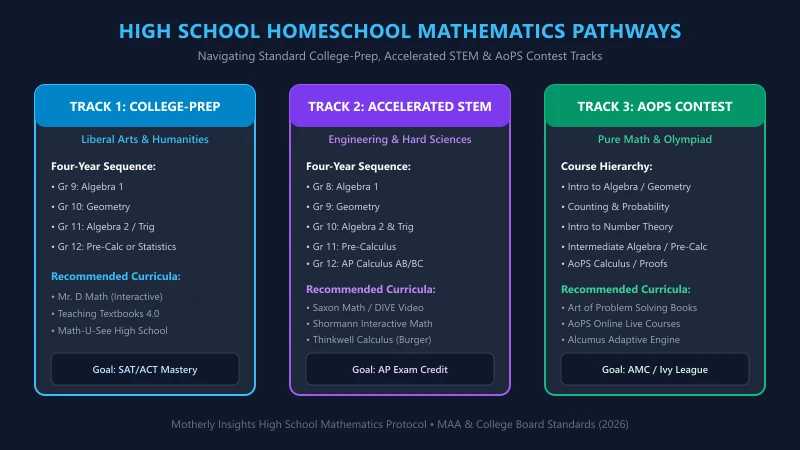
Every home educator should map out their student’s four-year high school math trajectory by eighth grade. In general, high school sequences fall into one of three distinct pathways:
1. The Standard College-Prep Pathway (Humanities, Business & Arts)
Designed for students who plan to attend a four-year college but intend to major in the humanities, social sciences, business, visual arts, or non-STEM fields:
- 8th Grade: Pre-Algebra
- 9th Grade: Algebra 1 (1.0 Credit)
- 10th Grade: Geometry (1.0 Credit)
- 11th Grade: Algebra 2 / Trigonometry (1.0 Credit)
- 12th Grade: Pre-Calculus, College Algebra, or AP Statistics (1.0 Credit)
Collegiate Goal: Satisfies all 4-year high school math requirements for selective universities while preparing students for outstanding scores on the SAT, ACT, or Classic Learning Test (CLT).
2. The Accelerated STEM Pathway (Engineering, Physics, Pre-Med & Tech)
Designed for students targeting competitive STEM degree programs (aerospace, mechanical, biomedical engineering, computer science, mathematics, or medicine) where admissions boards expect to see calculus on the high school transcript:
- 8th Grade: Algebra 1 (High School Credit earned in middle school)
- 9th Grade: Geometry (1.0 Credit)
- 10th Grade: Algebra 2 with Trigonometry (1.0 Credit)
- 11th Grade: Pre-Calculus / Honors Math (1.0 Credit)
- 12th Grade: AP Calculus AB or BC / Dual-Enrollment Calculus I & II (1.0 Credit)
Collegiate Goal: Secures Advanced Placement credit or transferable college credits, placing the student directly into multivariable calculus or differential equations as a college freshman.
3. The Pure Math & Contest Pathway (Art of Problem Solving)
Designed for mathematically gifted students who hunger for deep intellectual challenge, mathematical Olympiads (AMC 10/12, AIME), and Ivy League / MIT STEM admissions:
- Middle School: AoPS Pre-Algebra & Introduction to Algebra
- 9th Grade: AoPS Introduction to Geometry & Counting and Probability
- 10th Grade: AoPS Intermediate Algebra & Introduction to Number Theory
- 11th Grade: AoPS Precalculus & Competition Math Seminars
- 12th Grade: AoPS Calculus / Multivariable Calculus & Linear Algebra
The “Calculus Trap”: Why Rushing Is Dangerous
In modern high schools, an unfortunate cultural myth has developed: the belief that the sole marker of mathematical brilliance is how early a student reaches calculus. Richard Rusczyk, founder of Art of Problem Solving and former USA Mathematical Olympiad winner, famously coined the term “The Calculus Trap” to describe this phenomenon.
When students are rushed prematurely through Algebra 1, Geometry, and Algebra 2 just to check off a calculus box on a transcript, their foundational algebraic understanding is often paper-thin. They learn how to follow algorithmic steps mechanically, but they lack deep mathematical intuition, spatial reasoning, and the tenacity to solve novel, non-routine problems.
When these students arrive at university engineering programs, they frequently wash out of freshman calculus and physics because they cannot apply algebra flexibly under pressure.
The Golden Rule of High School Math: Depth always trumps speed. It is infinitely better for a student to achieve profound, rock-solid mastery of Algebra 1, Geometry, and Algebra 2—graduating with Pre-Calculus—than to struggle through a superficial, confusing calculus course that destroys their mathematical confidence.
Why Is Geometry Positioned Between Algebra 1 and Algebra 2?
Parents frequently ask: “Why do American high schools sandwich Geometry between Algebra 1 and Algebra 2 instead of teaching both algebras consecutively?”
There are two vital pedagogical reasons for this traditional structure:
- Cognitive Development of Deductive Logic: Geometry is fundamentally different from algebra. While algebra is computational and symbolic, classical Euclidean geometry is based on formal deductive proofs. Students learn how to begin with undefined terms, axioms, and postulates to logically prove geometric theorems. This rigorous proof system requires a level of abstract maturity that middle schoolers are just beginning to develop.
- Algebraic Reinforcement & Maturation: Algebra 2 is dramatically more abstract than Algebra 1, covering complex numbers, logarithmic functions, and polynomial matrices. Placing Geometry between the two courses gives the student’s brain a full year to mature intellectually while applying their Algebra 1 equation-solving skills to geometric perimeter, area, and volume problems.
Top High School Homeschool Math Curricula Compared
Selecting the right curriculum is the single most influential decision you will make for your student’s high school math journey. Here is how the top programs compare:
| Curriculum | Core Teaching Philosophy | Format & Delivery | Parent Involvement | Best Student Profile |
|---|---|---|---|---|
| Saxon Math | Incremental spiral repetition with constant cumulative review | Hardcover textbooks + DIVE / Nicole the Math Lady video lectures | Low to Moderate | Students who thrive on routine, predictability, and consistent reinforcement |
| Mr. D Math | Concept-first, supportive video instruction with friendly mentorship | Online interactive videos, live weekly help sessions, online grading | Very Low (Independent) | Visual/auditory learners who experience math anxiety or prefer human connection |
| Shormann Math | 21st-century computer-based classical STEM curriculum with automated grading | Self-paced online course, digital lectures, interactive practice | Very Low (Fully automated) | Self-motivated students wanting rigorous STEM preparation integrated with history |
| Art of Problem Solving (AoPS) | Discovery-based, proof-heavy inquiry; problems are designed to be difficult | Textbooks, Alcumus adaptive software, and live online courses | Low (Parent cannot easily assist) | Mathematically gifted students aiming for competitive STEM or math contests |
| Thinkwell | Collegiate-style energetic video lectures by Dr. Edward Burger | Online video streaming, automatically graded homework assignments | Very Low | Motivated independent learners targeting AP exam credit |
How to Handle Teaching Math When You Don’t Understand It
You do not need to relearn quadratic equations to homeschool high school math successfully. The modern homeschooling ecosystem provides exceptional support systems:
1. Leverage Video-Led Instruction
Programs like Mr. D Math, Shormann Interactive, and DIVE Video provide complete, professional instruction. An expert educator delivers every concept, works through multiple sample problems, and explains common pitfalls.
2. Implement Automated Grading & Step-by-Step Solutions
Never choose a high school math curriculum that only provides an answer key with the final numerical answer. Ensure your curriculum includes a complete solution manual that illustrates every intermediate step of algebraic work. When a student makes a mistake, they can immediately compare their pencil work to the manual to identify the exact algebraic operation that failed.
3. Dedicated Live Help Sessions
Many modern online platforms include built-in live tutoring. In Mr. D Math, for example, students attend live online office hours multiple times each week where certified teachers answer their specific homework questions in real time.
Documenting High School Math for College Transcripts & NCAA
To present your student’s math accomplishments with professional credibility to college admissions counselors and NCAA evaluators, adhere to standard academic transcript conventions:
- List Standard Academic Course Titles: Use recognizable course names (Algebra I, Geometry, Algebra II with Trigonometry, Pre-Calculus Honors, AP Calculus BC). Avoid idiosyncratic names like Creative Math 10.
- Award 1.0 Credit Per Year-Long Course: Each full high school math course represents 1.0 Carnegie credit (approx. 120–150 hours of instructional and practice time).
- Maintain Course Descriptions & Syllabi: Keep a one-page course description for each year detailing the textbook publisher, edition, topics mastered, grading breakdown (e.g., 20% homework, 30% quizzes, 50% exams), and the final percentage earned.
- External Validation: If your student is applying to highly selective universities or competitive STEM engineering departments, validate your homeschool grades with objective external measures:
- High math scores on the SAT (650+) or ACT Math section (28+).
- Passing scores (4 or 5) on the College Board AP Calculus AB or BC exam.
- Dual-enrollment transcript grades from an accredited local community college or four-year university.
By respecting your student’s developmental pace, prioritizing deep mathematical reasoning over superficial acceleration, and equipping them with high-quality video and problem-solving curricula, your high schooler will graduate with the mathematical fluency and resilience needed to conquer any collegiate academic challenge.
Disclaimer: This post is for informational and educational purposes only, accurate to the best of our knowledge at publication. It does not constitute advice. We do not guarantee accuracy or completeness and accept no liability for any decisions or losses resulting from reliance on this content.