
The homeschool cooperative is one of the most powerful institutional innovations in modern alternative education. When functioning smoothly, a cooperative pooling of parental talents provides students with laboratory science, foreign language immersion, competitive debate, musical ensembles, and vibrant peer socialization that single families could never replicate in isolation.
Yet organizational data reveals a tragic reality: over 70% of parent-led homeschool cooperatives collapse or fracture within three to four years of inception.
The root cause of these failures is almost never financial collapse or lack of pedagogical passion. Cooperatives fracture because of structural ambiguity, unmanaged founder burnout, mission drift, and the absence of a formalized conflict resolution architecture. When a cooperative operates as an informal social club without clear corporate shields, written bylaws, and restorative behavioral protocols, the first interpersonal clash between parents over disciplinary standards, curriculum choices, or volunteer workloads detonates the entire community.
Building an enduring, joyful homeschool cooperative or hybrid micro-school requires treating governance not as an unpleasant administrative burden, but as the essential scaffolding that protects community trust and parental friendships.
The Root Problem: The Informal Trap and Founder Burnout
Homeschool co-ops typically begin around a kitchen table. Three enthusiastic mothers agree to meet on Thursdays: one teaches art, one teaches biology, and one reads history. The arrangement feels organic, relational, and pure.
By Year Two, word spreads. Fifteen families join. By Year Three, forty families are renting a church education wing. Suddenly, the founding parents are managing facility leases, fire marshal inspections, $25,000 annual budgets, child allergy emergency plans, and parking lot traffic flow.
The Unpaid Emotional Labor Crisis
In an unstructured cooperative, 90% of administrative overhead falls on one or two founders who receive zero compensation, no formal authority, and endless informal critiques via text message at 10:00 PM. This dynamic creates deep resentment: founders feel exploited, while new members feel alienated by unspoken expectations. A sustainable co-op must replace informal familiarity with transparent organizational architecture.
Visual Architecture: The Co-Op Governance Model
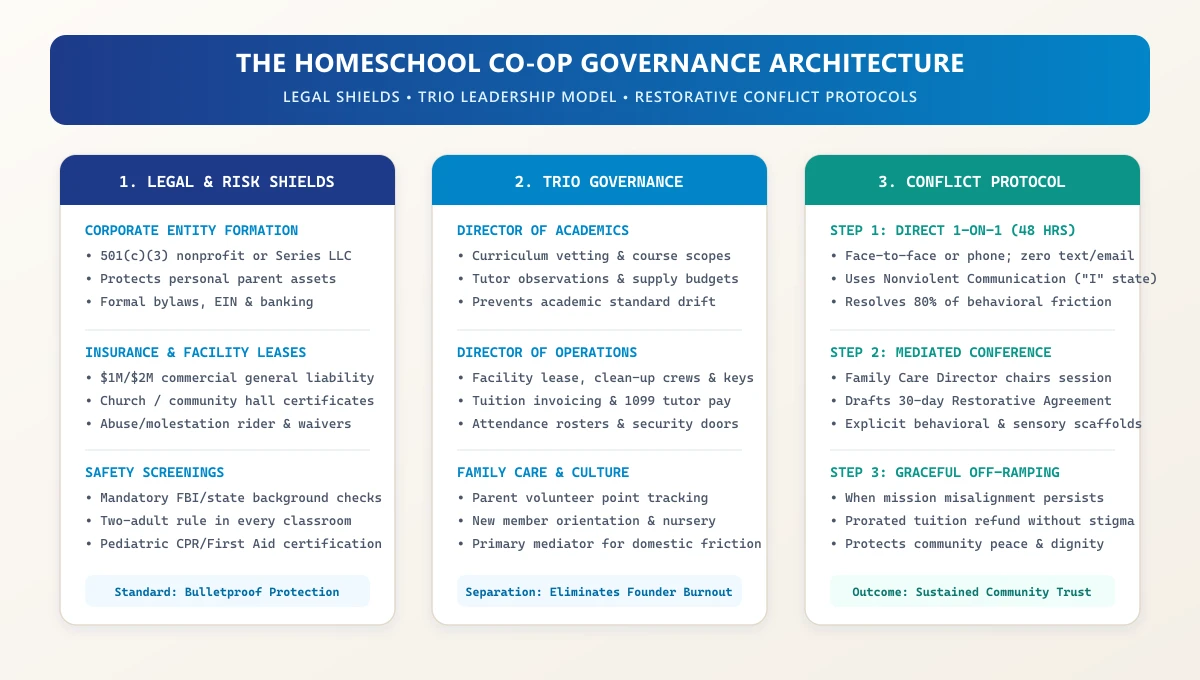
Pillar 1: Legal Shields, Risk Management & Facility Leases
Operating an informal group without formal corporate status exposes every participating parent to joint and several personal liability. If a child fractures an arm on a playground during co-op hours or an accidental fire occurs in a science lab, the individual families hosting the group can be personally sued.
1. Corporate Entity Structure: 501(c)(3) vs. Series LLC
To shield personal assets and open institutional bank accounts, a growing co-op must formally incorporate:
- 501(c)(3) Nonprofit Incorporation: The gold standard for parent-run co-ops. Grants exemption from federal income tax, allows parents to receive tax-deductible donations for equipment, and makes the organization eligible for corporate community grants. Requires an independent Board of Directors (typically 3 to 5 voting members) and annual IRS Form 990 filings.
- Micro-School LLC: Ideal for cooperatives utilizing paid professional tutors or founders seeking to operate as an educational business. Provides personal liability protection with lower administrative filing overhead.
2. Commercial General Liability Insurance
Churches, community centers, and municipal parks will not lease space to a homeschool group without a valid Certificate of Insurance (COI).
- Coverage Minimums: Secure an institutional policy with $1,000,000 per occurrence and $2,000,000 general aggregate liability limits.
- Crucial Riders: Ensure the policy includes an Abuse & Molestation Defense Rider and Participant Accident Medical Insurance to cover minor slip-and-fall injuries without triggering complex litigation.
- Additional Insured Endorsement: Name the host church or landlord as an “Additional Insured” on the policy to satisfy lease agreements.
3. Child Safety and Background Checks
Every adult present in the facility during instructional hours—whether a teaching parent, drop-off assistant, or professional instructor—must complete a state and FBI fingerprint background check through services like Sterling Volunteers or Verified Volunteers before setting foot on campus.
Furthermore, enforce the non-negotiable Two-Adult Rule: no adult is ever permitted to be alone behind a closed door with a student who is not their own biological child. Classrooms must feature window doors, or keep hallway doors propped open at all times.
Pillar 2: The Trio Governance Model
The most common leadership flaw in cooperatives is placing all responsibilities upon a single “President” or “Director.” This role inevitably becomes an unbearable bottleneck.
Sustainable cooperatives distribute leadership across the Trio Leadership Architecture:
1. Director of Academics
- Vets all curriculum choices, course syllabi, and lab safety protocols.
- Conducts quarterly classroom drop-ins to support parent-instructors and evaluate instructional quality.
- Manages supply requests, lab equipment maintenance, and academic booklists.
2. Director of Operations & Finance
- Acts as primary liaison with the facility landlord, managing lease contracts, facility keys, and cleaning schedules.
- Collects semester dues, issues 1099-NEC tax forms to paid instructors, and reconciles the co-op checking account.
- Manages enrollment databases, family emergency contact cards, and parking lot safety logistics.
3. Director of Family Care & Community
- Tracks parent volunteer service points to ensure equitable chore distribution (nursery duty, hall monitoring, sanitizing).
- Conducts new family orientations and hosts prospective parent interviews.
- Serves as the primary neutral mediator for behavioral issues, parent misunderstandings, and restorative conferences.
By dividing authority into three distinct portfolios, no single individual is crushed by administrative burden, and leadership transitions occur smoothly as founding families graduate out.
Pillar 3: The 4-Step Restorative Conflict Resolution Protocol
Interpersonal conflict in a homeschool co-op is inevitable. Parents possess diverse philosophical, theological, and behavioral standards. Without a written conflict resolution protocol signed during registration, minor grievances ferment into gossip and factional splits.
Every family must sign a covenant agreeing to the following 4-Step Restorative Protocol:
The 4-Step Restorative Agreement
- Direct 1-on-1 Dialogue (Within 48 Hours): If Parent A has an issue with Parent B or Instructor C, they are strictly prohibited from discussing it with third parties, posting in group WhatsApp threads, or emailing the Board. They must initiate a direct, private conversation in person or by phone using Nonviolent Communication principles ("I noticed X, and I felt concerned because Y"). Over 80% of misunderstandings resolve at this step.
- Mediated Conference with Family Care Director: If the issue is not resolved, both parties attend a structured, private conference facilitated by the Director of Family Care. The mediator ensures both voices are heard and drafts a written 30-Day Restorative Contract defining concrete behavioral benchmarks.
- Board Review and Final Intervention: If the contract is breached or a student presents recurring physical disruption, the Trio Leadership Board meets with the family to determine whether specialized adult supervision (e.g., parent shadowing the student full-time) is required.
- Graceful, Non-Punitive Off-Ramping: If philosophical or behavioral misalignment cannot be resolved, the co-op releases the family from membership with dignity, proration of remaining dues, and zero social stigma. Acknowledging that "our format does not fit your family's needs right now" protects both the group and the family's self-respect.
Neurodiversity and Classroom Accommodations
Modern cooperatives serve a high proportion of neurodivergent learners. Cooperatives must reject both extreme responses: rejecting neurodivergent children out of hand, or allowing severe sensory dysregulation to derail class instruction.
- Sensory Decompression Space: Designate a quiet, dimly lit room equipped with beanbag chairs, noise-canceling headphones, and weighted lap pads where overstimulated students can self-regulate under adult supervision.
- The Parent Shadow Agreement: If a child experiences acute impulse challenges or safety concerns during science labs or group games, the cooperative welcomes the child under the condition that their parent acts as a dedicated 1-on-1 shadow. This ensures safety without isolating or shaming the student.
Financial Architecture: Eliminating Volunteer Resentment
Nothing destroys morale faster than the perception that some parents do all the hard work while others simply treat the cooperative as cheap drop-off babysitting.
The Point System vs. Service Buy-Out
Implement a transparent service credit system:
- Each family is required to earn 10 service points per semester (e.g., teaching a 1-hour class = 4 points; assisting in nursery = 2 points; post-co-op bathroom cleaning = 1 point).
- For working parents or families with newborns who cannot physically serve on campus, offer a Formal Service Buy-Out Fee (e.g., $350/semester). This capital is then used to hire professional cleaning crews or pay high school student assistants, completely eliminating parental resentment.
Cultivating a Culture of Grace and Intellectual Fellowship
A homeschool cooperative is more than an educational delivery service; it is a vital counter-cultural community. In a fragmented society, it offers children a rare multi-generational sanctuary where they are known, nurtured, and mentored by a village of caring adults.
When leaders invest the time to build sound legal protections, transparent governance, and compassionate conflict protocols, they build a shelter that withstands cultural storms. They give their children not just an outstanding academic education, but an enduring model of how healthy, principled communities collaborate, resolve differences, and flourish together.
Disclaimer
Disclaimer: This post is for informational and educational purposes only, accurate to the best of our knowledge at publication. It does not constitute advice. We do not guarantee accuracy or completeness and accept no liability for any decisions or losses resulting from reliance on this content.