

For decades, the dominant cultural narrative in secondary education pushed a singular post-graduation pipeline: attend a four-year liberal arts university, accumulate tens of thousands of dollars in student loans, and pursue an office-bound corporate career. Yet in today’s economic climate, millions of high school graduates find themselves burdened with crippling student debt while facing saturated white-collar job markets.
Meanwhile, an unprecedented generational transition is reshaping the American economy. Over 40% of the existing skilled trades workforce—master electricians, industrial pipefitters, commercial HVAC technicians, precision CNC machinists, and structural welders—is reaching retirement age. The resulting nationwide skilled labor deficit has transformed vocational careers into some of the most lucrative, secure, and entrepreneurial pathways in the country, with journeyman tradespeople routinely earning $85,000 to $140,000+ per year completely debt-free.
For homeschooling families, Career and Technical Education (CTE) is a natural philosophical match. The flexibility, customized pacing, and autonomy of home education allow teenagers to step away from fluorescent-lit classrooms and immerse themselves in real-world craftsmanship.
By combining rigorous academic foundations (trade mathematics, physics of electricity, technical drafting) with accredited hands-on apprenticeships, homeschoolers can graduate high school with nationally recognized industry credentials, a paid journeyman pipeline, and an entrepreneurial portfolio.
This guide provides homeschool parents and teens with a blueprint for navigating industry certifications, Fair Labor Standards Act (FLSA) safety exemptions, Carnegie credit conversion, and registered youth apprenticeships.
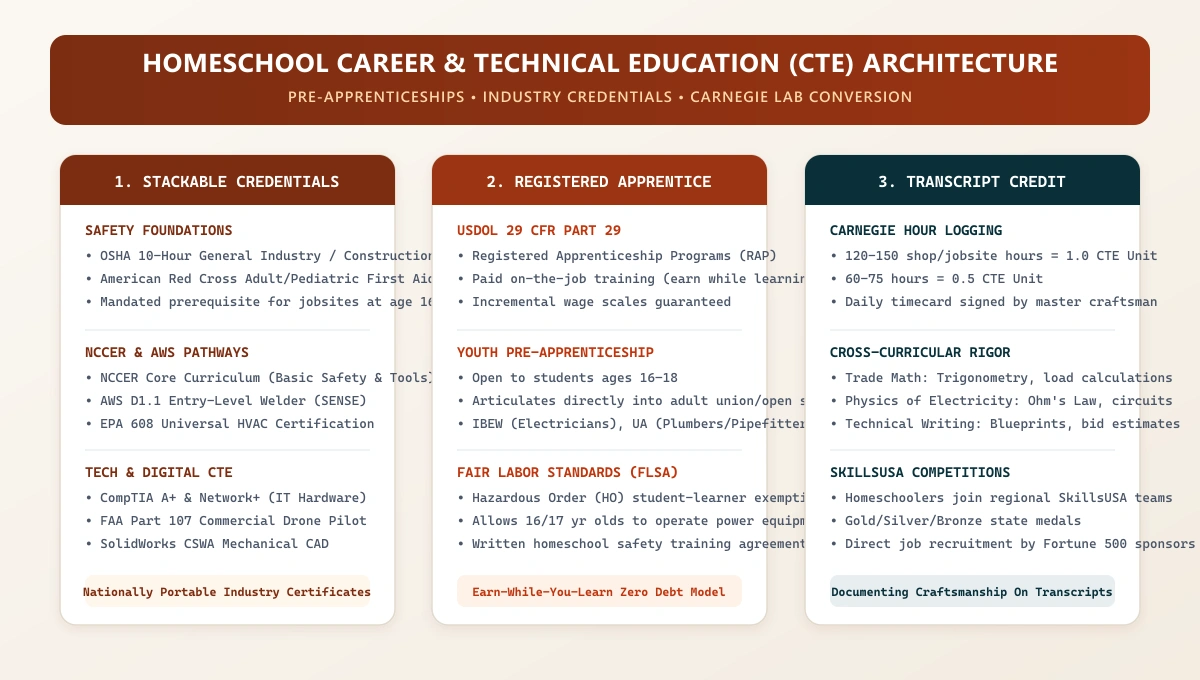
1. Stackable Industry Credentials: Build the Foundation First
Before a sixteen-year-old steps onto a commercial jobsite or enters an industrial fabrication shop, they must establish baseline safety and technical credibility. In the skilled trades, employers and union joint apprenticeship training committees (JATCs) value nationally portable credentials over generic homeschool grades.
Top Four Foundational Credentials for Homeschool Teens
1. OSHA 10-Hour Construction or General Industry
The gold standard safety benchmark administered by OSHA-authorized providers (e.g., CareerSafe or AdvanceOnline). Covers hazard communication, personal protective equipment (PPE), fall protection, electrical safety, and machine guarding. Completing this online 10-hour course demonstrates maturity and enables employers to satisfy jobsite insurance mandates.
2. NCCER Core Curriculum: Introductory Craft Skills
Developed by the National Center for Construction Education and Research, the NCCER Core covers basic safety, construction math, hand tools, power tools, construction drawings, basic rigging, and material handling. Earning this certificate places the student into the national Automated National Registry (ANR), visible to thousands of licensed contractors.
3. American Red Cross First Aid / CPR / AED Certification
Emergency trauma readiness is non-negotiable in field operations. A 2-year certification in adult and pediatric CPR and emergency field dressing is a prerequisite for youth apprenticeships.
4. AWS SENSE Level I Entry Welder (American Welding Society)
For students pursuing metal fabrication, AWS SENSE (Schools Excelling through National Skills Standards Education) provides modular qualifications in Shielded Metal Arc Welding (SMAW), Gas Metal Arc Welding (GMAW/MIG), and Gas Tungsten Arc Welding (GTAW/TIG).
2. Navigating Child Labor Laws: The FLSA Student-Learner Exemption
A frequent hurdle for homeschool parents is the Fair Labor Standards Act (FLSA) Child Labor Regulations (29 CFR Part 570). Federal law designates seventeen “Hazardous Occupations” (HOs) that are strictly off-limits to minors under age eighteen, including the operation of power-driven woodworking machines (HO 5), power-driven metal-forming tools (HO 8), and circular saws/guillotine shears (HO 14).
However, the U.S. Department of Labor provides a crucial, codified exemption known as the Student-Learner Exemption:
FLSA Student-Learner Exemption Requirements (29 CFR § 570.50)
Sixteen- and seventeen-year-old vocational students may legally operate certain hazardous machinery under the following strict conditions:
- 1. Written Educational Agreement: A formal tripartite agreement must be signed by the homeschool parent/educator, the student, and the employer/craft mentor.
- 2. Incidental and Supervised Operation: Any hazardous tool operation must be purely incidental to the educational training and performed under the direct, close supervision of a qualified journeyman craftsman.
- 3. Integrated Safety Training: Safety instruction must be an integral component of the ongoing homeschool curriculum.
- 4. Progressive Schedule of Work: The training program must follow a documented schedule of progressive work processes.
By drafting a formal Student-Learner Training Plan and maintaining written logs, homeschooling families ensure full statutory compliance while unlocking high-level fabrication experience for older adolescents.
3. High School Transcripts: Converting Shop Hours to Carnegie Credits
To ensure that your student’s high school transcript reflects both academic rigor and technical depth, apply standardized Carnegie Unit metrics:
Carnegie Hour Conversion for Vocational Laboratory Courses
Standard Theory Course: 120 clock hours of academic study = 1.0 High School Unit.
Hands-On Shop / Lab Course: 150 clock hours of documented shop fabrication, field apprenticeship, and project execution = 1.0 High School CTE Unit.
Half-Credit Module: 75 clock hours = 0.5 High School CTE Unit.
Exemplary High School Vocational Transcript Schedule
A well-rounded homeschool high school transcript weaves skilled trades into core academic requirements across all four years:
| Grade | Academic Core | Technical CTE Coursework | Documented Hours | High School Units |
|---|---|---|---|---|
| 9th Grade | Algebra I, English 9, Biology, World History | Introduction to Craft Skills & Shop Safety (OSHA 10, hand tools, wood framing) | 150 hours | 1.0 CTE Credit |
| 10th Grade | Geometry, English 10, Chemistry, US History | Residential Electrical Systems I & Applied Trade Math (Ohm’s law, circuit design, conduit bending) | 150 hours | 1.0 CTE Credit |
| 11th Grade | Algebra II, Technical Writing, Physics | Structural Welding & Metallurgy (SMAW/MIG) (AWS SENSE curriculum + shop fabrication) | 180 hours | 1.0 CTE Credit (Honors) |
| 12th Grade | Government/Econ, Small Business Management | Advanced Carpentry Apprenticeship & Project Capstone (Registered pre-apprenticeship jobsite placement) | 300 hours | 2.0 CTE Credits |
4. The Registered Apprenticeship Pipeline: USDOL 29 CFR Part 29
The pinnacle of vocational acceleration is enrolling in a Registered Apprenticeship Program (RAP) certified by the U.S. Department of Labor or a State Apprenticeship Agency (SAA):
The Five Hallmarks of a Registered Apprenticeship
- 1. Paid Employment from Day One: Apprentices are formal W-2 employees earning competitive entry-level wages (typically \$18 to \$24/hr to start).
- 2. Guaranteed Progressive Wage Increases: As the apprentice masters competency benchmarks across their 2- to 4-year term, hourly wages automatically scale upward.
- 3. On-the-Job Mentorship: A minimum of 2,000 hours per year of hands-on field instruction under a licensed journeyman or master technician.
- 4. Related Technical Instruction (RTI): A minimum of 144 hours per year of classroom and laboratory theory (often completed at a partner community college at zero tuition cost).
- 5. Nationally Portable Credential: Upon completion, the apprentice receives a federal Department of Labor Certificate of Completion, qualifying them as a licensed journeyman nationwide.
Union vs. Merit Shop (Open Shop) Avenues:
- Union Apprenticeships (JATCs): Administered jointly by trade unions and contractor associations (e.g., IBEW-NECA for electrical, UA for plumbing/pipefitting, SMART for sheet metal). They offer world-class training facilities, complete health benefits, and defined pension plans.
- Merit Shop Apprenticeships: Coordinated through organizations like Associated Builders and Contractors (ABC) or the Independent Electrical Contractors (IEC), offering flexible, private employer-sponsored apprenticeships without union membership requirements.
5. SkillsUSA and Career Technical Student Organizations (CTSOs)
To provide homeschoolers with peer benchmarking, leadership development, and national recognition, join a Career and Technical Student Organization (CTSO)—most notably SkillsUSA:
- Homeschool Chapters: Multiple states have established official Homeschool SkillsUSA chapters, allowing independent students to compete in regional, statewide, and national skills championships.
- Competition Categories: Events include Architectural Drafting, Cabinetmaking, CNC Milling, Commercial UAS Drone Operation, Electrical Construction Wiring, Plumbing, and Welding Fabrication.
- Employer Recruitment: The annual SkillsUSA National Leadership & Skills Conference is attended by recruiters from Boeing, Caterpillar, 3M, Lincoln Electric, and Snap-on, offering immediate full-time employment contracts and equipment sponsorships to medalists.
Step-by-Step Action Plan for Parents
- Ages 13–14: Build general tool literacy at home. Construct woodworking sheds, repair lawnmower small engines, assemble computers, and solder simple circuits.
- Age 15: Enroll your teen in an authorized OSHA 10-Hour online safety course. Begin formal shop hour timecards logged in a spiral notebook or digital spreadsheet.
- Age 16: Establish contacts with local trade contractors, machine shops, or family businesses. Draft an FLSA Student-Learner training agreement. Consider dual enrolling in introductory trade courses at your local community college.
- Age 17: Prepare your teen’s Vocational Capstone Dossier: high school transcript, OSHA/NCCER credential certificates, photo portfolio of finished projects, and letters of recommendation from master tradesmen.
- Spring of 12th Grade: Submit apprenticeship applications to local JATCs, ABC chapters, or commercial contractors for immediate post-graduation full-time placement.
Pedagogical References and Regulatory Citations
- U.S. Department of Labor. Apprenticeship USA: Title 29 Code of Federal Regulations (CFR) Part 29 and Part 30 Policy Standards. Washington, DC.
- Occupational Safety and Health Administration (OSHA). Outreach Training Program Guidelines for General Industry and Construction.
- National Center for Construction Education and Research (NCCER). Standardized Craft Training Curriculum and Credentialing Framework. Alachua, FL.
- Office of Career, Technical, and Adult Education (OCTAE). Perkins V: Strengthening Career and Technical Education for the 21st Century Act Guidance. U.S. Department of Education.
- SkillsUSA. National Standards for Career Readiness and Technical Skill Assessments. Leesburg, VA.
Disclaimer: This post is for informational and educational purposes only, accurate to the best of our knowledge at publication. It does not constitute advice. We do not guarantee accuracy or completeness and accept no liability for any decisions or losses resulting from reliance on this content.