
Dual enrollment—also referred to as concurrent enrollment or dual credit—has emerged as one of the most powerful strategic accelerators in modern home education. By enrolling in authentic college-level coursework at local community colleges, state universities, or accredited online institutions while completing high school, homeschooled students can simultaneously satisfy secondary graduation requirements and accumulate transferable university credits.
When navigated with tactical foresight, dual enrollment accomplishes three monumental goals:
- Third-Party Academic Validation: It provides unassailable, objective third-party grades from accredited institutions, eliminating any admissions skepticism surrounding parent-issued homeschool grades.
- Exponential Financial Savings: In many states (such as Florida, Washington, Ohio, and North Carolina), dual enrollment tuition is fully or partially subsidized by state legislative appropriations. Furthermore, entering university with 30 to 60 credits can shave one to two entire academic years off undergraduate tuition and room-and-board expenses.
- Intellectual Maturation: It bridges the developmental gap between home study and university lecture halls, acclimatizing adolescents to syllabi accountability, professor office hours, campus laboratory standards, and diverse peer discussions.
However, dual enrollment is not merely an advanced high school elective; it represents the permanent commencement of your child’s official collegiate academic record. A single poor grade earned at age sixteen remains permanently etched on an official transcript that must be submitted to medical school admissions (AMCAS), law school registries (LSAC), and graduate fellowships decades later.
This guide provides homeschool parents and high school students with a rigorous, step-by-step roadmap for mastering credit conversions, weighted GPA calculations, statewide transfer articulation pathways, and the crucial preservation of first-time freshman scholarship status.
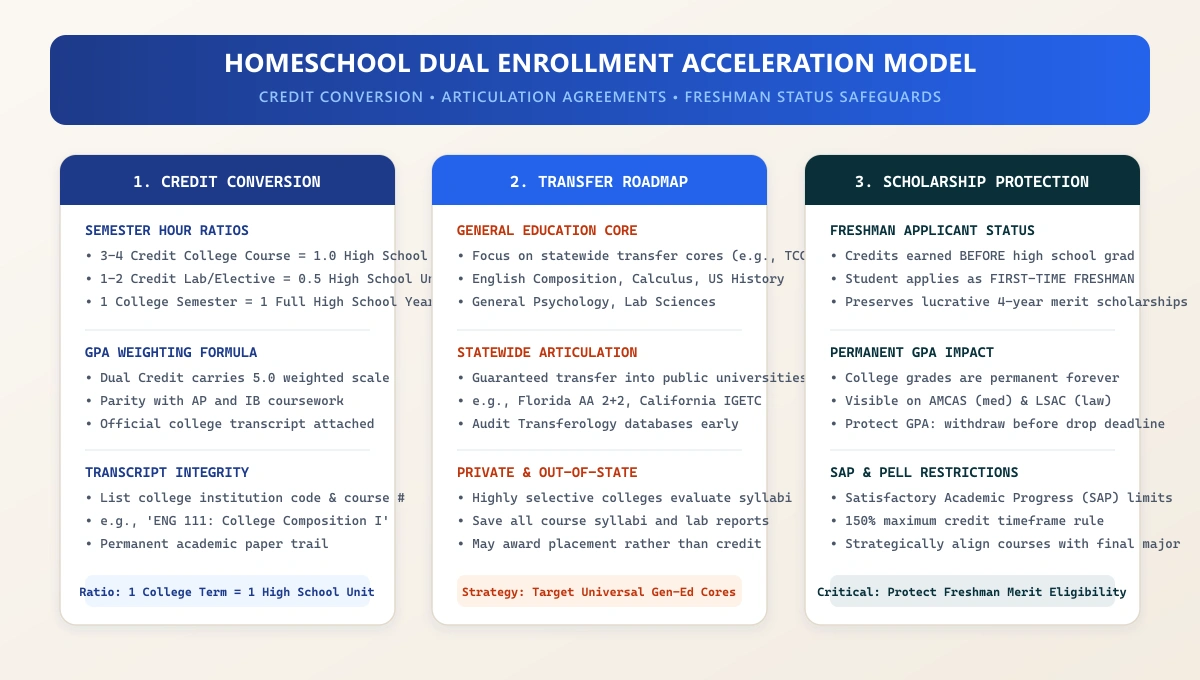
1. Credit Conversion Ratios: High School Units vs. College Semester Hours
A frequent point of confusion for homeschool parents designing high school transcripts is determining how many high school credits to award for an undergraduate college course.
The standard academic benchmark adopted by state departments of education and college admissions boards across the United States is based on the Carnegie Unit:
The Standard Dual Credit Conversion Matrix
3 or 4 Semester-Hour College Course = 1.0 Full High School Credit
A 3-credit college course (e.g., ENG 101 College Composition I or PSY 101 General Psychology) spans 45 contact hours plus 90 to 120 hours of independent study across a 15-week semester. Because the depth and velocity of college material covers a full year of high school content, it is recorded as 1.0 Carnegie unit on the high school transcript.
1 or 2 Semester-Hour College Course = 0.5 High School Credit
Standalone college science laboratories (e.g., 1 credit CHM 101L), physical education electives, or 2-credit computer modules translate to 0.5 Carnegie unit.
4 or 5 Semester-Hour Foreign Language / Calculus = 1.0 to 1.5 High School Credits
Intensive 4-credit or 5-credit courses (such as SPAN 101 Elementary Spanish I or MAT 271 Calculus I) can be recorded as 1.0 credit (standard) or up to 1.5 credits depending on your homeschool family's graduation credit framework.
Transcript Formatting Best Practices
When constructing your student’s official homeschool transcript, dual enrollment courses should be documented with precision:
- Course Title Clarity: Explicitly include the college course code and title. For example: English Composition I (ENG 111 - Northern Virginia Community College).
- Designation Symbol: Use a special marker or asterisk (e.g.,
*or[DE]) indicating:[DE] = Dual Enrollment College Course taken in residence. - Transcript Packaging: Always submit your official parent-signed homeschool transcript accompanied by the official, sealed collegiate transcript sent directly from the community college registrar to the admissions department.
2. Weighted GPA Calculations: The 5.0 Quality Point Scale
Dual enrollment courses represent genuine collegiate rigor. To reflect this academic depth, high school transcripts typically apply an honors or college-level weight to the student’s Grade Point Average (GPA):
| Letter Grade | Percentage Benchmark | Standard High School (Unweighted) | Honors Weight | Dual Enrollment / AP Weight |
|---|---|---|---|---|
| A | 93% – 100% | 4.0 | 4.5 | 5.0 |
| A- | 90% – 92% | 3.7 | 4.2 | 4.7 |
| B+ | 87% – 89% | 3.3 | 3.8 | 4.3 |
| B | 83% – 86% | 3.0 | 3.5 | 4.0 |
| B- | 80% – 82% | 2.7 | 3.2 | 3.7 |
| C+ | 77% – 79% | 2.3 | 2.8 | 3.3 |
| C | 73% – 76% | 2.0 | 2.5 | 3.0 |
| D | 65% – 72% | 1.0 | 1.0 | 1.0 (No Weight) |
| F | Below 65% | 0.0 | 0.0 | 0.0 |
Note: On your high school transcript, always report BOTH the Unweighted Cumulative GPA (out of 4.0) and the Weighted Cumulative GPA (out of 5.0). Universities frequently strip weights to calculate their own recalculated internal GPA, but reporting both demonstrates transparency and standardized compliance.
3. Transfer Articulation Agreements: Public vs. Private Universities
Not all college credits transfer equally. Understanding how institutions evaluate transfer credit prevents heartbreaking scenarios where 30 earned community college credits become “general unassigned electives” that fail to satisfy degree requirements:
In-State Public Universities & Common Course Numbering
Most state legislatures have mandated comprehensive Statewide Articulation Agreements. For example:
- Florida’s 2+2 Articulation: An Associate in Arts (AA) degree completed at any Florida College System institution guarantees junior-standing admission into one of the state’s 12 public universities.
- Texas Common Course Numbering System (TCCNS): Identical course rubrics (e.g., ENGL 1301) guarantee direct 1:1 equivalency across all Texas public community colleges and four-year universities.
- California IGETC: The Intersegmental General Education Transfer Curriculum satisfies all lower-division general education breadth requirements across the University of California (UC) and California State University (CSU) systems.
Parent Strategy: If your student plans to attend an in-state public university, strictly select dual enrollment courses that belong to the state’s codified “General Education Core.”
Private, Out-of-State, and Highly Selective Universities
Ivy League, elite private colleges (MIT, Stanford, Duke), and selective liberal arts institutions maintain independent credit evaluation policies:
- The “High School Graduation” Rule: Some highly selective colleges will only award college credit for dual enrollment if the courses were taken on a physical college campus with matriculated college undergraduates, taught by college faculty, AND were not used to satisfy high school graduation requirements.
- Placement vs. Credit: Highly selective institutions frequently use dual enrollment coursework for advanced placement (e.g., allowing a student to skip introductory Chemistry directly into Organic Chemistry) rather than shortening the required 8 undergraduate semesters of paid tuition.
- Syllabus Preservation: Always download and permanently archive every single dual enrollment syllabus, textbook ISBN list, and substantial research paper or lab notebook. Admissions deans and academic department chairs require syllabi to evaluate equivalencies during individual credit petition reviews.
4. The Golden Rule: Preserving “First-Time Freshman” Scholarship Status
Perhaps the single most critical strategic distinction in homeschool college advising is the boundary between First-Time Freshman and Transfer Student.
The Golden Timeline Rule for Homeschool Admissions
Any number of college credits earned PRIOR to formal high school graduation = Student legally and procedurally remains a FIRST-TIME FRESHMAN for college admissions and institutional merit awards.
Even if a homeschooled student earns 60 college credits and graduates high school with a fully conferred Associate of Science (AS) degree at age 18, they must apply to four-year universities as an Incoming First-Time Freshman, NOT as a transfer student.
Why Freshman Status is Worth Tens of Thousands of Dollars:
- Institutional Merit Scholarships: Colleges allocate their largest endowments to freshman recruiting. Prestigious four-year renewable merit awards (e.g., presidential scholarships, full-tuition waivers) are exclusively reserved for incoming freshmen. Transfer scholarships are notoriously sparse, non-renewable, or capped at modest amounts ($2,000 to $5,000).
- Freshman Housing & Community Cohorts: Freshmen are guaranteed priority on-campus housing, freshman seminar cohorts, and specialized undergraduate research grants that transfer students are frequently excluded from.
- Credit Application Post-Admission: Once accepted as a freshman and after merit aid packages are formally locked in, the student submits their official community college transcript to the university registrar to have their 30 to 60 credits applied toward their degree audit.
The Fatal Mistake: If a student takes even a single college class during the summer or autumn immediately after their official high school graduation date without being enrolled at their target university, they automatically forfeit freshman status and become classified as a Transfer Student. Never graduate high school early on paper unless the university application cycle has been completely finalized.
5. Potential Pitfalls: Satisfactory Academic Progress (SAP) & The Permanent Record
While dual enrollment offers unprecedented acceleration, parents must actively manage the underlying institutional risks:
Satisfactory Academic Progress (SAP) Timeframe Limits
Federal Title IV financial aid regulations stipulate that undergraduate students are only eligible for federal loans and Pell Grants for up to 150% of the published length of their educational program (known as the Maximum Timeframe Rule). For a standard 120-credit Bachelor’s degree, the limit is 180 attempted credit hours.
If a dual enrollment student takes 40 random elective credits that do not apply toward their ultimate undergraduate major, those credits count as “attempted hours” against their federal financial aid clock, potentially exhausting eligibility before senior year.
The AMCAS and LSAC Mandate
When applying to medical school (via the American Medical College Application Service - AMCAS) or law school (via the Law School Admission Council - LSAC), applicants are legally required to submit transcripts from every post-secondary institution ever attended, regardless of whether credit transferred or how young the student was. AMCAS recalculates an all-inclusive undergraduate GPA where dual enrollment grades carry equal weight to senior-year college grades.
The Golden Guideline: If your homeschooled teenager encounters academic distress, illness, or executive function overload in a college class, exercise the college’s official “W” (Withdrawal) option prior to the drop deadline. A mark of “W” on a college transcript carries zero GPA penalty, whereas a permanent “D” or “F” will anchor their collegiate GPA for life.
Recommended Step-by-Step Enrollment Timeline
- Age 14–15 (9th/10th Grade):
- Solidify foundational algebra and academic essay mechanics.
- Have the student take community college placement assessments (e.g., ACCUPLACER, TSI, or qualifying PSAT/SAT/ACT scores).
- Start modestly with one single course in a subject of high interest (e.g., Introduction to Astronomy, Drawing I, or World History).
- Age 16 (11th Grade):
- Increase course load to two courses per semester.
- Tackle core university requirements: College Composition I (ENG 111) and College Algebra or Precalculus.
- Practice digital syllabus tracking, academic portal navigation (Canvas/Blackboard), and professor communication via official student email.
- Age 17 (12th Grade):
- Advance to lab sciences (General Biology I with Lab) and upper-level math (Calculus I).
- Simultaneously assemble the university application packet via the Common App, ensuring student checks “First-Time Freshman.”
- Request official transcripts from the community college registrar for early action/regular decision submission deadlines.
Pedagogical References and Regulatory Citations
- American Council on Education (ACE). Dual Enrollment Progression Models and Post-Secondary Degree Attainment. Washington, DC.
- Education Commission of the States (ECS). 50-State Comparison: Dual and Concurrent Enrollment Policies. ECS Policy Clearinghouse.
- National Alliance of Concurrent Enrollment Partnerships (NACEP). National Standards for Academic Rigor in College High School Partnerships.
- National Center for Education Statistics (NCES). Dual Credit Course Taking in Secondary Education. U.S. Department of Education.
- American Medical College Application Service (AMCAS). Instruction Manual: Complete Transcript Submission Policies for Post-Secondary Coursework. Association of American Medical Colleges (AAMC).
Disclaimer: This post is for informational and educational purposes only, accurate to the best of our knowledge at publication. It does not constitute advice. We do not guarantee accuracy or completeness and accept no liability for any decisions or losses resulting from reliance on this content.