When a bright, articulate child bursts into tears over a basic subtraction worksheet, parents frequently assume they are dealing with laziness, stubbornness, or ordinary math anxiety[1]. You explain that four plus three equals seven. Three minutes later, looking at the exact same equation, your child stares at the paper blankly, starting over from one and tapping their fingers against their leg.
This is not a character flaw. It is not an intellectual limitation. It is the hallmark signature of developmental dyscalculia—a specific neurodevelopmental learning difference that affects an estimated 5% to 7% of the population[2].
In a traditional classroom, children with dyscalculia are routinely crushed under the weight of timed arithmetic drills, standardized testing benchmarks, and spiral curricula that move on before foundational number sense is established.
Homeschooling provides the single most powerful therapeutic environment for a dyscalculic learner. At home, you can strip away the arbitrary deadlines, toss out the flashcards that produce panic, and rebuild your child’s mathematical architecture from the ground up using multisensory, concrete pedagogical tools.
What Is Developmental Dyscalculia? (And What It Is Not)
The Diagnostic and Statistical Manual of Mental Disorders (DSM-5-TR) classifies dyscalculia under the diagnostic umbrella of Specific Learning Disorder with Impairment in Mathematics (Code 315.1)[1].
While dyslexia impairs the brain’s phonological processing circuit, dyscalculia impairs the brain’s Approximate Number System (ANS), located primarily within the intraparietal sulcus[2].
Neurotypical brains possess an innate, pre-verbal sense of quantity known as subitizing—the ability to look at a group of three or four objects and immediately recognize how many there are without counting them one by one. A child with severe dyscalculia does not perceive quantity instinctively. To them, the numeral “5” is merely an arbitrary squiggly symbol on a page, entirely disconnected from the physical reality of five apples or five stones.
Clinical Diagnostic Distinctions:
- Dyscalculia vs. Math Anxiety: Math anxiety is an emotional response, often induced by negative classroom experiences or timed drills. When provided with a low-stress environment, a child with pure math anxiety can retrieve math facts and grasp spatial quantitative concepts. A dyscalculic child cannot retrieve facts because the underlying mental number line has never formed in their cognitive map.
- Dyscalculia vs. ADHD Working Memory Lapses: Many neurodivergent children have ADHD, which compromises working memory. An ADHD student might understand multi-digit division perfectly but forget to carry a number halfway through the algorithm due to an attentional drift. In contrast, a dyscalculic student struggles with the fundamental directionality of numbers, the concept of magnitude, and place value itself.
The Multisensory Intervention Continuum (C-R-A)
Traditional public school math curricula operate almost exclusively at the abstract level: students are presented with abstract Arabic numerals (like 7 + 5 = 12) and instructed to memorize algorithm procedures. For a dyscalculic mind, memorizing abstract algorithms without underlying semantic meaning is like trying to memorize telephone directories in a foreign language.
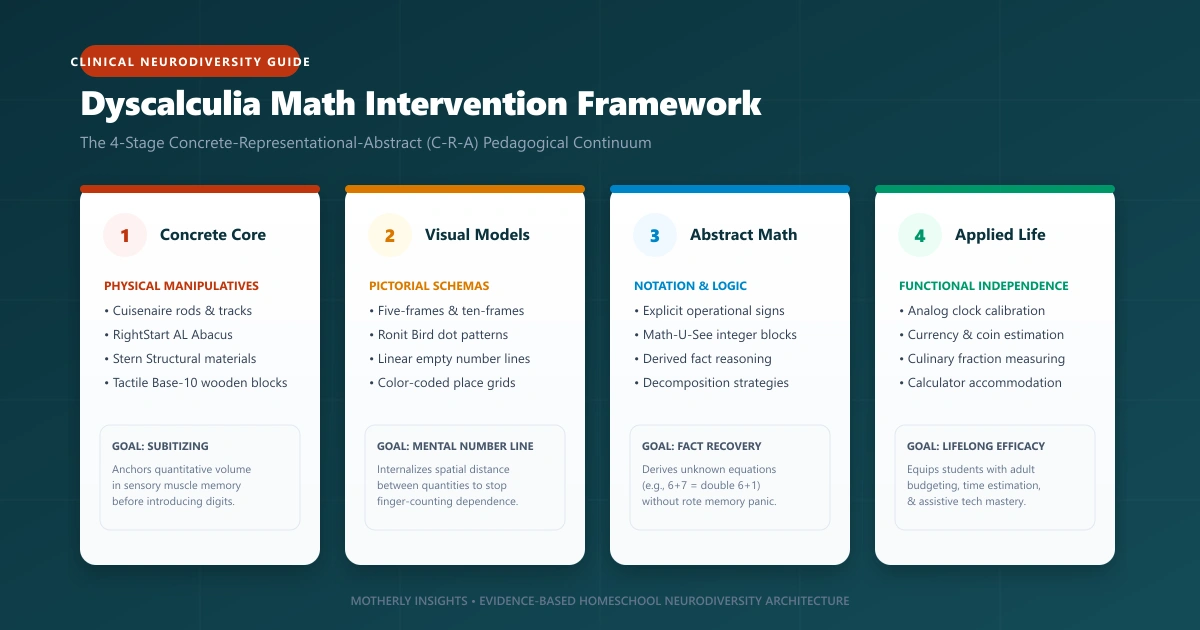
Clinical math remediation relies on the Concrete-Representational-Abstract (C-R-A) continuum. This evidence-based progression ensures that every mathematical truth is first anchored in physical muscle memory before moving to pictorial schematics, and finally to abstract mathematical symbols[3].
Stage 1: The Concrete Foundation (Sensory Anchor)
Before a child touches a pencil or sees a printed numeral, they must physically interact with quantities.
- Cuisenaire Rods: Unlike standard blocks that require counting individual studs, Cuisenaire rods represent number by length. A 7-rod is physically seven times longer than a 1-rod. When a child places a 3-rod and a 4-rod end-to-end alongside a 7-rod, they physically observe and feel that the lengths match.
- The RightStart AL Abacus: Designed by Dr. Joan Cotter, the AL Abacus groups twenty rows of ten beads into distinct color blocks of five (five yellow, five blue). This allows a dyscalculic child to subitize large quantities instantly by referencing five-and-ten groupings rather than laboriously counting single beads.
Stage 2: The Representational Pivot (Mental Number Line)
Once quantity is anchored in physical blocks, the student transitions to pictorial representations.
- Ronit Bird Dot Patterns: UK dyscalculia specialist Ronit Bird demonstrated that dice patterns and domino dot arrays are far easier for dyscalculic brains to internalize than linear rows of items[3].
- Ten-Frames and Five-Frames: Grid boxes where counters are placed systematically help children visualize that “8 is a full five-frame plus three extra,” establishing the decimal base anchor necessary for mental arithmetic.
- Empty Number Lines: Drawing physical hops along an unmeasured horizontal line trains spatial directionality (addition moves to the right; subtraction moves to the left).
Stage 3: The Abstract Notation (Derived Facts)
Abstract symbols (+, -, ×, ÷) are introduced only when the child can describe the operation using their own conversational vocabulary.
- Rather than demanding instant recall of 100 isolated multiplication facts, dyscalculic learners are taught derived fact strategies.
- If a student cannot recall 6 × 7, they are not shamed. Instead, they derive it: “I know 6 × 5 is 30, and two more groups of 6 is 12, so 30 plus 12 is 42.” This shifts mathematics from a terrifying memory recall test into a reliable puzzle of logical decomposition.
Stage 4: Applied Life Functional Skills
Dyscalculia is not limited to math class; it affects daily life navigation, analog clock reading, financial budgeting, and cooking measurements. Real-world application bridges academic concepts into permanent life independence.
Evaluating Homeschool Math Curricula for Dyscalculic Learners
Not all homeschool math programs are created equal. Many popular programs marketed to homeschoolers can be actively damaging to a student with developmental dyscalculia. Here is an authentic breakdown of clinical recommendations versus programs that require significant modification.
| Curriculum / Intervention Toolkit | Core Pedagogical Philosophy | Dyscalculia Suitability | Key Strengths & Considerations |
|---|---|---|---|
| Ronit Bird Toolkits & eBooks | Pure multisensory structural math | Exceptional (Gold Standard) | Specifically engineered for dyscalculia; focuses on dot patterns, Cuisenaire rods, and games. Zero busywork. |
| RightStart Mathematics | Hands-on Montessori/Asian math via AL Abacus | High (Levels A–C) | Replaces finger-counting with 5-and-10 visual groupings. Highly conversational. Parent-intensive. |
| Math-U-See | Systematic mastery using integer block manipulatives | High | Sequential mastery. Video lessons model manipulative use. Single-topic focus prevents cognitive overload. |
| Stern Structural Arithmetic | Tactile wooden blocks in grooved pattern trays | High | Physical trays make self-correction automatic; impossible to make an error without visually seeing the gap. |
| Saxon Math / Abeka | Spiral rote memorization & timed speed drills | Unsuitable / High Risk | Rapid spiral transitions cause confusion; heavy reliance on memorization triggers acute math anxiety. |
| Beast Academy / Singapore Math | Conceptual problem-solving with high visual complexity | Moderate to Poor | High visual crowding and rapid mental jumps can overwhelm dyscalculic children with executive dysfunction. |
The Power of Ronit Bird’s Approach
If your child cannot reliably add single-digit numbers without counting on their fingers, pause all formal grade-level textbooks immediately. Begin with Ronit Bird’s The Dyscalculia Toolkit or her digital books (Dot Patterns, Cuisenaire Activities, Overcoming Difficulties with Number)[3].
Her methodology treats numbers not as words or symbols, but as physical structures that can be combined, broken apart, and reassembled through games. When learning is game-based, the amygdala remains calm, allowing the prefrontal cortex to forge new neural pathways.
Essential Daily Accommodations in the Home Classroom
The most profound advantage of homeschooling is your legal freedom to adapt the instructional pacing and environment. Implement these evidence-based accommodations daily:
Dyscalculia Daily Home Accommodation Protocol
- 1. Strict 20-Minute Cognitive Limit: Cap focused instruction at 15–20 minutes before cognitive fatigue sets in.
- 2. Ban Speed Drills: Eliminate all timed tests, speed drills, and countdown timers to prevent anxiety paralysis.
- 3. Large-Grid Paper: Replace lined worksheets with 1/2-inch grid notebooks to enforce spatial number alignment.
- 4. Permanent Manipulatives: Keep physical blocks, abacuses, and rods on the desk without restriction or shame.
- 5. Color-Coded Signs: Provide a laminated reference chart for operations (+ in green, - in red, × in blue, ÷ in purple).
1. The 20-Minute Cognitive Fatigue Boundary
A neurotypical child might spend 45 minutes on math without cognitive collapse. For a dyscalculic child, processing quantitative calculations requires five times more mental energy. After 20 minutes, their brain exhausts its glucose reserves. Pushing beyond this threshold produces tears, tantrums, and zero retention. Stop when focus begins to unravel, even if you have only completed four problems.
2. Large-Grid Paper to Counteract Spatial Disorganization
Many children with dyscalculia also exhibit spatial dysgraphia or visual processing issues. Standard lined paper invites catastrophic alignment errors in multi-digit addition or long division. Use 1/2-inch or 1-inch grid paper, requiring the child to write exactly one digit per box. Color-code the columns (e.g., green for units, blue for tens, red for hundreds) to provide clear spatial boundaries.
3. Normalize Assistive Technology Early
There is no moral virtue in suffering through hand calculations that a calculator can perform in milliseconds. Once a dyscalculic student demonstrates conceptual understanding of an operation (e.g., they understand that multiplication represents equal groups), grant them permanent access to a four-function calculator. This frees their working memory to engage in higher-order problem solving, scientific inquiry, and logical reasoning.
High School Math Pathways & Standardized Test Accommodations
When a child with dyscalculia reaches 9th grade, parents frequently panic: How will my student pass Algebra and Geometry? Will they ever get into college?
Crafting a Valid High School Transcript
In almost all states, homeschool parents possess the statutory legal authority to design graduation requirements and establish course titles. You do not need to subject your student to advanced calculus or trigonometry if their intended career path lies in the humanities, creative arts, trades, or biological sciences.
- Legitimate Course Alternatives:
- Consumer Math / Financial Literacy: Balances checkbooks, analyzes mortgage interest rates, calculates payroll taxes, and budgets for independent living. This is deeply practical, authentic mathematics that state departments of education universally recognize for high school credit.
- Applied Statistics: Often far more intuitive for dyscalculic students than abstract symbolic algebra, as it deals with real-world datasets, graph interpretation, and visual trend analysis.
- Hands-On Geometry: Focuses on spatial construction, woodworking measurements, and architectural drafting rather than abstract axiomatic proofs.
Securing Accommodations on the SAT, ACT, and AP Exams
If your student plans to pursue higher education, they are entitled to formal test accommodations under the Americans with Disabilities Act (ADA)[4]. However, the College Board and ACT require strict documentation:
- Comprehensive Psychoeducational Evaluation: Secure a formal diagnostic evaluation conducted by a licensed clinical neuropsychologist or educational psychologist within the last three to five years. The evaluation must clearly state DSM-5 code 315.1 (Specific Learning Disorder with Impairment in Mathematics).
- Documented History of Accommodations: You must demonstrate that the student has utilized these accommodations consistently in their homeschool environment. Maintain a detailed portfolio showing:
- Untimed or 50% extended time (Time and a Half) on math tests.
- Use of a four-function calculator on non-calculator sections.
- Use of scratch paper and visual math reference tables.
- Application Timelines: Submit your request through the College Board’s Services for Students with Disabilities (SSD) portal and ACT’s Special Testing portal at least seven to nine months prior to the scheduled exam date.
💡 Related Educational Pathways: To compare related legal frameworks and recommended study programs, explore our detailed reviews on California homeschool legal guidelines, Ohio homeschool notification regulations, Pennsylvania Act 169 requirements.
💡 Related Educational Pathways: To compare related legal frameworks and recommended study programs, explore our detailed reviews on Georgia homeschool compliance framework, Michigan homeschool statutory rules, Indiana homeschool attendance laws.
Frequently Asked Questions About Dyscalculia in Homeschooling
Can a child outgrow developmental dyscalculia? ↓
Why do timed math fact worksheets cause so much damage? ↓
Should I allow my dyscalculic high schooler to use a calculator? ↓
What is the single best first step if I suspect my child has dyscalculia? ↓
Disclaimer: This post is for informational and educational purposes only, accurate to the best of our knowledge at publication. It does not constitute advice. We do not guarantee accuracy or completeness and accept no liability for any decisions or losses resulting from reliance on this content.