

When homeschooling families transition into the high school years, no academic requirement causes more anxiety than laboratory science. While elementary and middle school nature study and kitchen demonstrations feel accessible and charming, high school chemistry, biology, and physics demand quantitative rigor, complex instrumentation, and genuine physical hazard management.
Parents frequently confront pressing concerns: Can we legally store and use chemicals like hydrochloric acid at our kitchen table? Do colleges accept homeschool science courses as legitimate “lab sciences”? Will my teenager be disadvantaged in STEM admissions or NCAA athletic eligibility if they complete experiments at home rather than in a million-dollar high school laboratory?
The reassuring reality is that home educators can establish safe, highly sophisticated, and collegiate-accredited home science laboratories. In fact, because homeschool students work independently with full hands-on responsibility—rather than sharing a lab station with three disengaged peers—homeschooled students frequently develop superior laboratory technique, data analysis discipline, and scientific maturity compared to conventionally schooled graduates.
What Officially Constitutes a “Lab Science” on a Transcript?
Colleges, university admissions boards, and the NCAA Eligibility Center do not award lab credit simply for reading a textbook and answering end-of-chapter questions. A legitimate laboratory science course requires four definitive components:
- Physical Manipulation of Scientific Apparatus: Hands-on interaction with authentic scientific tools (micropipettes, graduated cylinders, burettes, spring scales, compound microscopes). While computer simulations have value as pre-lab preparation, top universities require physical sensory execution.
- Quantitative Data Collection: Students must measure, record, and manipulate real-world numbers with appropriate units and significant figures—never merely qualitative observations like “the liquid turned pink.”
- Hypothesis-Driven Scientific Inquiry: Conducting controlled experiments where an independent variable is systematically altered, a dependent variable is measured, and confounding variables are held constant.
- Time Commitment (Carnegie Units): Standard high school accreditation expects 30 to 45 hours of dedicated laboratory work per 1.0 high school science credit, typically structured as 15 to 25 complete, formal multi-hour experiments across the academic year.
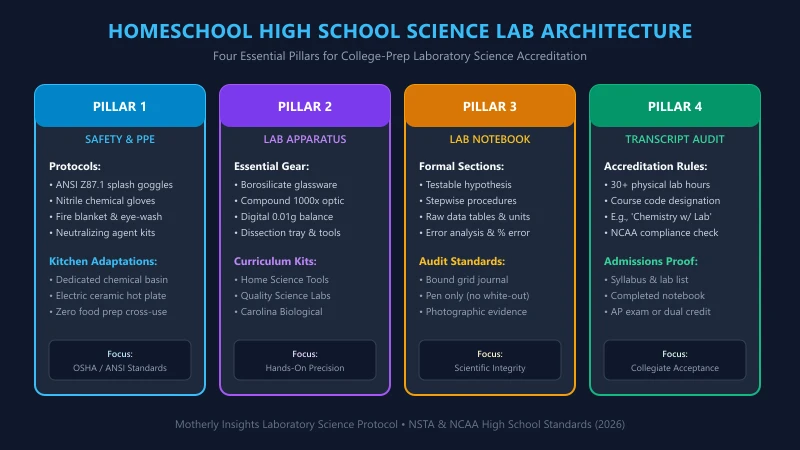
Pillar 1: Home Laboratory Safety & Hazard Protocols
Safety is the absolute prerequisite of any experimental science program. Establishing strict laboratory protocols protects your family and instills the professional habits demanded in university research facilities.
1. Essential Personal Protective Equipment (PPE)
Never permit your student to begin an experiment without mandatory PPE:
- Splash Goggles (ANSI Z87.1 Certified): Standard hardware store safety glasses are insufficient. High school chemistry requires indirect-vented chemical splash goggles that form a complete seal against the face to prevent corrosive liquid ingress.
- Chemical-Resistant Nitrile Gloves: Superior to latex, nitrile protects against mild acids, bases, and organic staining agents while accommodating skin sensitivities.
- Lab Coat or Heavy Cotton Apron: Prevents chemical spills from contacting street clothes and skin.
2. Location & Ventilation
- The Golden Rule: Never conduct chemistry or biological dissection in a space where food is actively prepared or stored.
- Surface Protection: Work on non-porous surfaces (granite, stainless steel, or heavy-duty chemical-resistant polyethylene trays).
- Ventilation: Ensure cross-ventilation with open windows and exhaust fans when heating volatile organic compounds or working with preserved dissection specimens.
3. Emergency Equipment
Equip your home laboratory station with three critical safety tools:
- Eyewash Station: A dedicated squeeze-bottle eyewash station or faucet adapter capable of continuous 15-minute flushing.
- Fire Extinguisher & Fire Blanket: An ABC dry-chemical fire extinguisher positioned within arm’s reach, alongside a wool or treated fiberglass fire blanket.
- Chemical Spill Neutralizers: Keep a box of sodium bicarbonate (baking soda) on hand to instantly neutralize acid spills, and standard white vinegar to neutralize base spills.
Pillar 2: Curricula, Microchemistry & Complete Lab Kits
Unless a parent holds an advanced degree in chemistry or biology, sourcing individual chemical reagents and borosilicate glassware from commercial distributors is inefficient and expensive. The modern homeschooling movement solves this through pre-packaged microchemistry and biological lab kits.
Microchemistry utilizes tiny reagent volumes (milliliters rather than liters), dramatically reducing chemical fumes, fire hazards, and hazardous waste disposal while preserving full quantitative stoichiometry.
| High School Subject | Gold-Standard Lab Kit Provider | Key Laboratory Investigations |
|---|---|---|
| High School Biology | Quality Science Labs (QSL Biology) / Home Science Tools | 1000x cellular microscopy, mitosis slide stains, enzyme kinetics, fetal pig dissection |
| High School Chemistry | Home Science Tools Chemistry / MicroChem Kit | Acid-base titration, copper sulfate synthesis, gas law stoichiometry, calorimetry |
| AP Chemistry / Physics | Carolina Biological Distance Learning / PASCO Sensors | Beer’s Law spectrophotometry, Le Chatelier’s equilibrium, digital motion sensors |
| Anatomy & Physiology | Ward’s Science / Homeschool Science Press | Mammalian organ dissection (sheep brain, cow eye, pluck), histology slide analysis |
Pillar 3: The Formal Laboratory Notebook
The physical laboratory notebook is your student’s ultimate proof of academic legitimacy. If a university admissions office or NCAA evaluator audits your homeschool science program, handing them a professional, bound laboratory notebook provides undeniable evidence of collegiate rigor.
Laboratory Notebook Rules of Professional Practice
- Permanently Bound Journal: Use a quad-ruled (graph paper) composition book. Loose-leaf binders or digital word processor files are vulnerable to post-hoc editing; a bound book establishes chronological authenticity.
- Ink Only: All entries must be written in blue or black permanent pen. If an error occurs, draw a single neat strike-through line (‘—’) and write the correct value above it. Erasing or using correction fluid is scientifically prohibited.
- Immediate Recording: Record raw measurements directly into data tables in real time—never on scratch napkins or scraps of paper to be recopied later.
Anatomy of a Complete Lab Report
Every formal investigation in the notebook should follow the standardized collegiate template:
- Title & Date: Descriptive experiment title and date of execution.
- Theoretical Background & Testable Hypothesis: 1–2 paragraphs explaining the relevant physical or chemical laws, concluding with an explicit If… then… because… statement.
- Materials & Labeled Apparatus Diagram: An exhaustive list of chemicals, concentrations, glassware, and precision tools, accompanied by a clean diagram of the experimental setup.
- Stepwise Methodology: Clear, past-tense procedural steps executed during the experiment.
- Raw Quantitative Data Tables: Cleanly drawn tables featuring column headers with precise physical units (e.g., $mL pm 0.05$, $g pm 0.01$) and uncertainty estimates.
- Sample Calculations & Graphing: Mathematical conversions, stoichiometry calculations, and hand-plotted or digitally pasted linear regression curves.
- Error Analysis: Quantitative calculation of percent error: $$ ext{Percent Error} = left| rac{ ext{Experimental Value} - ext{Theoretical Value}}{ ext{Theoretical Value}} ight| imes 100%$$ Identify at least two systematic or random sources of experimental error (e.g., meniscus parallax, heat dissipation).
- Conclusion & Synthesis: A summary explaining whether the experimental evidence supported or rejected the original hypothesis.
Pillar 4: Transcripts, Course Descriptions & NCAA Accreditation
To ensure seamless credit transfer and collegiate evaluation, your homeschool documentation must reflect standard academic nomenclature.
Transcript Course Titles
On your student’s official high school transcript, explicitly indicate laboratory completion in the course title:
- Correct: Biology (with Lab) — 1.0 Credit
- Correct: General Chemistry with Laboratory — 1.0 Credit
- Correct: AP Physics 1: Algebra-Based (with Lab) — 1.0 Credit
- Vague / Ineffective: Science 9 or Applied Science
Comprehensive Course Description Dossier
Alongside the transcript, maintain a one-page course description for each science subject. Your dossier should include:
- Textbook Spine: Title, author, edition, and publisher (e.g., Chemistry: A Molecular Approach, Nivaldo J. Tro).
- Lab Kit & Hours: Explicit statement of hands-on laboratory hours completed (e.g., “Completed 36 hours of physical laboratory investigations utilizing the Quality Science Labs MicroChem kit”).
- Comprehensive Lab List: An itemized list of all completed experiments (e.g., “Lab 4: Determination of the Molar Volume of a Gas,” “Lab 8: Acid-Base Titration of Unknown Concentration”).
When to Outsource: Dual Enrollment & Co-Op Labs
While high school biology and introductory chemistry are easily managed at home, certain specialized disciplines may benefit from external facilities:
- Dual-Enrollment Community College Courses: Taking general chemistry or physics at a local community college earns transferable college credit while providing access to professional chemical fume hoods, analytical balances, and university-grade spectroscopy instruments.
- Homeschool Co-Op Science Labs: Partnering with other homeschooling families allows parents to split equipment costs (such as investing in high-end binocular compound microscopes) while fostering collaborative peer debate and team data collection.
By establishing high safety standards, selecting rigorous microchemistry kits, and maintaining disciplined laboratory notebooks, your home laboratory will equip your student with the empirical curiosity, analytical grit, and scientific confidence required to excel in any university STEM degree.
Disclaimer: This post is for informational and educational purposes only, accurate to the best of our knowledge at publication. It does not constitute advice. We do not guarantee accuracy or completeness and accept no liability for any decisions or losses resulting from reliance on this content.