
Around the age of eleven or twelve, many homeschooling parents observe an unmistakable developmental shift. The child who once memorized poetry, spelling rules, and multiplication tables with eager compliance suddenly begins asking, “Why?” They point out slight inconsistencies in parental rules, challenge assertions made in history textbooks, and dissect family dinner conversations with newfound argumentative zeal.
In progressive educational circles, this phase is frequently labeled as emerging teenage rebellion or argumentative defiance. In classical education, however, it is celebrated as the dawn of the Dialectic or Logic Stage. The student’s brain is naturally transitioning from accumulating raw facts (the Grammar Stage) to examining how facts relate to one another, testing claims for truth, and constructing sound arguments.
Teaching explicit logic provides the essential intellectual guardrails for this developmental leap. Without formal training, a young adolescent’s newfound argumentative energy often devolves into emotional bickering, sophistry, or susceptibility to digital misinformation. With structured logic instruction, that same energy transforms into razor-sharp analytical clarity, ethical discernment, and academic eloquence.
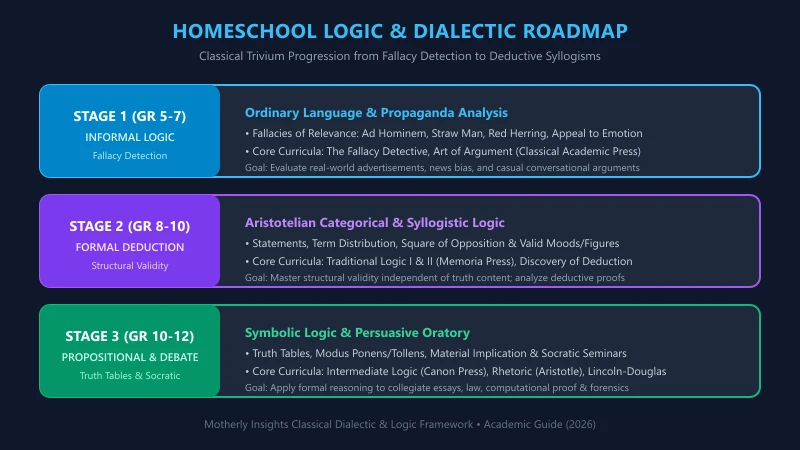
Informal Logic vs. Formal Logic: The Vital Distinction
Before purchasing curriculum workbooks, every homeschooling educator must understand the crucial difference between the two primary branches of logic education:
1. Informal Logic: The Study of Ordinary Language & Fallacies
Informal logic deals with arguments as they appear in everyday human speech, persuasive writing, commercial advertising, and political discourse. It evaluates:
- Argument Strength and Cogency: Is the evidence compelling and reliable?
- Informal Fallacies: Identifying psychological tricks, misleading statistics, and faulty reasoning patterns that seem persuasive on the surface but lack substantive support.
- Contextual Nuance: Analyzing tone, presuppositions, ambiguity, and definitions.
Best suited for: Grades 5 through 7 (ages 10–13). It is lively, humorous, practical, and highly intuitive for middle schoolers.
2. Formal Logic: The Science of Deductive Structure
Formal logic strips away ordinary language to examine the abstract structural architecture of deductive arguments. It is entirely concerned with validity—the necessary relationship between premises and conclusions:
- Categorical Syllogisms: Analyzing three-line deductive arguments (e.g., Major Premise, Minor Premise, Conclusion).
- The Square of Opposition: Mapping logical contradictions, contraries, and subcontraries.
- Symbolic & Propositional Logic: Utilizing variables, truth tables, and mathematical operators to prove conditional claims (e.g., Modus Ponens, Modus Tollens).
Best suited for: Grades 8 through 11 (ages 13–17). It functions much like algebra: precise, formulaic, and intellectually rigorous.
| Educational Dimension | Informal Logic | Formal Logic |
|---|---|---|
| Primary Focus | Detecting deception, bias, and flawed claims | Proving structural validity through deductive laws |
| Key Terminology | Straw Man, Ad Hominem, Red Herring, Slippery Slope | Major Term, Copula, Validity, Soundness, Modus Tollens |
| Core Medium | News editorials, advertisements, social debates | Aristotelian syllogisms, truth tables, symbolic proofs |
| Optimal Starting Age | 5th to 7th Grade (Ages 10–13) | 8th to 10th Grade (Ages 13–16) |
| Cognitive Benefit | Bullshit detection, critical media literacy | Spatial reasoning, rigorous analytical discipline, legal rigor |
Top Informal Logic Curricula: Building Critical Intuition
Starting with informal logic captures your middle schooler’s enthusiasm without intimidating them with abstract formulas. Here are the leading home education programs:
1. The Fallacy Detective & The Thinking Toolbox (Bluedorn Brothers)
Written by Christian homeschool graduates Nathaniel and Hans Bluedorn, these companion volumes remain the most widely used informal logic primers in the home education movement:
- Format: Short, bite-sized chapters followed by engaging multiple-choice practice problems featuring humorous comic-strip scenarios (often starring Peanuts or vintage detective tropes).
- Scope: Covers 38 common fallacies divided into four categories: Avoiding the Question (red herrings, ad hominem), Making Assumptions (circular reasoning, post hoc ergo propter hoc), Statistical Fallacies (hasty generalization, weak analogy), and Propaganda Techniques (bandwagon, testimonial).
- Best For: 5th to 8th graders looking for an enjoyable, low-pressure introduction to critical thinking that can be completed in 15 minutes a day during morning time.
2. The Art of Argument (Classical Academic Press)
Authored by Aaron Larsen and Dr. Christopher Perrin, The Art of Argument approaches fallacy analysis with collegiate-level pedagogical depth packaged in an energetic, magazine-style format:
- Pedagogical Structure: Teaches 28 core informal fallacies grouped systematically into Relevance, Presumption, and Clarity.
- Real-World Application: Incorporates faux print advertisements, modern political debate transcripts, and courtroom scenarios that teach students how marketing executives and speechwriters weaponize fallacies.
- Companion Resources: High-quality video lectures, audio pronunciation guides, and interactive teacher manuals.
- Best For: 7th and 8th graders who thrive on vibrant visual design, deep discussion, and debate games.
Top Formal Logic Curricula: The Syllogistic Deep Dive
Once a student understands how arguments fail informally, they are prepared for the architectural discipline of formal deductive logic.
1. Traditional Logic I & II (Martin Cothran, Memoria Press)
Martin Cothran’s Traditional Logic represents the premier classical Aristotelian logic course available for homeschoolers:
- Methodology: Reclaims the classical scholastic heritage of deductive reasoning rooted in Aristotle’s Prior Analytics and St. Thomas Aquinas. It avoids modern symbolic mathematical notation in favor of rigorous linguistic and philosophical precision.
- Book I Scope: The four forms of categorical propositions (A, E, I, O statements), contradictory and contrary relationships (Square of Opposition), distribution of terms, and the 256 forms of categorical syllogisms.
- Book II Scope: Complex syllogisms, enthymemes (arguments with unstated premises), hypothetical and disjunctive syllogisms, and the reduction of arguments to valid figures.
- Instructional Pace: Clear, concise daily readings paired with systematic workbook exercises. Video streaming lectures by Martin Cothran provide exceptional clarity.
- Best For: High school students seeking profound intellectual discipline, classical liberal arts preparation, and pre-law analytical mastery.
2. The Discovery of Deduction: An Introduction to Formal Logic (Classical Academic Press)
Written as the formal sequel to The Art of Argument, this course bridges classical Aristotelian categories with modern dialectic pedagogy:
- Approach: Emphasizes Socratic discovery rather than rote mechanical memorization. Students explore the history of ancient and medieval philosophers while deducing formal rules themselves.
- Visuals & Layout: Clean typography, diagrams, and historical sidebars that illuminate why formal deduction matters outside the classroom.
- Best For: 8th through 10th graders who prefer collaborative, discussion-heavy learning over strict drill work.
3. Introductory & Intermediate Logic (James Nance, Canon Press)
For families whose students lean toward STEM, computer science, and mathematics, Canon Press offers an exceptional symbolic pathway:
- Introductory Logic: Covers terms, statements, categorical syllogisms, and valid moods with an emphasis on systematic Christian apologetics.
- Intermediate Logic: Dives deeply into modern propositional logic, truth functional arguments, conditional proofs, and symbolic truth trees.
- STEM Synergy: The symbolic notation directly mirrors Boolean logic used in computer programming, software engineering, and formal mathematical proofs.
- Best For: Mathematically inclined high schoolers and future STEM majors.
How to Conduct Socratic Seminars at Home
A recurring concern among parents is that teaching logic will make their children insufferable dinner table contrarians. If a child uses logic solely as an intellectual cudgel to win arguments and embarrass siblings, the educator has succeeded in teaching syntax but failed in teaching wisdom.
The antidote to argumentative arrogance is the Socratic Method—the art of seeking truth collaboratively through humble, disciplined inquiry.
The Five-Step Socratic Questioning Protocol
When discussing history, literature, or current events, use these targeted questions rather than delivering lectures:
- Clarification: “What exactly do you mean by that term? How would you define it in your own words?”
- Probing Assumptions: “What unstated assumption must be true for that conclusion to hold?”
- Probing Evidence & Reasons: “What specific historical or textual evidence supports that claim? Can you show me the primary source?”
- Exploring Implications & Consequences: “If we accept your conclusion as a universal principle, what happens in this related edge case?”
- Questioning Viewpoints: “How would someone with an opposing worldview respond to that argument, and what is their strongest point?”
By modeling intellectual humility and requiring children to defend the strongest possible version of opposing views (the principle of charity), logic becomes an instrument of empathy and truth-seeking rather than ego.
Weekly Logic Homeschool Pacing Schedules
Logic does not require hours of daily study. It is most effective when practiced in short, concentrated bursts:
Middle School Pacing (Grades 6–8) • 2 Days Per Week
- Tuesday (30 Minutes): Read one chapter of The Fallacy Detective or The Art of Argument together. Discuss the featured fallacy and examine the cartoon examples.
- Thursday (30 Minutes): Complete the chapter practice problems together. Hunt for examples of that week’s fallacy in magazine ads, television commercials, or news headlines.
High School Formal Pacing (Grades 9–10) • 4 Days Per Week (0.5 High School Credit)
- Monday (30 Minutes): Watch the chapter video lecture (e.g., Memoria Press Traditional Logic). Read the textbook chapter.
- Tuesday (20 Minutes): Complete Exercise 1 (vocabulary, term distribution, proposition translation).
- Wednesday (20 Minutes): Complete Exercise 2 and 3 (testing syllogisms for validity using the 7 rules of the syllogism).
- Thursday (20 Minutes): Review difficult proofs. Discuss practical essay applications.
Long-Term Academic Dividends
Investing two years in formal and informal logic pays compounding dividends across high school and higher education:
- Advanced High School Writing: Students who understand premise-conclusion architecture effortlessly draft coherent five-paragraph essays and persuasive research papers with zero rambling.
- Standardized Testing (SAT/ACT/CLT): The Reading and Writing sections of modern exams test logical inference, argument structure, and fallacy recognition far more than obscure vocabulary.
- Ethical Resilience in a Digital Age: In an era of algorithmically amplified propaganda and generative AI hallucinations, a young person equipped with formal logic possesses an impenetrable intellectual immune system.
By guiding your student through the dialectic stage with patience, humor, and rigorous curricula, you equip them with the ultimate tool of human intellectual freedom: the ability to think independently, charitably, and soundly.
Disclaimer: This post is for informational and educational purposes only, accurate to the best of our knowledge at publication. It does not constitute advice. We do not guarantee accuracy or completeness and accept no liability for any decisions or losses resulting from reliance on this content.