
One of the most persistent and costly misconceptions in home education is the belief that homeschooled students face an uphill battle when competing for college scholarships. Parents frequently worry that without a recognized high school code, a class rank, or an accredited diploma, their children will be overlooked by university financial aid committees.
In reality, the modern college admissions and financial aid landscape is extraordinarily favorable to well-prepared homeschoolers. Universities actively seek out homeschooled applicants because longitudinal institutional research consistently shows that homeschooled undergraduates demonstrate higher first-year GPAs, superior retention rates, and exceptional self-directed research stamina.
However, scholarship committees do not award six-figure merit packages to vague, handwritten transcripts. Securing significant institutional merit aid requires a calculated, strategic packaging process that translates your student’s home education journey into the standardized language of university admissions deans.
This comprehensive playbook details how to leverage university Automatic Merit Grids, optimize your Student Aid Index (SAI) under the FAFSA Simplification Act, build a flawless Course Description Dossier, and cultivate third-party academic validation that unlocks the largest scholarship endowments in the country.
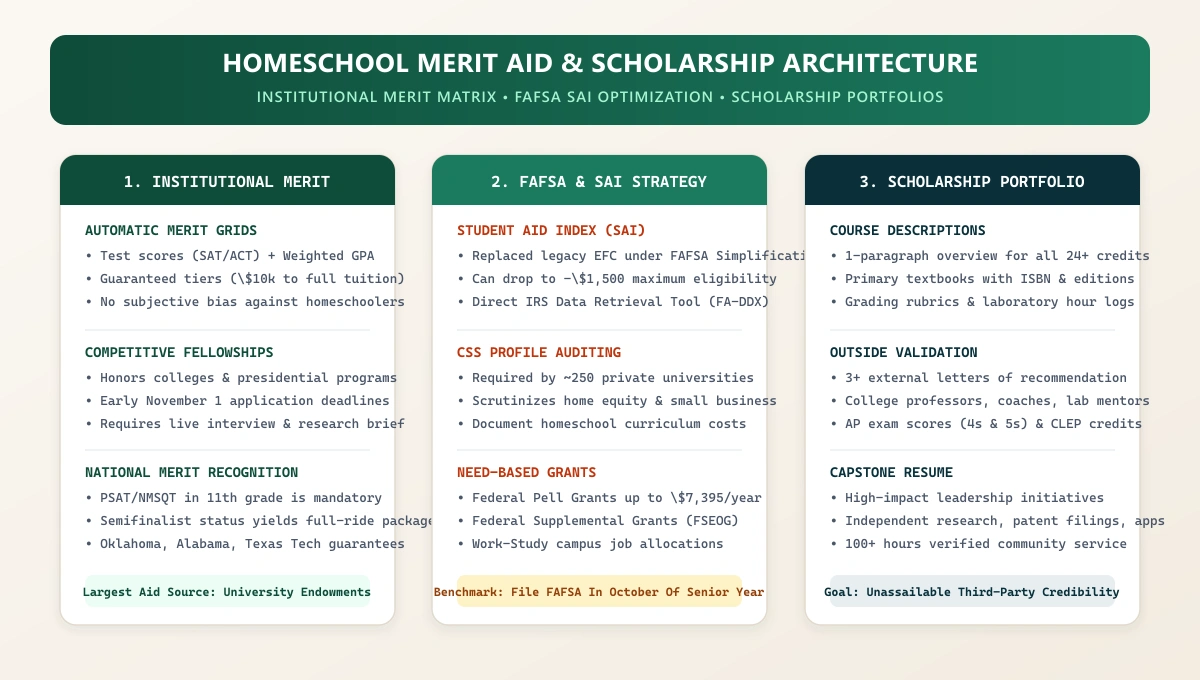
1. The Institutional Merit Advantage: Where the Real Money Lives
When families begin researching college funding, they often waste hundreds of hours applying for small $500 and $1,000 local civic scholarships found on search engines. While every dollar helps, the data published by the College Board is unequivocal: more than 80% of all non-federal grant and scholarship money awarded in the United States comes directly from colleges’ own institutional endowments.
Institutional merit scholarships fall into two distinct operational categories:
A. Automatic Merit Grids (The Objective Pathway)
Dozens of major public research institutions and private universities operate transparent, formulaic merit scholarship grids. If an applicant meets specific combinations of standardized test scores (SAT or ACT) and cumulative high school GPAs, the scholarship is automatically guaranteed upon admission—with zero subjective essay evaluation:
Representative Automatic Merit Grid Structure
Prominent Universities with Generous Automatic Merit Grids:
- University of Alabama: Legendary among homeschoolers for awarding full-tuition out-of-state scholarships for students achieving 32+ ACT or 1420+ SAT with a 3.5+ GPA.
- Texas Tech University: Offers automatic presidential scholarships that waive out-of-state tuition fees entirely once competitive score thresholds are achieved.
- University of Arizona & Arizona State University: Utilize transparent scholarship estimators that calculate guaranteed annual merit aid based on weighted high school core GPA.
B. Competitive Honors & Presidential Fellowships
Beyond automatic tiers, universities maintain highly competitive “Full-Ride” or “Full-Tuition” fellowship cohorts (e.g., the Morehead-Cain at UNC Chapel Hill, the Ingram Scholarship at Vanderbilt, or the McDermott at UT Dallas).
These programs require:
- Early application submission (typically strictly by November 1 of senior year).
- Specialized supplemental essays detailing intellectual leadership.
- Finalist interviews where students defend their capstone research or service initiatives before a faculty panel.
2. Navigating the FAFSA Simplification Act: The Student Aid Index (SAI)
Every college applicant—regardless of family wealth or intention to seek need-based aid—should submit the Free Application for Federal Student Aid (FAFSA). Many universities mandate a FAFSA on file to unlock non-need-based institutional merit scholarships and honors college admissions.
Under the landmark FAFSA Simplification Act, the federal financial aid architecture underwent the largest modernization in four decades:
Farewell EFC, Welcome SAI
The confusing “Expected Family Contribution” (EFC) was eliminated and replaced by the Student Aid Index (SAI). Unlike the legacy EFC, the new SAI:
- Can range from -$1,500 to 999,999. A negative SAI indicates catastrophic financial need, triggering maximum Pell Grant funding (up to $7,395 annually).
- Uses the FA-DDX (Future Act Direct Data Exchange), pulling verified federal tax information directly from the IRS, eliminating manual tax data entry errors.
- The Sibling Loophole Elimination: Under the new formula, having multiple children enrolled in college simultaneously no longer divides the parent contribution in half. Families with close-in-age homeschool siblings must plan ahead for this structural shift.
CSS Profile Considerations for Private Colleges
Approximately 250 top-tier private universities (including the Ivy League, Stanford, Northwestern, and Notre Dame) also require the CSS Profile administered by the College Board.
The CSS Profile probes far deeper into family finances than the FAFSA:
- It evaluates home equity in your primary residence.
- It examines small business and family farm assets.
- It scrutinizes non-custodial parent assets in cases of divorce or separation.
- Homeschool Tip: The CSS Profile allows a “Special Circumstances” narrative. If your family made substantial financial sacrifices or incurred significant out-of-pocket educational expenses (e.g., private specialized tutoring, laboratory equipment, or travel-learning) to support your child’s homeschooling, document these expenditures clearly.
3. The Cornerstone Asset: The Course Description Dossier
When an admissions officer reviews a public high school transcript, they rely on the school’s known curriculum profile. When they review a homeschool transcript, they need to know: What did “Honors Chemistry with Lab” actually consist of? What textbooks were studied? Who evaluated the lab work?
To substantiate your grades, every homeschooling family must compile a Course Description Dossier alongside the one-page transcript. This document should span 10 to 18 pages and provide a standardized entry for all 24 to 28 high school credits:
Anatomy of a Flawless Course Description Entry
Course Title: AP European History (Audit Approved)
Credit: 1.0 High School Unit | Grade Earned: A (95%) | Weight: 5.0 Quality Scale
Course Overview: A comprehensive survey of European history from the Renaissance (c. 1450) to the post-Cold War era. Course investigated political diplomacy, intellectual thought, and religious upheaval through primary source seminar discussions.
Primary Texts & Materials: McKay, J. P., et al. (2020). A History of Western Society (13th ed.). Bedford/St. Martin's. Primary sources including Machiavelli's The Prince, Luther's 95 Theses, and Rousseau's Social Contract.
Assessment & Evaluation: Student completed 12 document-based question (DBQ) essays, 4 historical research papers, and mid-term/final examinations. External Validation: College Board AP Exam Score: 5.
Providing this level of transparency elevates your child’s application into the top 1% of homeschool submissions, instantly building trust with merit aid committees.
4. Cultivating Outside Academic Validation
Scholarship officers evaluating homeschool applications look for outside anchors that corroborate parent-assigned A’s. An applicant with a straight-A parent transcript and an 1100 SAT will face skepticism. An applicant with straight A’s supported by external third-party benchmarks is an unstoppable candidate:
The Triangle of Validation
- Dual Enrollment Transcripts: Earning an ‘A’ in community college Calculus I or English Composition proves that the student excels under external professors, strict syllabus deadlines, and university testing standards.
- Standardized Exam Anchors: High scores on the SAT, ACT, or College Board AP Exams (scoring 4s and 5s) serve as objective equalizers across national applicant pools.
- Third-Party Letters of Recommendation: Secure 2 to 3 enthusiastic letters from instructors who are not family members:
- A community college dual enrollment professor.
- A laboratory research supervisor or robotics coach.
- An employer, internship director, or classical tutor.
5. The National Merit Scholarship Pipeline
The single most lucrative standardized testing pipeline for homeschoolers is the National Merit Scholarship Competition:
- In October of 11th grade, homeschooled students must take the PSAT/NMSQT at a local public or private school. (Parents must contact local school testing coordinators in August to register their student).
- Students scoring in the top 1% in their state earn National Merit Semifinalist status.
- Once designated a Finalist, dozens of major universities compete aggressively for the student, offering automatic packages that include 100% full tuition, free campus housing, study-abroad stipends, and research computer allowances valued at over $150,000 to $220,000 over four years.
High School Financial Aid Roadmap: 9th Through 12th Grade
- 9th & 10th Grade: Focus on academic rigor. Build the foundational coursework. Maintain meticulous course descriptions, syllabi, and textbook ISBN records.
- Spring of 10th Grade: Take a practice PSAT 10 to establish baseline testing metrics and identify target areas for improvement.
- October of 11th Grade: Take the official PSAT/NMSQT for National Merit competition entry.
- Spring of 11th Grade: Sit for the official SAT or ACT. Identify universities with generous Automatic Merit Grids aligning with the student’s test score range.
- Summer Before 12th Grade: Finalize the official high school transcript and Course Description Dossier. Draft the Common App personal statement and request external recommendation letters.
- October of 12th Grade: Submit the FAFSA and CSS Profile immediately upon release. Submit honors college and competitive merit scholarship applications prior to November 1 early action deadlines.
Pedagogical References and Regulatory Citations
- National Association of Student Financial Aid Administrators (NASFAA). FAFSA Simplification Implementation and Student Aid Index (SAI) Modeling. Washington, DC.
- College Board Research. Trends in Student Aid: Analysis of Institutional Grants and Merit Endowments. New York, NY.
- U.S. Department of Education. Federal Student Aid Handbook: Need-Based and Non-Need-Based Packaging.
- National Merit Scholarship Corporation (NMSC). PSAT/NMSQT Student Guide and Institutional Sponsorship Benchmarks. Evanston, IL.
- Education Commission of the States (ECS). State-Sponsored Merit Scholarship Programs and Post-Secondary Incentive Policies.
Disclaimer: This post is for informational and educational purposes only, accurate to the best of our knowledge at publication. It does not constitute advice. We do not guarantee accuracy or completeness and accept no liability for any decisions or losses resulting from reliance on this content.