
The relationship between the homeschooling family and state compulsory attendance authorities is fundamentally governed by administrative and constitutional law. Across all fifty states, home education has achieved robust statutory recognition; yet homeschooling parents frequently operate in a state of chronic legal anxiety, vacillating between two dangerous extremes: careless under-documentation or anxious over-compliance.
Careless under-documentation leaves families defenseless if an overzealous school district clerk flags an unexcused absence as truancy, or if an estranged relative files an unsubstantiated report with child welfare agencies. Conversely, anxious over-compliance—such as voluntarily submitting detailed lesson plans, grades, or personal student work samples when state law only requires a bare Notice of Intent—unwittingly surrenders constitutional privacy protections and invites bureaucratic overreach.
In administrative law, you never give an enforcement agency more information than the statute strictly mandates.
By establishing a rigorous Tri-Tier Recordkeeping Architecture, mastering the Fourth Amendment Front Porch Protocol, and maintaining a fireproof evidentiary Red Binder, home educators can bulletproof their domestic sanctuary against unwarranted audits, truancy investigations, and administrative subpoenas with calm, unshakeable confidence.
The Legal Premise: Strict Statutory Adherence vs. Voluntary Surrender
School districts operate as administrative bureaucracies governed strictly by state legislative statutes and administrative codes. When a superintendent or truancy officer demands information beyond what is specified in your state’s homeschooling statute, their request is legally classified as ultra vires—beyond their lawful authority.
The Danger of the Voluntary Precedent
When a well-meaning parent submits 200 pages of curriculum samples to an official who only asked for a list of textbook titles under statutory law, that parent unintentionally establishes an informal expectation that harms other homeschooling families in the district. Bureaucracies expand to fill whatever vacuum of compliance you provide. The hallmark of sophisticated legal defense is scrupulous, exact compliance with the letter of the law—and not a single syllable more.
Visual Architecture: The Legal Audit & Defense Model
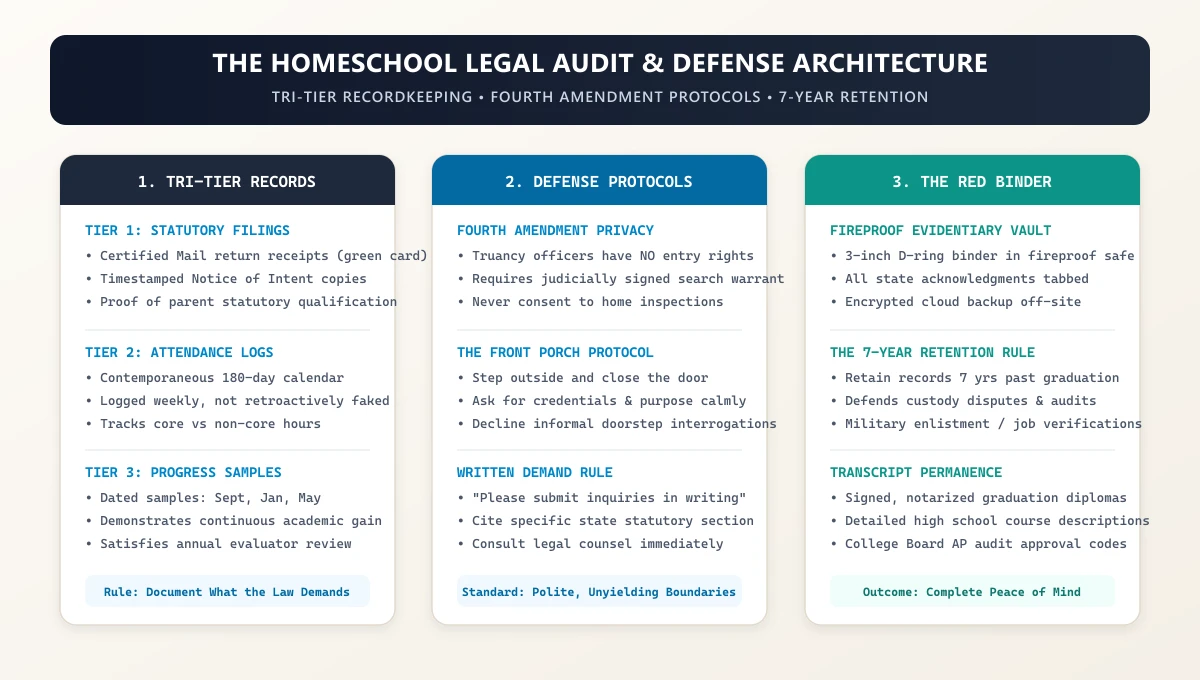
Pillar 1: The Tri-Tier Recordkeeping Architecture
To guarantee total legal compliance without cluttering your home with unnecessary paperwork, divide your homeschool records into three distinct evidentiary tiers:
Tier 1: Statutory Filings & Proof of Receipt (Inviolable Legal Shield)
The moment you notify state authorities of your homeschool status, your single most critical evidentiary asset is proof of delivery:
- Certified Mail Return Receipt (Green Card): If you file a physical Notice of Intent (NOI) or annual affidavit, send it via USPS Certified Mail with Return Receipt Requested. When the signed green card arrives back in your mailbox, staple it directly to your exact copy of the submitted notice.
- Digital Timestamped Receipts: If your state mandates filing through an online Department of Education portal (such as Delaware, Arkansas, or Virginia), take a full-screen screenshot of the confirmation page showing the date, timestamp, and confirmation number, and print two hard copies immediately.
- Parent Qualifications: Keep certified copies of your high school diploma, college transcripts, or certified tutor credentials alongside the filing if your state imposes parent education thresholds (such as North Carolina, Georgia, or Washington).
Tier 2: The Contemporaneous Attendance & Hour Log
In states that mandate tracking instructional time (such as Missouri’s 1,000-hour requirement, Wisconsin’s 875-hour benchmark, or Pennsylvania’s 180-day log), the word contemporaneous is the legal linchpin.
A court or administrative hearing officer will assign high evidentiary weight to a log that was updated weekly throughout the school year. Conversely, if an auditor discovers that 180 days of identical attendance checkboxes were filled out retroactively in the same blue pen on a single afternoon, the entire record can be disqualified as fraudulent.
- The Calendar Method: Keep a clean wall calendar or bound planner where you mark an “X” or record instructional hours at the end of each school day.
- Experiential Accounting: Remember that statutory law recognizes educational field trips, physical athletics, music rehearsal, library research, and hands-on science as legitimate instructional time.
Tier 3: The Cumulative Assessment Portfolio
In states requiring annual evaluations (such as Florida, Ohio, Maine, or Maryland):
- Select three dated work samples per core subject: one from September (demonstrating early-year skill level), one from January (demonstrating mid-year growth), and one from May (demonstrating mastery).
- Include the signed annual evaluation letter from your state-certified teacher or the official standardized test percentile score sheet (e.g., Iowa Assessments, Stanford 10, or MAP Growth).
Pillar 2: Constitutional Defense & The “Front Porch Protocol”
The most stressful legal event a homeschooling parent can encounter is an unannounced knock on the door by a school district attendance officer, social worker, or local police officer claiming they are investigating an “unregistered truant child.”
In that moment, your constitutional rights must be executed with politeness and immovable resolve.
The Fourth Amendment Domestic Privacy Boundary
Under the Fourth Amendment of the United States Constitution, your home is a legally protected private sanctuary. No public official—including truancy officers, superintendents, or social workers—possesses the legal right to step across your threshold, inspect your home, or interview your children without a search warrant signed by a judicial judge or clear, imminent life-or-death exigent circumstances.
The Front Porch Protocol: Step-by-Step
If an official arrives at your home unannounced, follow this precise legal sequence:
- Step Outside and Pull the Door Shut Behind You: Never conduct a conversation while standing inside your doorway. Stepping onto the porch and closing the front door prevents an officer from claiming they observed something in “plain view” that justified warrantless entry.
- Ask for Official Identification: Politely ask: “May I please see your official identification and business card? Which agency do you represent?”
- Inquire as to the Purpose of the Visit: Ask: “What is the specific nature of your inquiry today?”
- Decline Verbal Interrogations Calmly: When asked questions about your children, their curriculum, or their attendance, respond with the Golden Script:
“Our family conducts a legally compliant private home education program in full accordance with [State Statutory Code]. Because administrative matters require precise documentation, we do not conduct informal doorstep interviews. Please submit all questions and legal inquiries in writing to our address, citing the specific statutory authority under which you are requesting information. We will consult our legal counsel and respond promptly. Thank you, and have a good day.”
- Step Back Inside and Close the Door: Immediately write down a verbatim transcript of the entire interaction, including the officer’s name, badge number, car license plate, date, and exact timestamp. Contact your homeschool legal defense attorney immediately.
Pillar 3: The 7-Year Evidentiary “Red Binder” Vault
Do not scatter your homeschool paperwork across kitchen drawers, email folders, and desktop drives. Every homeschooling family should maintain a centralized, physical Red Binder stored in a fireproof safe.
Contents of the Master Red Binder:
- Tab 1: Current Academic Year Filings: Copy of Notice of Intent, green card postal receipts, school district acknowledgment letters.
- Tab 2: Attendance Registers: 180-day signed attendance logs, documentation of core subject hours.
- Tab 3: Standardized Test Scores & Evaluator Letters: Official percentile sheets, signed letters of progress from certified evaluators.
- Tab 4: Cumulative High School Transcripts: Signed and notarized academic transcripts, course descriptions, textbook ISBN lists, and grading scales.
- Tab 5: Statutory Exemptions & Medical Records: Immunization records or signed religious/medical exemption affidavits.
The 7-Year Rule
Retain all Red Binder documentation for at least seven years past your child’s legal high school graduation date.
Why? In administrative disputes, child custody litigation between divorced parents, civil service job background checks, military security clearances, and university admissions audits, adult children are frequently asked to provide proof of their high school completion years after the fact. Having an intact, beautifully organized Red Binder ready for legal presentation eliminates risk entirely.
Subpoenas and Administrative Audits: How to Respond Legally
If your family receives a formal administrative subpoena or a registered letter demanding an audit of your homeschool records:
- Do Not Panic, and Do Not Ignore It: Administrative deadlines are strictly enforced. Ignoring a formal inquiry can lead to a default civil finding of truancy.
- Contact Specialized Legal Defense Immediately: Reach out to a specialized homeschool legal defense organization (such as HSLDA or your state homeschool advocacy association). Do not attempt to represent yourself or negotiate informally with a district attorney.
- The Power of the Red Binder: When your attorney produces a clean, timestamped Red Binder featuring certified mail receipts, contemporaneous attendance logs, and certified teacher evaluations, 99% of district investigations are dismissed before ever reaching a courtroom.
Knowledge of the law is not combative; it is your family’s shield. When you maintain impeccable records and respect constitutional boundaries, you secure the legal freedom to educate your children in peace, dignity, and intellectual excellence.
Disclaimer
Disclaimer: This post is for informational and educational purposes only, accurate to the best of our knowledge at publication. It does not constitute advice. We do not guarantee accuracy or completeness and accept no liability for any decisions or losses resulting from reliance on this content.