The most intimidating threshold for homeschooling parents entering middle and high school education is the Wet Science Laboratory. Parents who comfortably teach algebra, world history, and literature often freeze when confronted with high school biology, chemistry, and physics. Memories of institutional laboratories with gas jets, hazardous reagent cabinets, and commercial fume hoods convince parents that genuine laboratory science is impossible in a domestic setting.
As a result, many homeschooling families retreat into passive video demonstrations or purely digital simulations. While virtual simulations have utility, they strip away the essential pedagogical core of science: the messy, tactile reality of calibrating a balance, misjudging a meniscus on a graduated cylinder, observing unexpected thermal changes, and learning to troubleshoot experimental error.
The truth is that an extraordinary, college-accredited science laboratory can be safely operated at your kitchen table.
With an investment of less than $250 in professional-grade borosilicate glassware and measurement tools, strict adherence to ANSI safety standards, and rigorous scientific notebooking, your student can conduct wet labs that not only fulfill state graduation requirements but rival the laboratory preparation of elite private academies.
The Paradigm Shift: Experiments vs. “Demonstrations”
Most elementary science kits marketed to families are not experiments; they are entertaining chemical demonstrations. Making a papier-mâché volcano erupt with vinegar and baking soda teaches children that chemical reactions look exciting, but it teaches virtually zero scientific methodology.
The Definition of Genuine Inquiry
An experiment requires a testable hypothesis, an isolated independent variable, a controlled environment, and quantifiable numerical data. If a student is merely following a cookbook recipe to achieve a predetermined visual effect, they are performing a demonstration. If they are altering the concentration of acetic acid to measure the exact milligram yield of carbon dioxide gas over time, they are conducting science.
Visual Architecture: The Kitchen Table Laboratory Model
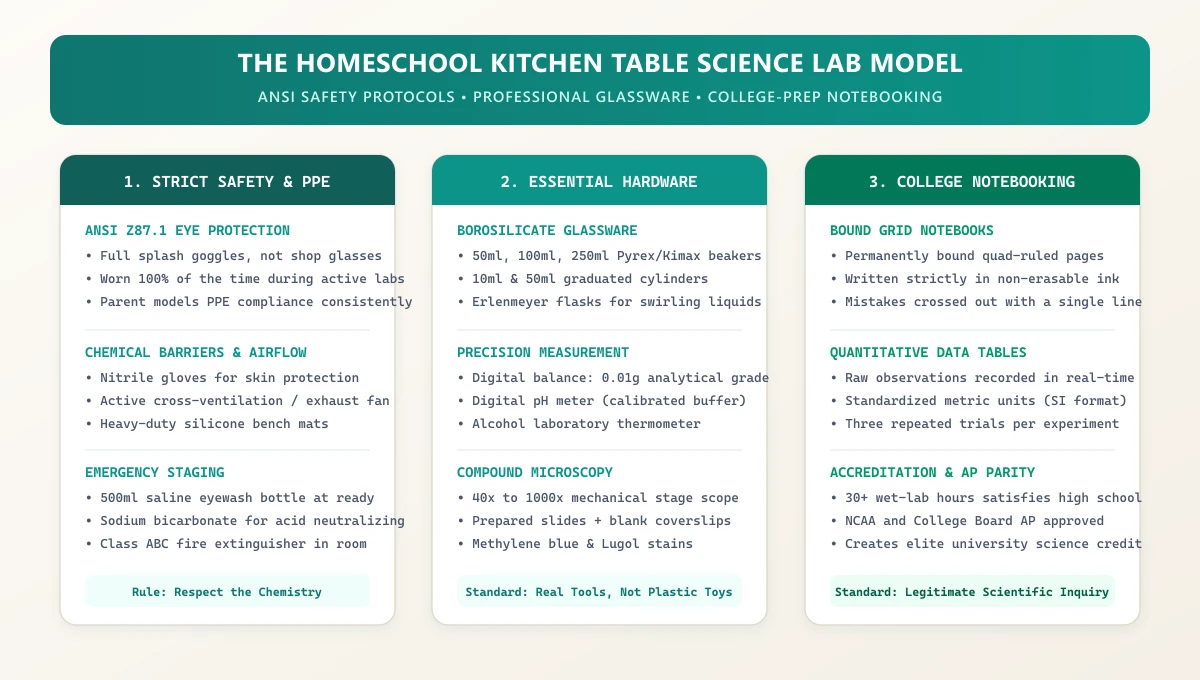
Pillar 1: Strict Laboratory Safety and PPE Protocols
Operating a home laboratory requires adopting professional laboratory culture from Day One. Safety is not a matter of fear; it is a discipline of systematic habit.
1. Eye Protection: The ANSI Z87.1 Standard
Never permit a student to use ordinary shop glasses or toy plastic goggles. You must purchase ANSI Z87.1-certified chemical splash goggles.
- Splash goggles feature indirect ventilation ports that prevent chemical vapors and liquid splashes from reaching the eyes while preventing lens fogging.
- The Inviolable Law: The goggles are put on before any reagent container is opened and are not removed until all glassware has been washed and returned to storage. If a student removes their goggles during a lab, all experimentation immediately pauses.
2. Physical and Chemical Barriers
- Nitrile Gloves: Use powder-free, chemical-resistant nitrile gloves rather than latex, which can trigger allergies or tear easily.
- Silicone Bench Mat: Cover your wooden or laminate dining table with a heavy-duty, heat-resistant silicone baking mat (typically 24x36 inches). This creates an impermeable barrier against accidental acid drips, heat damage, or staining dyes.
- Active Ventilation: Conduct all chemistry labs near an open window with an exhaust fan running, or on an electric induction hot plate directly beneath your kitchen stove’s ducted range hood.
3. Emergency Staging
Before striking a match or pouring a solution, stage your emergency containment tools:
- Eyewash Station: A sealed 500ml sterile buffered saline eyewash squeeze bottle positioned within arms’ reach.
- Neutralizing Agent: An open container of sodium bicarbonate (baking soda) to immediately neutralize acidic spills.
- Fire Suppression: A certified Class ABC dry chemical fire extinguisher mounted nearby, along with a 100% wool fire blanket.
Pillar 2: The Core Laboratory Hardware Toolkit
Discard flimsy plastic toy kits. High school laboratory competence requires handling authentic, calibrated equipment. The complete setup costs less than a single semester of commercial curriculum:
| Essential Hardware Item | Specification / Model | Pedagogical Function | Approximate Cost |
|---|---|---|---|
| Borosilicate Glassware Set | 3.3 Borosilicate beakers (50, 100, 250, 600ml) & Erlenmeyer flasks | Thermal shock-resistant heating and mixing | $35 |
| Graduated Cylinders | 10ml & 50ml Class B borosilicate glass | Precise volumetric measurement via liquid meniscus | $18 |
| Analytical Digital Balance | 0.01g precision, 500g capacity with tare | Accurate stoichiometric mass determinations | $25 |
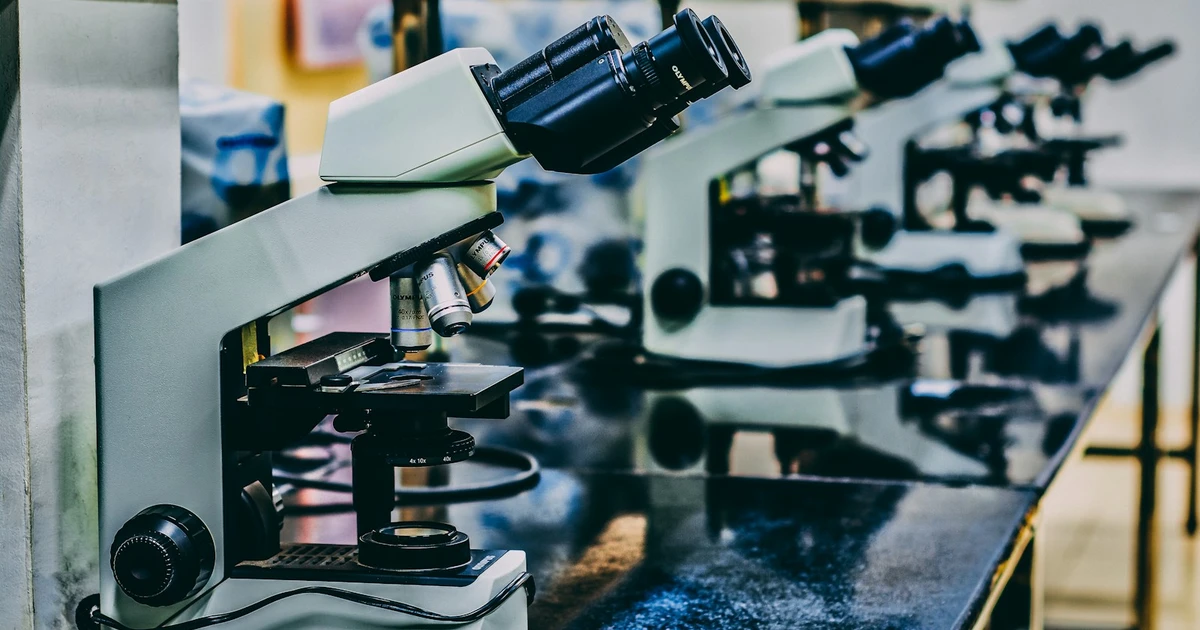
| Compound Microscope | All-metal frame, 40x–1000x, Abbe condenser, mechanical stage | Cellular histology, bacteriology, and microbiology | $120–$150 |
| Alcohol Lab Thermometer | -10°C to 110°C, partial immersion (non-mercury) | Thermal calorimetry and phase-change tracking | $12 |
| Digital pH Pen | Two-point buffer calibration (pH 4.01 / 6.86) | Acid-base titrations and environmental water testing | $15 |
Safe Reagent Chemistry: Household Chemical Equivalents
You do not need restricted industrial chemicals to teach rigorous high school chemistry. Advanced concepts such as stoichiometry, chemical equilibrium, acid-base titration, and thermodynamics can be demonstrated using safe, readily accessible reagents:
Safe Reagents for College-Prep Chemistry
- Acetic Acid (Concentrated Distilled Vinegar): Used for weak acid titrations and endothermic carbonate decomposition.
- Sodium Carbonate (Washing Soda): Strong alkaline base for precipitation reactions and double-replacement demonstrations.
- Copper Sulfate Pentahydrate: Safe, beautiful blue crystal salt for stoichiometry hydration labs and single-replacement galvanic reactions with iron nails.
- Lugol's Iodine Solution: Essential indicator for biochemical starch digestion and cellular staining in biology.
- 3% Food-Grade Hydrogen Peroxide: Decomposition kinetics and enzymatic catalysis studies using beef liver catalase or yeast.
Pillar 3: College-Prep Scientific Laboratory Notebooking
A student does not receive high school laboratory science credit simply for mixing chemicals; credit is earned through the permanent written record of their inquiry.
When admissions officers at elite universities, NCAA clearinghouse reviewers, or College Board AP auditors evaluate a homeschooler’s science transcripts, the primary document they request is the Laboratory Notebook.
The Anatomy of a Bulletproof Lab Entry
Provide your student with a hardbound, permanently bound quad-ruled grid notebook (such as a standard composition book). Loose-leaf binders or digital Word documents are universally rejected by academic accreditors because pages can be retroactively swapped or edited.
Every experiment must follow this strict 6-part academic format:
- Title & Date: Descriptive and specific (e.g., “Determination of the Empirical Formula of Hydrated Copper(II) Sulfate”).
- Abstract / Purpose: A 2-sentence statement defining the research question and the theoretical principle being tested.
- Hypothesis: Formatted as a predictive conditional statement (“If the molar mass of water is driven off via sustained thermal dehydration, then the mass ratio of anhydrous salt to lost water will demonstrate a 1:5 stoichiometric coefficient.”).
- Materials & Labeled Apparatus Diagram: A hand-sketched, labeled diagram showing the physical configuration of the beakers, heat source, and thermometer.
- Raw Quantitative Data Table: All measurements must be recorded directly into the notebook in permanent black ink as they happen—never written on scrap paper and copied later. Standard SI metric units must be attached to every single number. If an error occurs, it is crossed out with a single clean line; white-out is strictly prohibited.
- Error Analysis & Discussion: Where did real-world measurement diverge from theoretical yield? Did the balance drift? Did ambient humidity affect the anhydrous crystal? A student who can write a thoughtful error analysis demonstrates higher scientific maturity than one whose numbers miraculously matched the textbook.
Satisfying High School Credits and College Board AP Requirements
To grant a full high school Carnegie Unit for a “Lab Science” (e.g., Biology with Lab or Chemistry with Lab), most state departments of education and university admissions policies expect:
- Total Instructional Time: 120 to 150 hours per academic year.
- Wet Laboratory Requirement: A minimum of 30 hands-on laboratory hours (equivalent to 15 to 20 comprehensive two-hour laboratory sessions).
- AP Science Audits: If you choose to submit an AP Course Audit syllabus to the College Board, you can cite authorized lab manuals (such as Illustrated Guide to Home Chemistry Experiments by Robert Bruce Thompson or Carolina Biological AP kits). The College Board explicitly approves homeschool home labs provided the student executes guided inquiry labs and documents them in bound notebooks.
Nurturing Lifelong Scientific Literacy
When children witness science happening on their own kitchen counter, the discipline ceases to be an abstract set of dry formulas memorized for a standardized test. It becomes an active way of seeing the physical universe.
They learn that nature does not lie; that theories must bend to empirical evidence; that failure in an experiment is simply data pointing toward a deeper truth. By opening your kitchen to genuine scientific exploration, you cultivate in your children the skepticism, precision, and intellectual humility that define true scientific thinkers.
Disclaimer
Disclaimer: This post is for informational and educational purposes only, accurate to the best of our knowledge at publication. It does not constitute advice. We do not guarantee accuracy or completeness and accept no liability for any decisions or losses resulting from reliance on this content.