
When parents of autistic children make the courageous decision to homeschool, they are almost never leaving a school system that simply had an uninspiring math curriculum.
They are fleeing an environment of profound trauma.
They are bringing home an eight-year-old who holds in their distress all day through exhaustive social masking, only to collapse into screaming meltdowns the second they step inside the front door. They are rescuing an intellectually gifted twelve-year-old with a Pervasive Drive for Autonomy (PDA) profile who has been labeled “oppositional,” subjected to behavioral isolation rooms, or driven into debilitating clinical school refusal and autistic burnout.
In traditional schooling, autism is treated through a medical deficit lens: behaviorists attempt to extinguish stimming, force artificial eye contact, break hyper-fixations, and enforce arbitrary polytropic transitions every 45 minutes with ringing bells.
In the homeschool sanctuary, we reject the deficit model. Grounded in the clinical science of Monotropism, Declarative Language, and Low-Demand Parenting, home education allows autistic children to unmask, regulate their nervous systems, and leverage their extraordinary hyper-focused intellect to achieve profound academic mastery[1].
The Autism-Affirming Homeschool Pedagogical Model
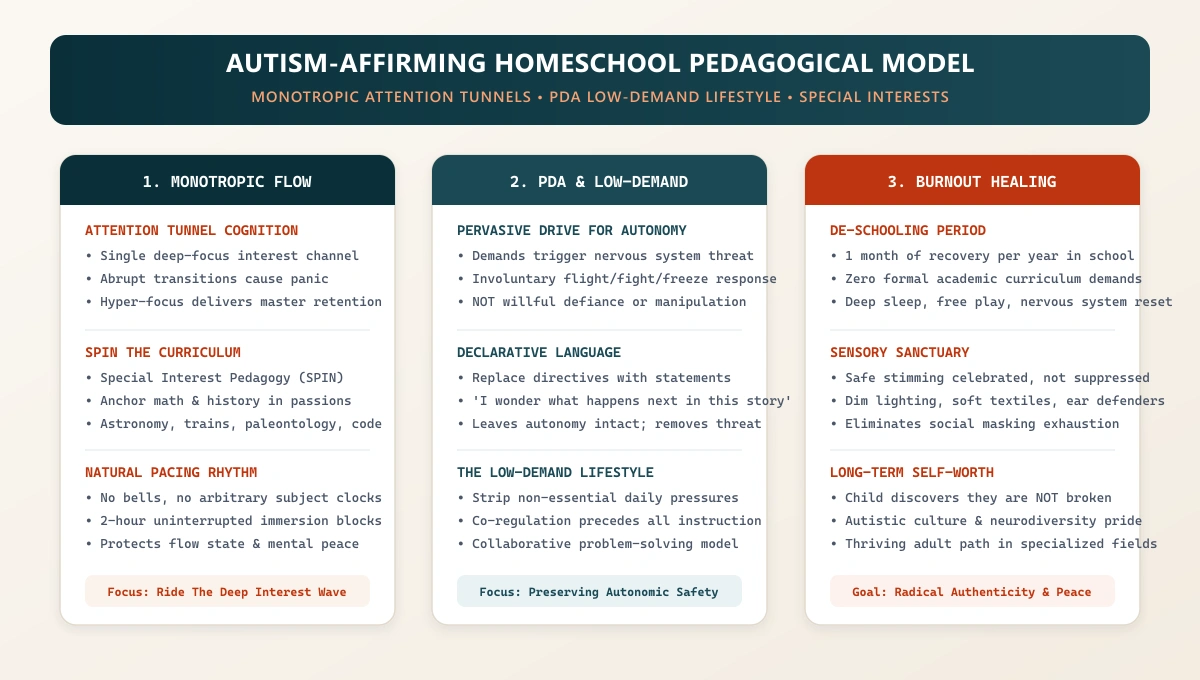
1. Monotropism: How the Autistic Brain Learns
The single most transformative theory in modern autism research is Monotropism, formulated by autistic researchers Dr. Dinah Murray, Mike Lesser, and Dr. Wenn Lawson in 2005[1].
- Polytropic Minds (Neurotypical): Attention is naturally divided across multiple competing streams. A neurotypical child can listen to a teacher, ignore a flickering fluorescent light, notice a classmate tapping a pencil, and transition quickly when a bell rings.
- Monotropic Minds (Autistic): Attention is allocated deeply into a single “Attention Tunnel.” When an autistic child enters this tunnel—whether building a complex Minecraft redstone computer, analyzing railway timetables, or categorizing insect taxonomy—their cognitive processing is immense, profound, and hyper-efficient.
The Educational Consequence:
Forcing a monotropic child to abruptly yank their attention out of an active tunnel to do an unrelated spelling sheet is neurologically jarring. It feels like slamming the brakes on a high-speed train, triggering severe fight-or-flight agitation.
In home education, we do not fight the attention tunnel; we ride it.
Instead of scheduling six fragmented 30-minute subjects per morning, an autism-affirming homeschool provides long, uninterrupted immersion blocks (90 to 120 minutes). When your child is immersed in their passion, learning accelerates at quadruple the speed of conventional instruction.
2. Navigating the PDA Profile: The Pervasive Drive for Autonomy
For families raising a child with Pathological / Pervasive Demand Avoidance (PDA), standard parenting and homeschool advice fails catastrophically[2].
Traditional homeschool gurus advocate reward charts, token economies, firm boundaries, and “first work, then play.” For a PDA child, these behavioral incentives trigger instant, violent autonomic threat responses:
- Direct demands (“Sit down,” “Open your book,” “Write your name”) are perceived by the PDA brain as an existential loss of autonomy and physical safety.
- The child’s nervous system perceives the demand as a predator attack, triggering panic: explosive aggression, sudden physical paralysis (fawning), running away (flight), or intense meltdowns.
- The child is not being “manipulative” or “stubborn”; they are in survival mode.
The PDA Low-Demand Homeschool Protocol:
- Drop All Non-Essential Demands: During periods of burnout, eliminate all formal academic expectations. Allow your child’s nervous system to experience prolonged, authentic safety.
- Declarative Language Over Imperatives: Replace direct orders with collaborative, non-threatening observations[3]:
- Imperative (Demand): “Come here and read page 14.” ➔ Triggers PDA defense.
- Declarative (Observation): “I left the book about volcanoes on the table. The diagram of magma chambers on page 14 is wild.” ➔ Invites curiosity while leaving autonomy 100% in the child’s hands.
- Side-by-Side Co-Regulation: PDA children resist hierarchical teacher-student dynamics. Sit on the floor as equal partners. Work on your own project, invite low-stakes collaboration, and celebrate every micro-step of self-directed engagement.
3. Special Interest Pedagogy (SPIN): Turning Fixations into Curricula
Conventional educators often view an autistic child’s deep special interests (SPINs) as distractions to be restricted or used as conditional bargaining chips (“You can read about trains for 10 minutes only after you finish your math”).
In an autism-affirming homeschool, the Special Interest IS the curriculum[4].
Because monotropic brains learn through depth and semantic connection, anchoring academic skills within their passion yields breathtaking results:
Example: A Child Passionate About Roller Coasters
- Physics & Mathematics: Calculate gravitational acceleration, velocity, friction, and kinetic energy formulas using real roller coaster drop angles and loop designs.
- History & Geography: Map the historical evolution of amusement park engineering from 17th-century Russian ice slides to modern Japanese magnetic-levitation coasters.
- Language Arts & Writing: Draft formal letters to roller coaster design firms (like Intamin or Bolliger & Mabillard) requesting technical schematics; write persuasive travel brochures reviewing theme parks.
- CAD & Engineering: Build functioning coaster models using K’Nex, 3D printers, or simulation software like Planet Coaster.
The child is not merely completing homeschool requirements; they are acquiring pre-professional engineering mastery without ever experiencing academic resistance.
4. Healing Autistic Burnout: The De-Schooling Imperative
If you have just pulled your autistic child out of an institutional public or private school, do not purchase a box curriculum and do not open a textbook tomorrow morning.
Your child is almost certainly suffering from Autistic Burnout: a state of profound nervous system exhaustion, loss of executive functioning skills, and intense sensory fatigue caused by months or years of social masking and sensory overstimulation.
The De-Schooling Formula:
- One Month of De-Schooling per Year in School: If your child attended school for three years, plan on a minimum of three months of zero formal curriculum.
- Sensory Detox: Let them sleep 10–12 hours a night. Provide quiet rooms with warm incandescent lighting, noise-canceling headphones, and unhindered access to their safe stimming behaviors (pacing, hand-flapping, vocalizing, rock-collecting).
- Rebuilding Parental Trust: When you remove the pressure of demands, your child learns that you are their safe harbor, not another agent of institutional compliance. Only when their eyes soften, smiles return, and natural curiosity bubbles up are they ready for gentle, interest-led learning.
Autism-Affirming vs. Traditional Homeschooling Matrix
| Dimension | Traditional Homeschool Approach | Autism-Affirming Homeschool Approach |
|---|---|---|
| Instructional Flow | Rigid schedule, subjects broken into 30-min slots | Monotropic deep-dive blocks (90–120 min), single-subject immersion |
| Language Style | Imperative commands: “Finish your copywork now” | Declarative invitations: “I’m curious how this sentence ends” |
| Special Interests | Restricted as a reward after ‘real work’ | The central interdisciplinary vehicle for all academic subjects |
| Physical Stimming | Suppressed as distracting or disruptive | Welcomed and protected as vital nervous system regulation |
| Assessment | Standardized testing, grades, timed quizzes | Authentic project portfolios, building working models, oral narrations |
Frequently Asked Questions About Autism Homeschooling
How will my autistic child develop social skills if they are homeschooled? ↓
What should I do if my child only wants to engage in their special interest all day? ↓
How do I meet state homeschool reporting requirements with an unschooling/PDA approach? ↓
Can an autistic homeschooler earn a valid high school diploma and attend college? ↓
Disclaimer: This post is for informational and educational purposes only, accurate to the best of our knowledge at publication. It does not constitute advice. We do not guarantee accuracy or completeness and accept no liability for any decisions or losses resulting from reliance on this content.