The financial landscape of American home education has undergone a historic paradigm shift. Historically, homeschooling was funded entirely out-of-pocket through domestic frugality, thrift store curriculum sales, and library borrowing. However, the nationwide expansion of universal Education Savings Accounts (ESAs)—now active in over a dozen states including Arizona, Florida, Iowa, Utah, Ohio, and West Virginia—alongside specialized state income tax deductions, has injected billions of dollars into alternative K-12 education.
Participating families can receive between $4,000 and $8,500 per student annually in state-allocated education funds, transforming their ability to afford professional science lab equipment, speech therapy, private tutors, and foreign language immersion.
Yet with public money comes public oversight. State auditors, comptroller offices, and private voucher management platforms (such as ClassWallet, Odyssey, and Step Up for Students) enforce rigorous, unforgiving accounting rules. A parent who mistakenly purchases an unapproved curriculum, misplaces an itemized invoice, or improperly claims homeschool expenses on federal tax returns faces frozen accounts, formal clawback demands, and criminal tax penalties.
Understanding the precise legal boundaries between state tax deductions, ESA voucher compliance, 529 savings plans, and financial audit trails is essential for protecting both your family’s budget and your educational independence.
State Tax Deductions vs. The Federal Tax Myth
The single most widespread financial misconception among new homeschoolers is the belief that curriculum purchases, computer equipment, and home schoolroom supplies are deductible on federal income tax returns (IRS Form 1040).
The Federal Tax Reality: Zero Homeschool Deductions
Under current Internal Revenue Code regulations, homeschooling expenses are 100% non-deductible on federal tax returns. The famous "Educator Expense Deduction" (up to $300 on Form 1040 Schedule 1) is statutorily restricted to licensed classroom teachers who work at least 900 hours in an accredited public or private elementary or secondary school. Claiming this deduction or attempting to write off homeschool supplies on Schedule A or Schedule C without a bona fide business entity triggers automatic IRS audit flags.
However, state tax codes vary dramatically. Several forward-thinking states offer significant state income tax credits and deductions:
Legitimate State Income Tax Deductions:
- Indiana: Grants a $1,000 deduction per homeschooled child under Indiana Code § 6-3-2-22, provided the student is educated in an independent private home school.
- Louisiana: Under La. R.S. 47:297.10, parents are eligible for a 50% state income tax deduction on educational expenses up to $5,000 per child (providing up to a $2,500 tax subtraction) for approved textbooks, curricula, and instructional materials.
- Illinois: The Education Expense Credit allows parents to claim 25% of qualifying educational expenses exceeding $250, up to a maximum credit of $750 per family, for instructional materials and book rental fees.
- Minnesota: Provides the K-12 Education Subtraction (subtraction from taxable income up to $1,625 for elementary and $2,500 for high schoolers) and a refundable K-12 Education Credit for lower-income families covering textbooks, computer hardware, and educational tutoring.
Visual Architecture: The Homeschool Financial & ESA Model
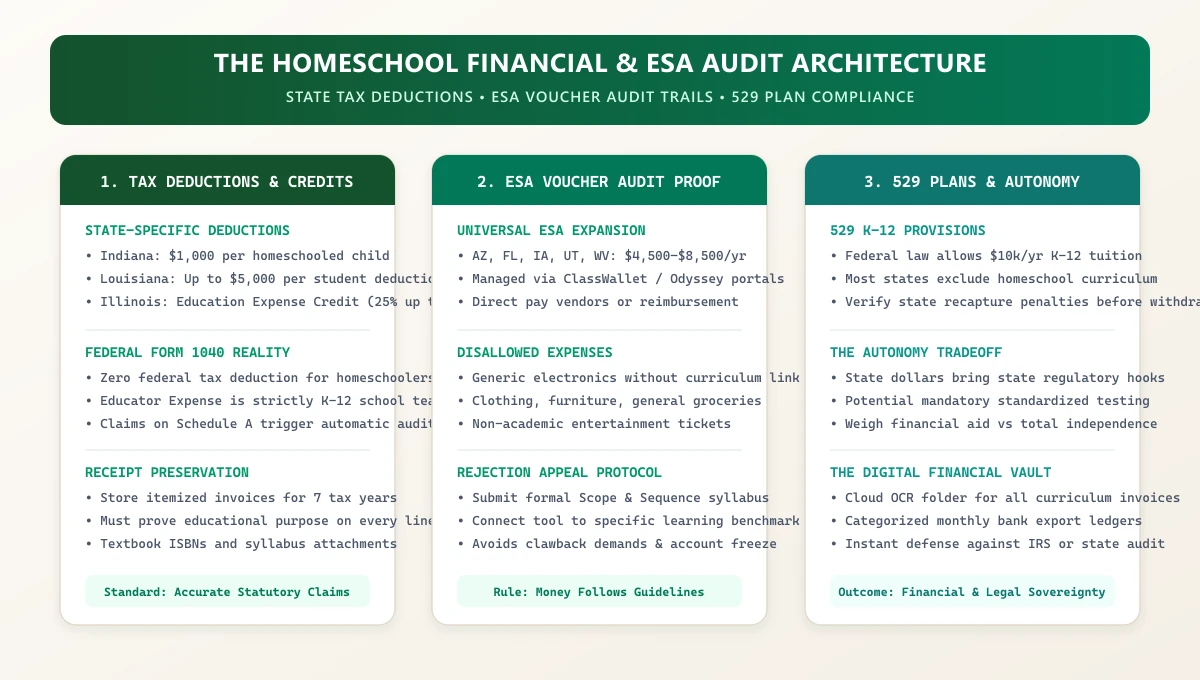
Pillar 1: Navigating Education Savings Accounts (ESAs) & Vouchers
Education Savings Accounts are state-funded accounts established for qualifying students to pay for approved educational expenses. Rather than funding an institutional school district, the state deposits a portion of its per-pupil funding (typically $4,500 to $8,500) into a dedicated digital wallet.
The Two Payment Pathways:
- Direct Marketplace Pay (Preferred): Purchasing textbooks, software licenses, or accredited online classes directly through the state vendor portal (e.g., ClassWallet, Odyssey, Merit). Because the vendor is pre-vetted, audit risk is minimal.
- Parent Reimbursement (High Audit Risk): Paying out-of-pocket and submitting an itemized receipt for state reimbursement. Every reimbursement request is reviewed by state compliance officers.
Approved vs. Disallowed Expenditures: What Triggers an Audit?
State statutes strictly define allowable expenses. Violations occur when parents blur the line between educational necessities and general household items:
| Expense Category | Approved ESA Expenditures | Disallowed / Clawback Triggers |
|---|---|---|
| Curriculum & Books | Boxed academic curricula (Singapore Math, All About Reading), classic living literature, historical biographies | General fiction, coloring books without instructional syllabus, religious sectarian materials (in select states) |
| Hardware & Tech | Single laptop/tablet per student every 2–3 years, basic printer, graphing calculator | Gaming monitors, VR headsets, televisions, multi-thousand-dollar custom PC builds, cell phones |
| Instructional Services | Certified subject tutors, piano instruction, dual-enrollment college tuition, speech/occupational therapy | General daycare, babysitting, unaccredited life coaching, non-academic camp fees |
| Physical & Sensory | Anatomy dissection kits, compound microscopes, sensory balance boards, gymnastics tuition | Trampolines, bicycles, amusement park passes, family zoo memberships, camping gear |
Pillar 2: The Audit Defense Protocol: Surviving ESA Compliance Reviews
If a state compliance officer flags an expense as non-allowable, you will receive a formal Notice of Disallowed Expenditure. If unaddressed within 30 days, your account will be suspended, and the state attorney general’s office may demand immediate monetary clawback.
To successfully defend your purchases, maintain the following evidentiary protocols:
The 3-Part Reimbursement Dossier
- The Itemized Merchant Invoice: Credit card statements or order summary screenshots are rejected. You must provide an official receipt displaying the merchant's name, transaction date, individual item descriptions, ISBNs, and zero sales tax (or itemized tax).
- Curriculum Scope & Sequence: When purchasing specialized items (e.g., digital drawing tablets or specialized science glassware), attach a PDF excerpt of your curriculum's syllabus showing where that specific tool is required for assigned projects.
- The Written Pedagogical Justification: If questioned, submit a formal 1-paragraph explanation: "Item X was purchased strictly as an instructional manipulative for Chapter 4 (Kinetic Energy) of our accredited high school physics course."
Pillar 3: 529 College Savings Plans for Homeschoolers
The 2017 Tax Cuts and Jobs Act expanded Section 529 Qualified Tuition Programs to allow tax-free distributions of up to $10,000 per student per year for K-12 elementary and secondary education.
However, homeschooling families must exercise extreme caution:
- The “Tuition” Trap: The federal statute explicitly uses the term “tuition in connection with enrollment or attendance at an elementary or secondary public, private, or religious school.”
- State Conformity Issues: In many states, independent home schools are not legally classified as “private schools.” If you withdraw 529 funds to purchase homeschool books or computers in a state that does not conform to the federal expansion, the state may treat the withdrawal as a non-qualified distribution, imposing state income taxes plus a 10% federal penalty on earnings.
- Safe 529 Uses for Homeschoolers: Paying tuition for accredited community college dual-enrollment courses, online accredited micro-schools, or approved private umbrella school tuition. Always consult a certified CPA before withdrawing 529 assets for domestic curricula.
The Strategic Decision: Should You Accept State Funds?
The availability of $7,000 in state voucher funding is an immense blessing for single parents, low-income households, and families with neurodivergent children requiring expensive clinical therapies.
However, veteran home educators urge parents to weigh the regulatory strings attached to public money:
- Curriculum Censorship: Some state voucher portals restrict the purchase of faith-based or alternative classical curricula.
- Mandatory Standardized Testing: Several states require ESA recipients to take statewide standardized public school assessments (such as the Florida FAST or Arizona AASA), reintroducing the testing anxiety that families sought to escape.
- Regulatory Mission Creep: Legislative majorities shift. What begins as a flexible voucher program can, through subsequent legislation, become a mechanism for state-mandated curriculum oversight and teacher certification demands.
Families who prioritize total educational autonomy, absolute domestic privacy, and religious freedom often choose to decline state vouchers entirely, relying on low-cost open-source curricula and cooperative purchasing.
Financial Sovereignty: Assembling the 7-Year Digital Tax Vault
Whether you utilize state tax deductions, an ESA voucher, or 100% out-of-pocket funding, financial organization is your greatest asset.
Establish a cloud-based Digital Tax Vault organized by calendar year:
- Receipts Folder: OCR-scanned PDFs of every educational invoice, labeled by date and vendor (e.g., “2026-04-12_SingaporeMath_Workbook.pdf”).
- Ledger Spreadsheet: A simple monthly ledger tracking date, vendor, category (Math, Science, Art, Testing), and amount.
- State Confirmation Records: Copies of filed state tax returns and ESA approval letters.
Retain these digital records for seven years. When you manage your homeschool finances with professional transparency, rigorous documentation, and legal discernment, you protect your family’s financial future while providing your children with an abundant, uncompromised education.
Disclaimer
Disclaimer: This post is for informational and educational purposes only, accurate to the best of our knowledge at publication. It does not constitute advice. We do not guarantee accuracy or completeness and accept no liability for any decisions or losses resulting from reliance on this content.