
If you have ever attempted to teach three different children using three separate grade-level textbooks, you know the quiet desperation of the homeschooling parent: hopping from third-grade science workbooks to fifth-grade American history worksheets, while a first-grader demands help sounding out vowel blends[1]. By eleven o’clock in the morning, the dining room table is littered with twelve disparate workbooks, the parent is emotionally exhausted, and the children have absorbed isolated, fragmented facts they will forget by Friday.
Traditional schooling divides human knowledge into artificial, 45-minute compartments: at 9:00 AM we study biology, at 10:00 AM we read historical fiction, and at 11:00 AM we study world geography, as if these disciplines exist on separate planets.
The Unit Study approach fundamentally restores knowledge to its natural, unified state[1]. Instead of parceling the day into fragmented subject periods, a family anchors their learning around a central theme—such as the Renaissance, the Amazon Rainforest, Flight and Aeronautics, or Ancient Egypt—and explores that topic through the lenses of history, science, living literature, geography, and the arts simultaneously[2].
For families with multiple children, the unit study is the single greatest structural tool for preserving parental sanity, cultivating deep intellectual curiosity, and building lasting sibling camaraderie.
The Thematic Architecture: How Unit Studies Work
Educational philosopher John Dewey famously observed that learning becomes durable only when ideas are connected to real-world context and lived experience[2]. Similarly, Dr. Heidi Hayes Jacobs demonstrated that interdisciplinary curriculum design significantly enhances long-term memory retrieval by creating rich cognitive web networks across neural synapses[1].
When a child studies a topic in isolation, the brain treats it as arbitrary trivia. When that same child studies the transatlantic voyage of the Mayflower by calculating navigational coordinates on a nautical map, examining the biological dynamics of scurvy and vitamin deficiency, reading primary-source journals by William Bradford, and building a scale model of the ship’s rudder, the concept becomes indelible.
What Belongs in a Unit Study (And What Must Stay Separate)
One of the most catastrophic mistakes novice homeschoolers make is attempting to force every single subject into the unit study theme.
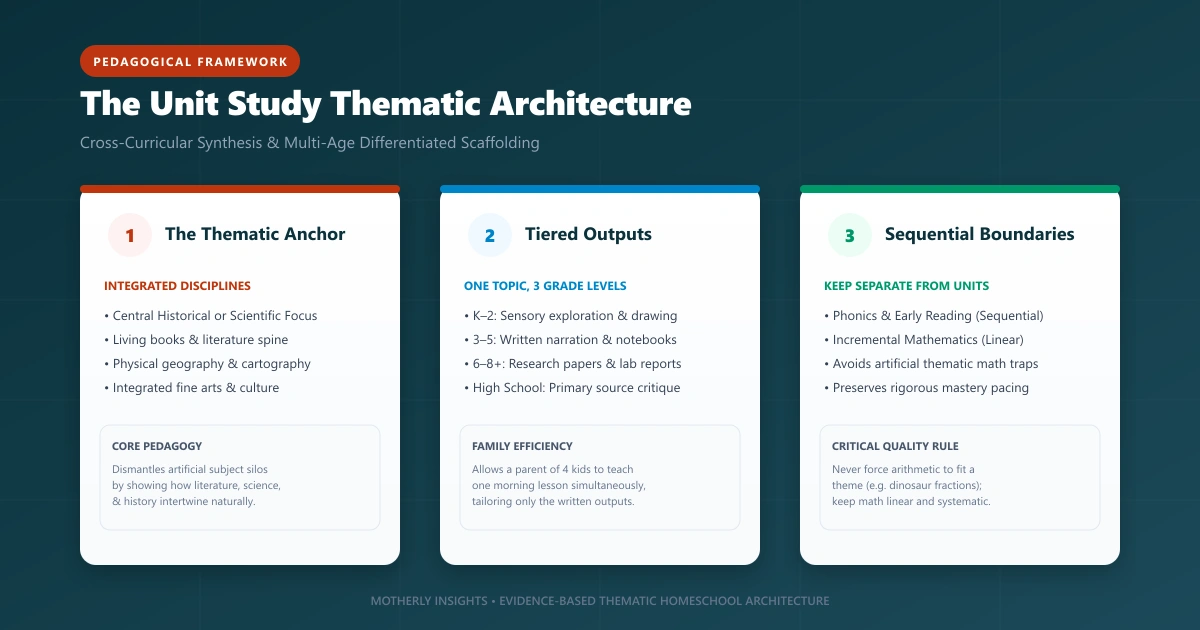
To maintain academic rigor and avoid artificial learning traps, you must divide your homeschool into two clear structural domains:
- The Integrated Core (The Unit Study): History, Biological and Earth Sciences, Literature, Geography, Fine Arts, and Composition. These subjects naturally intertwine and form the heart of your morning family gathering.
- The Modular Tracks (Sequential Non-Negotiables): Mathematics and Phonics/Early Reading. Mathematics is inherently linear and hierarchical; a student cannot leap into quadratic equations simply because they are studying Ancient Greek geometry. Keep your math curriculum (such as Math-U-See or Saxon) and systematic phonics program completely separate from your thematic unit.
Multi-Age Differentiation: Teaching Once, Scaffolding Thrice
The true magic of the unit study is that a parent can teach a 1st-grader, a 4th-grader, and a 7th-grader using one common core lesson, differentiating only the student’s expected output[4].
Consider a 4-week unit study exploring Volcanoes and Plate Tectonics:
Multi-Age Differentiated Output Example: Volcanoes
- All Ages Together (Morning Read-Aloud): The family gathers on the couch to read an illustrated living science book detailing the 1980 eruption of Mount St. Helens and examines samples of pumice and basalt.
- Tier 1: Primary (Grades K–2): The child creates a playdough cross-section model of the Earth's crust, labels the magma chamber with parental support, and orally narrates one fascinating fact to mom.
- Tier 2: Intermediate (Grades 3–5): The child maps the Pacific "Ring of Fire" on a physical geography world chart, completes a written paragraph comparing shield vs. composite volcanoes, and records a basic science lab experiment on viscosity.
- Tier 3: Middle & High School (Grades 6–9): The student analyzes tectonic subduction zones, calculates volcanic explosivity index (VEI) logarithmic scales, and writes a multi-paragraph research essay on the historical atmospheric impact of the 1883 Krakatoa eruption.
By utilizing tiered outputs, the parent prepares one lesson, reads one book aloud, and manages one central discussion. Every child participates at their developmental ceiling without feeling alienated or left behind.
Evaluating Top Packaged Unit Study Curricula
If you prefer not to build your own unit studies from scratch, several battle-tested, high-quality published curricula offer complete open-and-go unit study frameworks:
| Curriculum | Core Teaching Philosophy | Best Suited For | Key Strengths & Considerations |
|---|---|---|---|
| Five in a Row (FIAR) | Literature-based immersion; reading one classic picture book for 5 consecutive days | Kindergarten – 3rd Grade | Gentle, relational, zero-stress. Explores art, geography, and science through beloved living books. |
| Gather ’Round Homeschool | Open-and-go family binders covering all subjects (except math) simultaneously | All Ages (K–12) | Beautiful, full-color workbooks tiered by grade level. Highly organized. Christian worldview. |
| Konos | Hands-on, character-trait-based kinesthetic unit studies | Active & Kinesthetic Learners | High-energy, activity-heavy (costumes, building, dramatic play). Highly parent-intensive. |
| Beautiful Feet Books | Literature-rich history and geography unit study packs | Literature Lovers (Grades 1–12) | Outstanding living books library curation; Charlotte Mason notebooking approach. |
| Amanda Bennett Unit Study Adventures | 4-week topical interactive digital unit studies | Grades 2–8 (Independent Learners) | Click-and-go web links, video integration, and lapbooking printables. Minimal prep required. |
The Genius of Five in a Row (FIAR)
For families with young children, Five in a Row represents the pinnacle of gentle, literature-anchored education[3]. The family reads a masterfully crafted picture book—such as Make Way for Ducklings or The Story About Ping—once a day for five days. Each day, the parent leads a targeted 20-minute discussion exploring a different discipline:
- Monday (Social Studies): Geography of the Yangtze River in China.
- Tuesday (Language Arts): Onomatopoeia and alliteration in children’s poetry.
- Wednesday (Applied Math): Counting ducklings and spatial perspective in illustration.
- Thursday (Science): Duck anatomy, waterproof feathers, and freshwater ecosystems.
- Friday (Fine Arts): Caldecott-winning sepia watercolor brush techniques.
Children develop an extraordinary eye for detail and an intuitive grasp of literary style without filling out a single standardized comprehension test.
The 4-Week DIY Unit Study Planning Blueprint
Designing your own custom unit study allows you to follow your children’s organic passions—whether they are obsessed with Medieval Castles, Horse Anatomy, or Astronomy. Follow this repeatable 4-step framework:
Step 1: Select the Spine Book (The Conceptual Core)
Every great unit study requires a high-quality “spine”—a rich, well-illustrated nonfiction or historical fiction book that anchors the daily narrative. For a Middle Ages unit, this might be The World of Columbus and Sons by Genevieve Foster or The Story of the Middle Ages by Samuel Harding.
Step 2: The Library Haul & Media Curation
Two weeks before your unit begins, visit your local public library or reserve books online. Aim for:
- 3 to 4 historical fiction read-aloud novels.
- 5 to 8 richly illustrated nonfiction picture books.
- 1 high-definition documentary series (e.g., BBC, PBS Nova, or Smithsonian).
- 1 high-quality audiobook for listening during quiet time or afternoon chores.
Step 3: Map the Subject Spokes
Create a simple visual web mapping your central topic into specific disciplines:
- Science: What natural laws, biological organisms, or physical mechanics connect to this topic?
- History & Culture: What key historical events, key figures, and societal shifts occurred?
- Geography: Where on Earth did this take place? What physical terrain, climate zones, and trade routes influenced outcomes?
- Language Arts: What vocabulary, oral narrations, copywork, and written essays will students generate?
- Fine Arts & Hands-On: What recipes can you cook? What art mediums can you explore?
Step 4: The Culminating Showcase Project
A unit study should never end with a multiple-choice bubble test. Instead, end with an authentic celebration of mastery:
- Host an “Ancient Egyptian Tomb Museum” in the living room, inviting grandparents to take a guided tour curated by the children.
- Cook an authentic medieval banquet with roast chicken and spiced cider while children recite Shakespearean monologues.
- Produce a stop-motion animated film documenting the life cycle of a honeybee.
When children know their research will culminate in a public showcase, their intrinsic motivation and pride in workmanship skyrocket.
💡 Related Educational Pathways: To compare related legal frameworks and recommended study programs, explore our detailed reviews on California homeschool legal guidelines, Ohio homeschool notification regulations, Pennsylvania Act 169 requirements.
Frequently Asked Questions About Homeschool Unit Studies
How do I make sure there are no educational gaps with unit studies? ↓
Can you use unit studies in high school for official credit? ↓
How long should a single unit study last? ↓
Are unit studies overwhelming for parents to plan? ↓
Disclaimer: This post is for informational and educational purposes only, accurate to the best of our knowledge at publication. It does not constitute advice. We do not guarantee accuracy or completeness and accept no liability for any decisions or losses resulting from reliance on this content.