
For the past four decades, American secondary education has operated under a single, monolithic cultural mandate: “College for All.” High schools systematically dismantled shop classes, defunded vocational technical tracks, and channeled every student toward four-year liberal arts degrees. The economic consequence of this social experiment has now reached a boiling point in 2026: over $1.8 trillion in national student loan debt, millions of underemployed college graduates stranded with non-marketable degrees, and the most acute skilled labor deficit in American history.
Simultaneously, a massive generational retirement wave—the “Silver Tsunami”—is vacating master trades across the nation. For every five journeymen electricians, plumbers, HVAC technicians, precision machinists, and industrial mechanics retiring today, fewer than two qualified apprentices enter the workforce. The result is unprecedented earning potential, extraordinary job security, and an economic landscape where a licensed journeyman can easily out-earn their university-educated peers by age 23—completely free of student debt.
In this high-stakes landscape, homeschooled teenagers possess an immense structural advantage. Unlike traditional high schoolers locked into rigid 8:00 AM to 3:00 PM classroom schedules, homeschoolers possess the temporal freedom to participate in daytime job-shadowing, cooperative work experiences, community college dual-enrollment CTE labs, and Department of Labor (DOL) registered apprenticeships.
As a licensed journeyman electrician, Career and Technical Education (CTE) consultant, and vocational lead at Motherly Insights, I have mapped this blueprint to show homeschooling parents exactly how to guide their teens into lucrative, dignified, and intellectually demanding skilled trade careers.
The Economic Realities of Skilled Trades in 2026
Before addressing curriculum and legalities, parents must deprogram the lingering twentieth-century stigma that the skilled trades are merely a “fallback plan” for students who struggle academically. Modern vocational trades are highly technical, intellectually demanding STEM professions:
- Electrical Systems & Automation: Modern industrial electricians do not merely pull residential wire; they program Programmable Logic Controllers (PLCs), calibrate Variable Frequency Drives (VFDs), install industrial solar inverters, commission three-phase motor controls, and analyze complex three-phase power schematics.
- HVAC/R & Heat Pump Engineering: Climate control technicians work at the intersection of mechanical engineering, thermodynamic physics, combustion chemistry, and micro-electronic microprocessor diagnostics, mastering complex digital refrigeration cycles.
- Precision CNC Machining & Toolmaking: Today’s machinists program multi-axis computer numerical control (CNC) lathes and mills using Mastercam and CAD/CAM software, holding tolerances down to one ten-thousandth of an inch (0.0001”) for aerospace and medical device manufacturers.
- Plumbing & Pipefitting Engineering: Commercial pipefitters calculate complex hydraulic pressures, grade angles, volumetric flow rates, and vent ratios using advanced applied geometry and structural load physics.
The Financial Trajectory: University vs. Registered Apprenticeship
| Financial Metric | Traditional 4-Year University Track | DOL Registered Trade Apprenticeship |
|---|---|---|
| Direct Education Cost | $120,000–$240,000 (Tuition, room & board) | $0 (100% employer or union funded) |
| Cumulative Debt at Age 22 | $35,000–$85,000+ in student loans | $0 in educational debt |
| Earnings During Ages 18–22 | Minimum wage part-time campus work | $140,000–$220,000 in progressive wages |
| Credential at Completion | Bachelor of Arts / Science | State-Licensed Journeyman Card & AAS Degree |
| Average Starting Salary (Age 23) | $48,000–$62,000 (often non-field related) | $75,000–$115,000+ (plus overtime & benefits) |
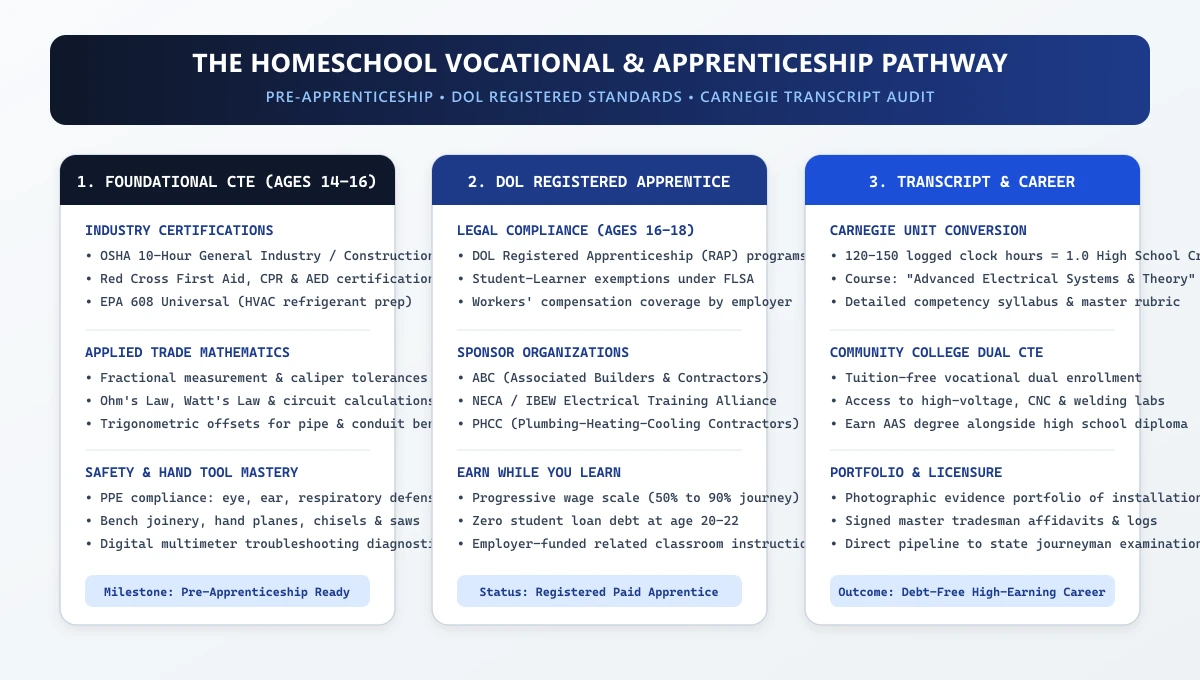
Pre-Apprenticeship Foundation: Ages 14 to 16
A successful trade career does not begin at graduation; it begins during the early high school years with intentional pre-apprenticeship preparation. A fourteen- or fifteen-year-old homeschooler should focus on four foundational pillars:
1. Foundational Industry Certifications
Before stepping onto an active job site, teenagers can complete industry-recognized credential courses that immediately distinguish them from other applicants:
- OSHA 10-Hour General Industry / Construction: Administered online through authorized OSHA training institutes (such as CareerSafe or 360training). Teaches hazard recognition, fall protection, electrical safety, personal protective equipment (PPE), and hazard communication.
- American Red Cross CPR, First Aid & AED Certification: Demonstrates personal responsibility and emergency preparedness on job sites.
- EPA Section 608 Universal Certification: For teens interested in HVAC/R, studying for and passing the EPA refrigerant handling exam at age 16 provides an immediate leg up for summer helper positions.
2. Applied Trade Mathematics
Trade mathematics is fundamentally different from abstract theoretical calculus. It is intensely practical, requiring rapid mental calculation, precise fraction manipulation, and spatial trigonometry:
- Fractional Precision: Adding, subtracting, and dividing fractions down to 1/32nd and 1/64th of an inch on standard imperial tape measures without hesitation.
- Electrical Formulae: Solving for voltage, current, resistance, and wattage using Ohm’s Law ((V = I imes R)) and Watt’s Law ((P = I imes V)), calculating conduit fill percentages, and calculating voltage drop across long wire runs.
- Geometric Layout & Trigonometry: Using Pythagorean theorem ((a^2 + b^2 = c^2)) for squaring walls, calculating rafter lengths, and using trigonometric sine/cosine tables to determine multiplier offsets for 30°, 45°, and 60° conduit and pipe bends.
3. Tool Safety and Material Culture
Establish a dedicated workshop space in your garage or basement. Guide your teen through the proper maintenance, sharpening, calibration, and operation of core hand and power tools:
- Hand Tool Fluency: Mastering hand saws, wood chisels, block planes, pipe cutters, conduit benders, torque wrenches, and wire strippers.
- Power Tool Protocols: Safe operation of compound miter saws, drill presses, band saws, angle grinders, and cordless impact drivers.
- Diagnostic Instrumentation: Learning how to read analog dial calipers, digital micrometers, spirit levels, laser levels, and digital multimeters (measuring AC/DC voltage, continuous resistance, and amperage with clamp meters).
Legal Frameworks: Navigating Child Labor Laws & DOL Standards
When parents investigate trade training for minors, they frequently encounter confusion surrounding federal and state child labor laws. Under the federal Fair Labor Standards Act (FLSA), youth under 18 are prohibited from hazardous occupations (such as operating commercial woodworking machinery, roofing, or operating cranes).
However, the Department of Labor provides specific, legal pathways for sixteen- and seventeen-year-old students:
The Student-Learner Exemption
Under FLSA regulations (29 CFR § 570.50(c)), sixteen- and seventeen-year-old student-learners may perform certain hazardous trade tasks if:
- The student is enrolled in a recognized, accredited vocational education course under a formal training agreement.
- The hazardous work is incidental to the training, intermittent, and performed under the direct, close supervision of a qualified journeyman or master tradesperson.
- Safety instruction is integrated into related classroom instruction.
- A written schedule of progressive work processes is maintained.
Homeschool families satisfy this requirement by establishing a formal Career and Technical Education (CTE) Training Agreement between the home school, the student, and the sponsoring employer, detailing safety protocols, hourly schedules, and academic objectives.
Department of Labor Registered Apprenticeship Programs (RAP)
A Registered Apprenticeship Program (RAP) is a gold-standard training model validated by the U.S. Department of Labor or a State Apprenticeship Agency (SAA). RAPs consist of five essential components:
- Paid Employment: Apprentices are legal W-2 employees earning competitive, progressive wages that increase automatically as they achieve specific skill benchmarks.
- On-the-Job Training (OJT): A minimum of 2,000 hours (typically 1 to 5 years) of structured, mentored hands-on training on actual job sites under the tutelage of licensed journeymen.
- Related Technical Instruction (RTI): A minimum of 144 hours per year of theoretical classroom instruction covering blueprint reading, safety codes (e.g., National Electrical Code or Uniform Plumbing Code), chemistry, physics, and drafting.
- Mentorship: Direct, one-on-one supervision by experienced journeymen.
- Nationally Recognized Credential: Upon graduation, the apprentice receives a Department of Labor Certificate of Completion and becomes eligible for state licensing examinations.
Sponsoring Trade Organizations
Homeschool teens can apply to both union and non-union (merit shop) apprenticeship pathways:
- Associated Builders and Contractors (ABC): Non-union merit-shop trade association offering nationally accredited NCCER apprenticeships across all major construction crafts.
- Electrical Training Alliance (NECA & IBEW): The largest union electrical apprenticeship in the nation, offering five-year paid apprenticeships with comprehensive health and pension benefits.
- Plumbing-Heating-Cooling Contractors Association (PHCC): Premier trade academy for plumbing and HVAC technicians.
- Independent Electrical Contractors (IEC): Major merit-shop electrical training network with chapters across 50 states.
Carnegie Unit Conversion: Crafting the High School Trade Transcript
One of the most frequent questions homeschooling parents ask is: “How do I translate grease, sparks, and tool belts into academic high school credits that colleges, military recruiters, and scholarship boards will respect?”
The solution lies in the standard Carnegie Unit. In secondary education:
- 1.0 High School Credit = 120 to 180 logged clock hours of instruction and practical application.
- 0.5 High School Credit = 60 to 90 logged clock hours.
Structuring Trade Courses on the Transcript
Rather than grouping trade activities under a vague elective title like “Shop” or “Work Experience,” utilize formal, industry-standard Career and Technical Education course titles with detailed course descriptions, textbook syllabi, and competency rubrics:
| Recommended Transcript Course Title | Academic Focus & Core Curricular Resources | Carnegie Credit |
|---|---|---|
| Applied Technical Mathematics | Practical geometry, trigonometry, Ohm’s law, pipe layout, and estimation. (Mathematics for the Trades by Carman & Saunders). | 1.0 Math Credit |
| Electrical Systems & National Electrical Code (NEC) | Residential/commercial wiring, circuit theory, branch load calculations, ground-fault protection. (Ugly’s Electrical References & Mike Holt NEC guides). | 1.0 Science / CTE Credit |
| HVAC/R Thermodynamics & Fluid Dynamics | Refrigeration cycles, heat transfer, psychrometrics, EPA 608 compliance. (Modern Refrigeration and Air Conditioning by Althouse). | 1.0 Lab Science Credit |
| Architectural Drafting & Blueprint Reading | Orthographic projections, MEP schematics, CAD modeling, structural symbol decoding. (Print Reading for Construction by Brown). | 1.0 Fine Arts / Tech Credit |
| Occupational Safety & Industrial Standards | OSHA 10/30 standards, hazardous material handling, tool mechanics, jobsite ergonomics. | 0.5 Health / Safety Credit |
| Vocational Apprenticeship Practicum I & II | 300–600 logged hours of on-the-job mentorship, verified task logs, and employer evaluations. | 2.0 to 4.0 CTE Elective Credits |
The Apprenticeship Documentation Binder
To defend your student’s transcript against audit or review, maintain a physical and digital Apprenticeship Documentation Portfolio containing:
- Daily Time Log: Detailed timestamps recording hours worked, jobsite locations, and tasks performed, signed monthly by the supervising journeyman.
- Task Competency Rubric: A checklist of mastered skills (e.g., “Demonstrated proper 90° stub-up bend on 3/4” EMT conduit within 1/16” accuracy”).
- Photographic Evidence Gallery: Clean, high-resolution photographs of projects constructed, wired, plumbed, or machined by the student.
- Safety Verification Records: Copies of OSHA 10 cards, CPR cards, and employer safety orientation sign-offs.
Community College CTE Dual Enrollment: The Supercharged Hybrid Track
The most efficient and cost-effective route for homeschoolers aged 16 to 18 is concurrent vocational dual enrollment at a local community college or technical institute.
Almost every state offers subsidized or completely free dual enrollment for high school juniors and seniors. By enrolling in an accredited Associate of Applied Science (AAS) program in Electrical Technology, Welding, or Automotive Technology:
- Access to Multi-Million-Dollar Labs: Students gain access to industrial computer-controlled machinery, pipe-welding booths, hydraulic trainers, and high-voltage distribution switchgear that no home workshop could ever accommodate.
- Double-Dip Academic Credits: A 3-credit-hour college course (such as ELT 111: Circuit Analysis) fulfills both a full Carnegie unit on the high school transcript and 3 credits toward an AAS degree or journeyman educational hour requirement.
- Instant Employer Credibility: When a 17-year-old homeschooler applies for an apprenticeship possessing 24 completed college trade credits and an OSHA card, contractors recognize an extraordinarily dedicated candidate.
The Step-by-Step Roadmap: From Age 14 to Journeyman Card
To eliminate guesswork, here is the chronological trajectory for homeschool families pursuing the vocational pathway:
| Age & Stage | Academic Focus & Milestones | Actionable Practical Objectives |
|---|---|---|
| Ages 14–15 (Grades 9–10) The Explorer Phase |
• Applied Technical Mathematics (geometry, imperial/metric conversions) • OSHA 10-Hour General Industry / Construction certification • American Red Cross First Aid, CPR & AED credentials |
• Set up safe home workshop; master hand and power tools • Conduct 4–6 informational interviews with master tradespeople • Practice precise fraction measurement and layout drafting |
| Age 16 (Grade 11) The Pre-Apprentice Phase |
• Community College CTE Dual Enrollment (DC Circuits, Welding I) • Study National Electrical Code (NEC) or Uniform Plumbing Code • Technical blueprint reading & schematic analysis |
• Secure Saturday/summer helper role under Student-Learner exemption • Log Carnegie clock hours (120–150 hrs per 1.0 credit) • Build photographic portfolio of completed installations |
| Age 17 (Grade 12) The Registered Candidate |
• Advanced trade theory, industrial controls & system diagnostics • EPA Section 608 Universal or AWS D1.1 welding qualifications • Finalize high school transcript with 2.0–4.0 CTE Practicum credits |
• Submit applications to DOL Registered Apprenticeship Programs (ABC, NECA/IBEW, PHCC) • Interview with apprenticeship evaluation committees • Graduate high school debt-free with 1,000+ logged field hours |
| Ages 18–22 The Journeyman Trajectory |
• Complete 8,000 on-the-job training (OJT) hours over 4–5 years • Attend employer-sponsored night school related technical instruction • Sit for State Journeyman Licensing Examination |
• Earn competitive progressive wages ($24–$38/hr) with full benefits • Graduate with national Department of Labor Journeyman Card • Attain complete financial sovereignty with zero student loans |
Dignity, Autonomy, and Lifelong Craftsmanship
There is a profound, irreplaceable psychological dignity in standing back at the end of a long workday and seeing a tangible, functional reality that you created with your own hands: a building powered by electrical switchgear you wired, a hospital cooled by chillers you calibrated, or an aircraft flying on components you machined.
For the homeschooled student whose education has emphasized self-direction, discipline, and practical capability, the skilled trades represent not a compromise, but a triumphant expression of human agency. By combining rigorous academic homeschool fundamentals with early vocational immersion, you provide your teenager with the greatest gift an educator can bestow: complete economic self-sufficiency, intellectual autonomy, and mastery of a craft that the modern world desperately needs.
Disclaimer: This post is for informational and educational purposes only, accurate to the best of our knowledge at publication. It does not constitute advice. We do not guarantee accuracy or completeness and accept no liability for any decisions or losses resulting from reliance on this content.