
In traditional institutional classrooms, educational systems are rigidly built on an outdated industrial assumption: that a child’s chronological age determines their cognitive capacity, emotional maturity, physical stamina, and reading level.
For the Twice-Exceptional (2e) child, this chronological paradigm is an intellectual prison.
A 2e student is defined as an individual who exhibits evidence of exceptional intellectual or creative ability co-occurring with one or more learning differences or neurodivergent profiles—including Attention-Deficit/Hyperactivity Disorder (ADHD), Autism Spectrum Disorder (Level 1), Dyslexia, Dysgraphia, or Executive Function Deficits[1].
In a conventional school, these children are perpetually misunderstood. Teachers see an eight-year-old who can discuss black hole thermodynamics with collegiate nuance, yet has a sensory meltdown when asked to copy spelling words, or bursts into tears when organizing a backpack.
By pulling a 2e child into the custom sanctuary of home education, parents can unlock what developmental psychologists call the Dual-Differentiation Model: accelerating the child’s soaring intellect while ruthlessly scaffolding their developmental vulnerabilities.
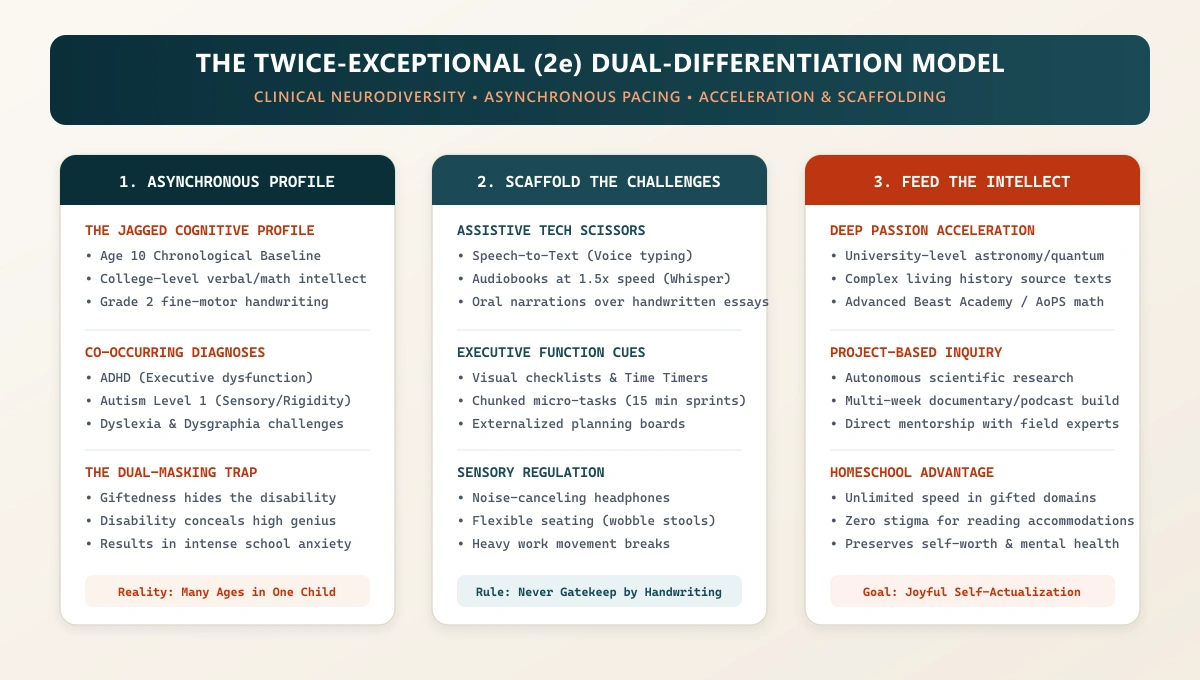
The Twice-Exceptional (2e) Dual-Differentiation Architecture
1. Understanding Asynchronous Development: “Many Ages in One Child”
To parent and educate a 2e child without constant friction, one must first master the clinical concept of Asynchronous Development, first formalized by the Columbus Group in 1991[2]:
“Giftedness is asynchronous development in which advanced cognitive abilities and heightened intensity combine to create inner experiences and awareness that are qualitatively different from the norm. The discrepancy between intellectual capacity and physical or emotional maturity creates vulnerability.”
Consider an actual developmental profile of a 9-year-old 2e homeschooled boy:
- Intellectual Reasoning: Equivalent to a 16-year-old (devouring university astronomy and complex military history).
- Reading Decoding: Equivalent to a 12-year-old.
- Handwriting & Motor Output: Equivalent to a 6-year-old (severe dysgraphia and hand fatigue after three sentences).
- Emotional Regulation: Equivalent to a 5-year-old (catastrophic tears when a puzzle piece does not fit or routines change abruptly).
When parents expect this child to function uniformly like a standard “9-year-old fourth grader,” conflict is guaranteed. In homeschooling, however, you do not teach a “fourth grader”—you teach the child’s asynchronous spikes independently, allowing each faculty to operate at its true developmental station.
2. The Dual-Masking Trap: Why Schools Fail 2e Learners
In public and private schools, millions of 2e children fall into the devastating Dual-Masking Trap[3]:
- The Giftedness Masks the Disability: Because the child has an extraordinarily high IQ and superior verbal reasoning, they use sheer cognitive horsepower to compensate for their dyslexia or ADHD. They scrape by with mediocre ‘B’ or ‘C’ grades, preventing teachers from identifying their underlying neurodivergence.
- The Disability Masks the Giftedness: Because their written output is sparse, handwriting illegible, or desk disheveled, school staff assume the child is “lazy,” “unmotivated,” or of average intelligence, disqualifying them from gifted and talented enrichment programs.
The result is chronic anxiety, school refusal, severe imposter syndrome, and psychological burnout. By age ten, many 2e children internalize the toxic belief that they are “broken” or “stupid.”
Homeschooling immediately shatters this trap. At home, you do not need an administrative committee or a standardized testing cutoff to grant your child access to advanced astrophysics, Shakespearean drama, or complex programming.
3. The Dual-Differentiation Strategy in the Homeschool Room
The gold standard for educating a 2e child is Dual-Differentiation: designing an instructional environment that operates on two opposite tracks simultaneously:
Track A: Aggressive Acceleration & Conceptual Complexity
A 2e child’s emotional stability depends directly on intellectual nourishment. If you force a brilliant 2e child with dysgraphia to repeat basic second-grade addition worksheets because their handwriting is sloppy, they will act out or shut down.
- Provide High-Ceiling Curricula: Utilize conceptual mastery curricula like Beast Academy or Art of Problem Solving (AoPS) for math, and living source documents for history.
- Project-Based Deep Dives: Allow the child to immerse themselves in multi-week hyper-fixations (building a working radio, researching Mesozoic marine fossils, writing a fantasy mythology language).
- Mentorship: Pair older 2e students with adult practitioners—amateur astronomers, software engineers, or university historians—who speak their intellectual dialect.
Track B: Ruthless Scaffolding & Assistive Technology
Simultaneously, you must aggressively remove mechanical obstacles that throttle the child’s expressive output:
- Separate Ideation from Handwriting: The child’s ideas operate at 120 words per minute, but their hand moves at 8 words per minute. Use Voice Typing (Speech-to-Text) in Google Docs, audio narrations, or let the parent act as the student’s scribe.
- Audiobooks at Accelerated Speed: Dyslexic or ADHD 2e children frequently comprehend auditory language at 1.5x or 2.0x speed without visual eye strain. Pair Whispersync audiobooks with physical texts.
- Externalize Working Memory: Use visual checklists, Time Timers, whiteboard workflows, and Kanban boards to manage executive function fatigue.
4. Emotional Intensity and Dabrowski’s Overexcitabilities
Clinical research in gifted child psychology reveals that 2e children almost universally present with what Polish psychologist Kazimierz Dabrowski identified as Overexcitabilities (OEs)[4]:
- Psychomotor OE: Intense physical energy, driven rapid speech, fidgeting, and an insatiable need to pace while processing abstract thoughts. (Solution: Let them bounce on an exercise ball or pace while reciting Latin or listening to history).
- Sensory OE: Acute sensory sensitivity to clothing tags, fluorescent lighting, chewing sounds (misophonia), or fabric textures. (Solution: Seamless clothing, noise-canceling headphones, and natural incandescent lamp lighting).
- Intellectual OE: A relentless, insatiable hunger for truth, logic, and existential answers. These children will ask deep moral questions about mortality, war, or cosmic entropy at seven years old.
- Emotional OE: Profound empathy, intense moral sensitivity, and extreme vulnerability to rejection. A harsh reprimand or perceived injustice can cause hours of intense weeping.
Recognizing overexcitabilities as neurological features rather than behavioral defiance transforms the homeschool environment from a battleground into a peaceful haven.
2e Homeschool Accommodation Checklist
| Area of Difference | Common 2e Manifestation | Recommended Homeschool Accommodation |
|---|---|---|
| Dysgraphia | Severe hand cramps, resistance to writing, brilliant oral explanations | Speech-to-text, parent scribe, keyboarding from age 7, mind-mapping |
| ADHD (Inattentive) | Forgetting multi-step instructions, wandering focus during lectures | 15-minute micro-lessons, gamified challenges, standing desks, pomodoro timers |
| Autism Level 1 | Meltdowns during unexpected transitions, intense special interests | Visual daily schedules, clear transition warnings, integrating special interests into all subjects |
| Dyslexia | Reading fatigue, skipping lines, high verbal comprehension | Orton-Gillingham phonics (Logic of English/AAR), audiobooks, large-print fonts |
| Sensory Processing | Overwhelm from noise, smells, or tactile classroom clutter | Minimalist schoolroom, noise-canceling headphones, outdoor nature school breaks |
Frequently Asked Questions About Homeschooling 2e Children
How do I determine what grade level my 2e child is in? ↓
Should I fix the learning disability before advancing gifted subjects? ↓
How do I manage the emotional meltdowns of a 2e child during school? ↓
Can a 2e homeschooler successfully attend college? ↓
Disclaimer: This post is for informational and educational purposes only, accurate to the best of our knowledge at publication. It does not constitute advice. We do not guarantee accuracy or completeness and accept no liability for any decisions or losses resulting from reliance on this content.