
In the contemporary parenting culture dominated by competitive social media benchmarks, a pervasive anxiety has taken hold: the pressure to turn toddlerhood into an academic sprint. Parents are bombarded with advertisements for commercial flashcard sets, phonics tablets, and preschool workbooks promising to teach eighteen-month-olds to read and calculate.
Yet developmental neurobiology, clinical pediatric therapy, and early childhood psychology speak with one unified voice: formal academic drilling for children under age four is not only unnecessary—it is developmentally counterproductive.
The human brain between ages one and three is not wired for abstract two-dimensional symbols. It is undergoing the most rapid burst of synaptic arborization and sensory integration in the human lifespan. A toddler’s primary developmental work is sensorimotor: mapping the spatial boundaries of their physical body, calibrating vestibular balance on uneven terrain, building emotional security through secure parental attachment, and establishing speech patterns through face-to-face vocal cadence.
When parents understand how to create a Gentle Daily Rhythm—grounded in the Waldorf rhythm of breathing, Elinor Goldschmied’s heuristic play, and Chris Athey’s play schemas—homeschooling a toddler ceases to be a stressful battle of wills. It transforms the home into a peaceful sanctuary of sensory discovery.
This comprehensive guide establishes a daily rhythm blueprint, decodes common toddler play schemas, and introduces open-ended sensory foundations that nurture lifelong curiosity.
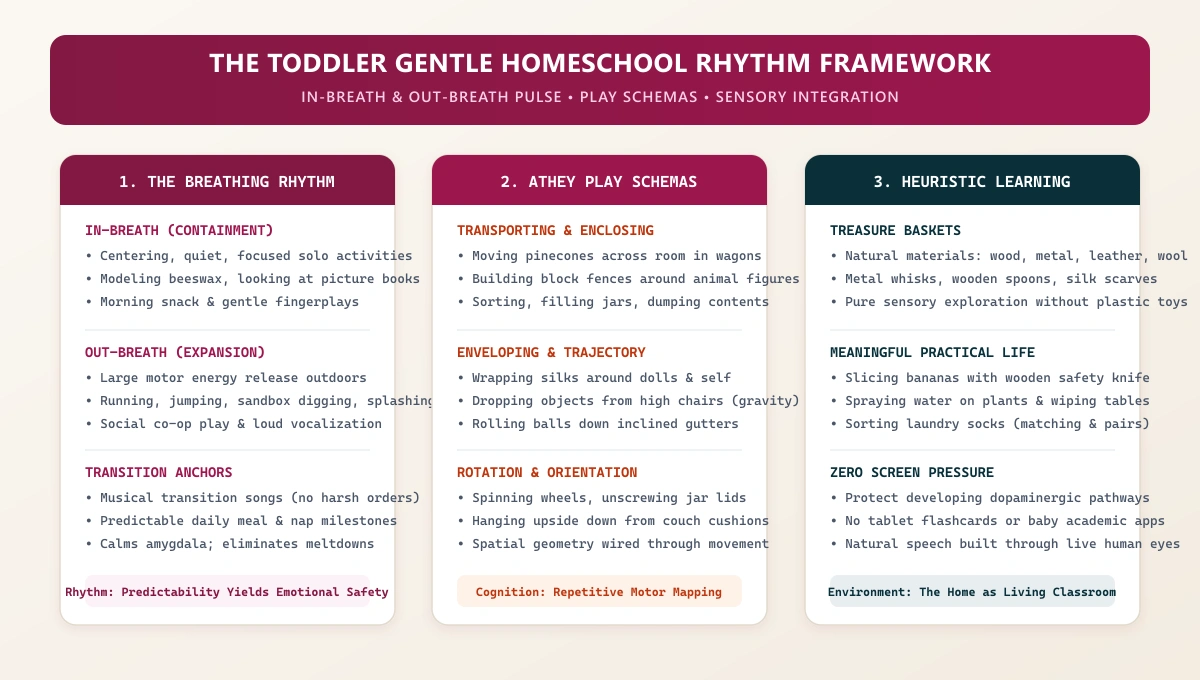
1. The Pulse of the Day: The In-Breath and Out-Breath Rhythm
Toddlers do not understand clocks, minutes, or calendar schedules. Attempting to run a toddler homeschool on a rigid clock-based agenda (“At 9:30 AM we do art; at 10:00 AM we do sensory bins”) inevitably produces tears and defiance.
Instead, traditional Waldorf early childhood education organizes the day around the biological metaphor of Breathing:
The Waldorf Breathing Rhythm Model
The In-Breath (Centering, Contained, Quiet)
An in-breath activity draws the child's energy inward. The child is close to the parent, calm, and focused. Examples include: sitting together on the couch reading a board book, eating a peaceful warm breakfast, kneading warm beeswax or homemade salt dough, participating in gentle fingerplays, or listening to quiet acoustic harp melodies.
The Out-Breath (Expansive, Active, Energetic)
An out-breath activity allows the child to release physical energy outward into the world. The child is mobile, vocal, and exploratory. Examples include: outdoor puddle jumping, running up grassy hills, digging in a dirt pit, building blanket forts, dancing with silk scarves, or water play with sponges.
Why Meltdowns Happen: The Rhythm Disruption
Toddler meltdowns frequently occur when an out-breath goes on for too long without containment (producing overtired sensory overload), or when a child is forced into consecutive in-breath sessions without physical release (producing restlessness and explosive physical outbursts).
By rhythmically alternating between in-breath and out-breath throughout the morning and afternoon, the parent provides an emotional thermostat that regulates the toddler’s nervous system automatically.
2. Chris Athey’s Play Schemas: Decoding Repetitive Toddler Behaviors
Have you ever watched your two-year-old repeatedly empty your kitchen cabinets, carry every shoe into the living room, or drop food from their high chair to watch it fall, and wondered: “Why are they doing this?”
In the 1970s and 1980s, British researcher Chris Athey, building upon the work of Jean Piaget, identified that toddlers learn about the physical world through Cognitive Schemas—repetitive patterns of physical behavior that wire the brain for mathematics, physics, and spatial geometry:
| Play Schema | Toddler Behaviors | Underlying Cognitive Concepts | Homeschool Provocation / Materials |
|---|---|---|---|
| 1. Transporting | Moving objects from one room to another in wagons, buckets, purses, or pockets | Mass, displacement, volume, spatial relocation, classification | Wooden wagons, canvas totes, baskets, wooden tongs, collections of large pinecones or river stones |
| 2. Enclosing | Building fences around toy animals, climbing inside cardboard boxes, sitting in laundry baskets | Boundaries, perimeter, containment, spatial perimeter, geometry | Wooden building blocks, large packing boxes, soft floor pillows, play silks, masking tape grids |
| 3. Enveloping | Wrapping dolls in blankets, covering toys in playdough, painting over entire paper sheets in dark paint | Object permanence, surface area, sensory occlusion, thermal warmth | Muslin scarves, silk scarves, wool blankets, nesting bowls, burial sensory bins with lentils or rice |
| 4. Trajectory | Throwing objects, dropping cups from high chairs, jumping off bottom steps, following running water | Gravitational acceleration, horizontal/vertical vectors, projectile physics | Gutter tracks for rolling wooden balls, outdoor beanbag tossing, balloon volleyball, ribbon wands |
| 5. Rotation | Spinning wheels on toy trucks, turning door knobs, spinning in circles until dizzy, unscrewing lids | Radial symmetry, centrifugal force, gears, mechanics, angular momentum | Salad spinners, jar lids, wooden spinning tops, tricycle wheels, sensory bottles with glitter |
When a parent recognizes which schema their toddler is currently exploring, they no longer view repetitive behavior as “naughty” or “destructive.” Instead, they provide targeted materials that satisfy the child’s neurological craving safely.
3. Heuristic Play and Treasure Baskets: Ditching the Plastic Noise
In traditional toy aisles, shelves are dominated by brightly colored plastic toys with batteries, blinking LED lights, and prerecorded robotic voices. Pediatric occupational therapists term this Passive Sensory Overload: the toy performs all the action, while the child’s brain remains a passive observer. Furthermore, molded plastic offers zero tactile variation; a plastic block feels, weighs, and smells identical to a plastic dinosaur.
In the 1980s, pioneering educator Elinor Goldschmied developed the concept of Heuristic Play (from the Greek eurisko, meaning “to discover”). For toddlers, this centers around the Treasure Basket:
Assembling a Developmental Treasure Basket
A shallow, sturdy wicker basket containing 20 to 30 clean, non-toxic household objects representing diverse sensory textures:
- Natural Wood: Wooden napkin rings, wooden egg cups, untreated wooden blocks, pinecones, thick tree bark slices.
- Metal: Stainless steel measuring cups, small whisk, tea strainer, large metal keys, brass coaster. (Metal offers cold thermal contrast and distinct acoustic resonance).
- Natural Fibers & Textiles: Pure wool dryer balls, silk ribbons, cotton rope, velvet swatches, leather coasters.
- Natural Shells & Stones: Large smooth river pebbles, sea sponges, large clam shells.
A toddler presented with a treasure basket will sit quietly for thirty to forty-five minutes, feeling weights, tapping metal against wood to compare acoustic pitches, testing thermal conductivity, and mouthing natural textures. This is pure, self-directed scientific experimentation.
4. Language Acquisition Without Screens: Fingerplays and Rhythms
The American Academy of Pediatrics (AAP) and the World Health Organization (WHO) explicitly advise against screen media for children under eighteen months and urge strict limits for ages two to three. Neuroimaging studies confirm that fast-paced digital animation overstimulates developing dopaminergic reward pathways and is associated with expressive speech delays.
Speech is biologically designed to be acquired through shared human gaze (triadic attention) and vocal acoustic melody:
The Power of Rhythmic Fingerplays
Fingerplays (e.g., “Here is the beehive, where are the bees?”, “Open, shut them”, “Five little peas in a peapod pressed”) are among the most potent language-learning tools ever invented:
- Bilateral Motor Synchronization: Moving hands in coordination with spoken rhyme activates both cerebral hemispheres simultaneously.
- Phonemic Segmentation: Slow, metered singing naturally stretches vowel phonemes, allowing the toddler’s auditory cortex to map individual sound segments.
- Executive Inhibition: Fingerplays that involve sudden stops or whispers teach impulse control in a joyful, playful context.
5. Practical Life as the Core Curriculum
Parents often ask: “What curriculum should I buy for my 2-year-old?” The answer is: None. The home itself is the toddler’s curriculum.
Following the Montessori principle of Practical Life, toddlers experience profound satisfaction when invited into authentic adult domestic work:
- Snack Preparation: Let your toddler peel a banana, slice a soft strawberry with a blunt wooden toddler chopper, or pour water from a tiny child-sized ceramic pitcher.
- Housekeeping Collaboration: Provide a child-sized wooden broom and dustpan. When milk spills, do not shoo the toddler away; hand them a dry microfiber cloth and show them how to wipe.
- Nature Care: Give the child a small brass spray bottle to mist indoor houseplants or carry a small bucket of birdseed to the garden feeder.
Participating in real, meaningful family work builds fine-motor bilateral coordination, executive sequencing, and a profound sense of self-worth and belonging.
Recommended Daily Toddler Rhythm Template
- 7:30 AM (In-Breath): Gentle wake-up, warm breakfast, singing morning blessing, lighting a candle.
- 8:30 AM (In-Breath): Morning practical life (clearing plates, sweeping floor, wiping table).
- 9:15 AM (Out-Breath): Outdoor immersion. Forest walk, puddle jumping, mud kitchen play, sensory garden exploration.
- 11:00 AM (In-Breath): Warm bath or hand washing. Quiet treasure basket or playdough modeling while lunch is prepared.
- 12:00 PM: Family lunch and peaceful storybook reading.
- 1:00 PM: Rest time / afternoon nap.
- 3:30 PM (Out-Breath): Outdoor play, playground swing, or active blanket fort building.
- 5:30 PM (In-Breath): Dinner preparation, soothing evening songs, warm bath, bedtime story.
Pedagogical References and Regulatory Citations
- Athey, C. (2007). Extending Thought in Young Children: A Parent-Teacher Partnership (2nd ed.). Paul Chapman Publishing.
- Goldschmied, E., & Jackson, S. (2004). People Under Three: Young Children in Day Care (2nd ed.). Routledge.
- Salter, J. (1987). The Incarnating Child: Developing the Young Child’s Five Senses. Rudolf Steiner Press.
- American Academy of Pediatrics (AAP). Policy Statement: Media and Young Minds. Council on Communications and Media.
- Montessori, M. (1966). The Secret of Childhood. Fides Publishers.
Disclaimer: This post is for informational and educational purposes only, accurate to the best of our knowledge at publication. It does not constitute advice. We do not guarantee accuracy or completeness and accept no liability for any decisions or losses resulting from reliance on this content.