When a bright, articulate child freezes in tears before writing a single sentence on a blank worksheet, traditional school systems often misinterpret the struggle as lack of effort, defiance, or attention deficit. In home education, parents have the front-row seat to recognize what clinical occupational therapists understand: dysgraphia is not an intellectual limitation or carelessness. It is a complex neurodevelopmental motor-coordination and orthographic processing deficit that turns physical writing into an overwhelming cognitive bottleneck.
Homeschooling provides the single most effective therapeutic environment for a child with dysgraphia. Outside the rigid constraints of 30-student classrooms, parents can systematically eliminate unnecessary handwriting stress, provide assistive technology, and remediate fine-motor pathways without compromising intellectual growth.
Understanding Dysgraphia: The Neurological Bottleneck
Dysgraphia is categorized clinically under the Diagnostic and Statistical Manual of Mental Disorders (DSM-5-TR) as a Specific Learning Disorder with impairment in written expression. Neuropsychologically, producing written text requires synchronous harmony between three distinct neurological networks:
- Orthographic Working Memory: The mental capacity to retrieve visual representations of letters, numbers, and punctuation marks from long-term memory.
- Graphomotor Planning: The cerebellum and motor cortex communicating with the small muscle groups of the fingers, wrist, and forearm to execute precise physical strokes.
- Executive Formulation: Organizing grammar, vocabulary, logical sequencing, and analytical thoughts simultaneously while the hand is moving.
In neurotypical learners, graphomotor execution becomes automated by second or third grade, freeing working memory for high-level creative and analytical thinking. In a child with dysgraphia, that automation fails to consolidate. Every stroke of the pencil requires conscious, exhausting motor calculations. When cognitive energy is entirely consumed by holding the pencil and remembering how to form a lowercase “b,” high-level composition collapses.
The Three Clinical Subtypes of Dysgraphia
Effective homeschooling interventions depend directly on identifying your child’s specific dysgraphic presentation:
- Dyslexic Dysgraphia: Spontaneous written work is illegible and severely misspelled, but copied text is legible. Fine-motor finger tapping and non-writing drawing skills are typically intact.
- Motor Dysgraphia: Driven by deficient fine-motor coordination and muscle tone. Spontaneous writing, copied text, and drawing are equally illegible. Letter formation requires extreme physical exertion, frequently causing hand cramping and postural fatigue within minutes.
- Spatial Dysgraphia: Caused by impaired spatial perception. The child struggles with line awareness, spacing between words, margins, and directional orientation across the page. Copied text and spontaneous writing are illegible, though spelling ability may remain normal.
The Golden Principle: Decouple Thinking from Writing
The single most transformative decision you can make in your homeschool is to decouple the physical act of pencil-to-paper handwriting from intellectual evaluation.
If your fourth-grader is exploring ancient Egyptian irrigation systems, their knowledge should be assessed through oral narration, audio recording, 3D modeling, or parent scribing—never through a handwritten three-paragraph essay. When you force a dysgraphic child to demonstrate mastery of science, literature, or history through handwriting, you are not testing their understanding of the subject; you are testing their disability.
| Academic Subject | Traditional Expectation (High Stress) | Dysgraphia Accommodation (High Growth) |
|---|---|---|
| History & Social Studies | Written chapter summaries and essay exams | Oral narration, digital mind maps, or audio recordings |
| Literature Analysis | Hand-drafted book reports and character charts | Scribed oral debates, video presentations, or speech-to-text |
| Science | Handwritten lab observations and data tables | Digital lab templates, photographic evidence, and typed logs |
| Mathematics | Cramped workbook computation on 8.5x11 paper | Whiteboard calculations, graph-paper grids, or oral calculation |
| Language Arts | Simultaneous grammar, spelling, and handwriting | Separate typing instruction from creative writing brainstorming |
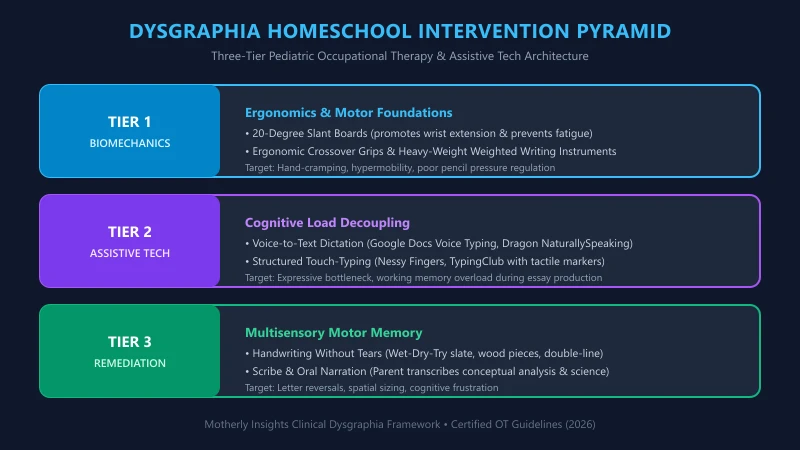
Tier 1: Biomechanical Accommodations in the Home Classroom
Before introducing software or curriculum overhauls, optimize the physical ergonomics of your child’s learning workstation. Pediatric occupational therapy research demonstrates that biomechanical positioning dramatically reduces muscular strain.
1. 20-Degree Slant Boards
Placing paper flat on a horizontal desk forces the wrist into flexion, reducing finger dexterity and triggering rapid muscular fatigue. A wooden or acrylic 20-degree desktop slant board automatically places the wrist in extension (bent slightly backward). This biomechanical shift stabilizes the hand’s arch and facilitates smooth, controlled finger movements.
2. Ergonomic Writing Instruments and Grips
Standard #2 yellow pencils are narrow, slippery, and require excessive pinch force. Replace them with specialized tools:
- Crossover Grips & Claw Grips: Soft silicone molded grips that physically prevent thumb-over-index-finger wrap while preserving an open web space.
- Weighted Pencils: Weighted metallic sleeves provide deep proprioceptive feedback to the joints of the hand, helping children who press either far too lightly or tear through paper with white-knuckle pressure.
- Twist-n-Write Y-Shaped Pencils: Ergonomic wishbone pencils that cradle the index finger and distribute force evenly across the hand.
3. Visual and Tactile Paper Adaptations
Standard wide-ruled notebook paper offers zero tactile boundaries, leading to floating baseline drift and erratic letter sizing.
- Raised-Line Paper: Embossed baselines provide an unmistakable physical bump that alerts the child’s pencil when a stroke descends below the writing plane.
- Color-Coded Three-Tier Paper: Visual sky-grass-ground coloring (blue top line, green middle line, brown baseline) offers clear spatial anchors for tall, small, and descending letters.
Tier 2: Assistive Technology for Upper Elementary, Middle & High School
As academic reading and analytical expectations accelerate after third grade, handwriting can no longer serve as the primary conduit for written expression. Integrating assistive technology preserves academic momentum and prepares students for college board accommodations.
Speech-to-Text Dictation
Modern speech recognition software eliminates graphomotor resistance entirely. Students can verbalize complex thoughts at natural speaking speed:
- Google Docs Voice Typing: Built directly into Chrome, highly accurate, and free. Students learn to speak punctuation explicitly (“comma,” “period,” “new paragraph”).
- Dragon NaturallySpeaking / Nuance: Professional-grade dictation tailored for older students requiring advanced technical vocabulary and hands-free document editing.
Structured Touch-Typing Protocols
Typing utilizes bilateral motor coordination, which is neurologically distinct from orthographic handwriting. Many dysgraphic students who cannot legibly form letters by hand can achieve 40–50 words per minute on a physical keyboard.
- Nessy Fingers: Specifically designed for neurodivergent learners, incorporating multisensory phonics reinforcement alongside keyboard mechanics.
- TypingClub: Free, highly structured web program featuring clear visual posture cues and gradual muscle memory sequencing.
- Tactile Key Markers: Placing small silicone adhesive dots on the home row keys (F and J) reinforces hand positioning without requiring visual gaze shifts.
Word Prediction and Graphic Organizers
When orthographic working memory impairs spelling retrieval, word prediction tools bridge the gap:
- Co:Writer: Contextual word prediction that anticipates intended vocabulary based on initial phonetic sounds, easing spelling frustration.
- Inspiration Maps / MindNode: Digital graphic organizers that let visual learners arrange thesis statements, supporting arguments, and textual citations visually before exporting them into structured essay drafts.
Tier 3: Evidence-Based Remediation Curricula
While accommodations protect intellectual confidence, targeted fine-motor and orthographic remediation remains essential. Handwriting practice should be capped at 10 to 15 focused minutes per day, conducted when the child is rested and calm.
1. Handwriting Without Tears (HWT)
Authored by occupational therapist Jan Olsen, Handwriting Without Tears represents the gold standard for dysgraphic remediation:
- Double-Line System: Eliminates the confusing middle dashed line of traditional handwriting paper, providing a clear visual baseline and mid-line.
- Multisensory Wet-Dry-Try: Children use a small slate blackboard, writing letters with chalk, tracing with a damp sponge cube, drying with a paper towel cube, and tracing again. This repetitive tactile sequence consolidates letter motor pathways without cognitive burnout.
- Logical Stroke Grouping: Letters are introduced by motor pattern (e.g., “Magic C” letters: c, a, d, g, o) rather than alphabetical order, eliminating common reversals.
2. Dianne Craft’s “Biology of Writing” & Brain Integration Therapy
Dianne Craft, MA, CND, developed targeted physical exercises designed to bridge hemispheric communication and remediate spatial disorientation:
- Figure-Eight Tracing: Large wall-sized infinity loops traced with both hands cross the visual and motor midline, reducing letter and number reversals.
- Postural Trunk Strengthening: Exercises including prone extension (“superman poses”) and tabletop weight bearing build the shoulder-girdle stability required for fine-motor control.
3. Logic of English: Rhythm of Handwriting
For families preferring cursive instruction, Logic of English provides explicit motor descriptions for every stroke:
- Why Cursive Often Bypasses Dysgraphia: Cursive requires a continuous fluid stroke rather than discrete stop-and-start pencil lifts, virtually eliminating letter reversals (especially b and d) and reinforcing whole-word spatial unity.
Daily Schedule: Balancing Remediation with High-Level Thinking
A common homeschooling mistake is allowing handwriting therapy to consume the entire school morning. When therapeutic struggle dominates every subject, children develop school refusal and chronic anxiety.
Structure your homeschool day with strict boundaries between remediation and academic discovery:
- Morning (15 Minutes Max): Dedicated handwriting remediation (Handwriting Without Tears slate work or Dianne Craft motor patterning).
- Mid-Morning (Academic Core): Mathematics using whiteboard markers, manipulatives, or oral problem walkthroughs. Parent acts as scribe for multi-step equations.
- Afternoon (Humanities & Science): High-level literature, history, and science conducted through audiobooks, documentary study, rich discussion, and speech-to-text dictation.
By confining motor struggle to a predictable 15-minute window, the rest of your school day remains intellectually invigorating, joyful, and productive.
Documenting Accommodations for College Board & Future Testing
If your child plans to pursue higher education, homeschooling documentation is critical for securing accommodations on the PSAT, SAT, ACT, and AP exams. The College Board requires demonstrable history of accommodations used consistently over time:
- Independent Clinical Evaluation: Secure a formal psychoeducational or neuropsychological evaluation diagnosing Specific Learning Disorder in Written Expression from a licensed clinical psychologist or occupational therapist.
- Formal Homeschool Accommodation Plan: Maintain an annual written accommodation agreement detailing speech-to-text usage, extended time (50% or 100%), 4-function calculators, and scribe accommodations across high school courses.
- Portfolio of Work Samples: Preserve side-by-side examples demonstrating the disparity between the student’s unaccommodated handwritten output versus accommodated typed or scribed work.
When home educators honor the neurobiology of dysgraphia, children transform from demoralized, tearful writers into confident, articulate, and prolific scholars.
Disclaimer: This post is for informational and educational purposes only, accurate to the best of our knowledge at publication. It does not constitute advice. We do not guarantee accuracy or completeness and accept no liability for any decisions or losses resulting from reliance on this content.