
One of the most heart-wrenching struggles a parent can experience is watching their intelligent, expressive child become trapped behind a barrier of speech.
The child’s eyes are bright. They comprehend complex books read aloud, assemble intricate LEGO creations, and laugh at witty family jokes. Yet when they attempt to speak, their words dissolve into tangled vowels, inconsistent consonants, or silence. When asked to repeat a sentence, the harder they try, the more their jaw and lips search erratically for the correct shapes.
In traditional institutional schoolrooms, children with Childhood Apraxia of Speech (CAS) or severe Developmental Language Disorders (DLD) face immense obstacles. Teachers frequently mistake motor speech paralysis for cognitive disability, reading instruction stalls because the child cannot “sound out” words orally, and recess becomes an isolating gauntlet of social misunderstanding.
By homeschooling, parents create an authentic clinical sanctuary. Using evidence-based Principles of Motor Learning, Multi-Sensory Prompting, and Adapted Speech-to-Print Phonics, home educators can nurture fluent literacy and joyful communication while supporting their child’s speech journey[1].
The Speech Apraxia & Language Delays Homeschool Matrix
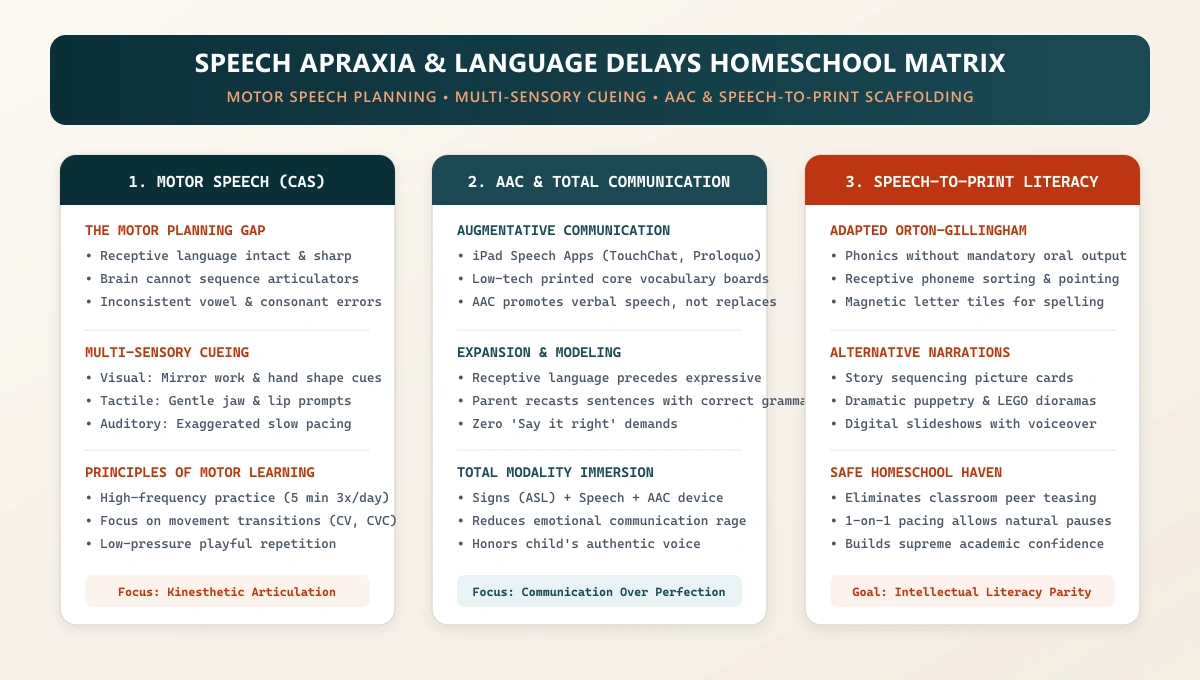
1. What Is Childhood Apraxia of Speech (CAS)?
To design an effective homeschool routine, parents must first distinguish between a phonological delay, a speech articulation disorder, and Childhood Apraxia of Speech (CAS):
- Articulation / Phonological Delay: The child has difficulty learning specific sound rules (e.g., fronting “tat” for “cat” or lisping on /s/). Their speech errors are predictable and consistent.
- Childhood Apraxia of Speech (CAS): CAS is not a muscle weakness disorder (dysarthria), nor is it a knowledge deficit. It is a neurological motor speech planning disorder[1]. The brain struggles to program and sequence the exact millisecond-level muscular movements of the lips, tongue, palate, and vocal cords required to produce syllables smoothly.
Three Clinical Hallmarks of CAS (Per ASHA Guidelines):
- Inconsistent Errors: The child might say “water” clearly at breakfast, but say “wa-ter”, “ah-ter”, and “wa-tah” twenty minutes later.
- Disrupted Coarticulatory Transitions: Speech sounds choppy or disjointed as the child transitions from consonant to vowel (groping or silent pauses between syllables).
- Inappropriate Prosody / Equal Stress: The child speaks in a robotic or flat cadence, putting equal emphasis on every syllable (e.g., “DOC-TOR” instead of the natural “DOC-tor”).
2. Principles of Motor Learning in the Homeschool Room
Because apraxia is a motor planning challenge, speech therapy mirrors athletic motor skill acquisition (like learning a golf swing or playing the violin).
In traditional schools, a child receives 30 minutes of group speech therapy once a week. Motor learning research proves that distributed, high-frequency practice—practicing for 5 minutes, 3 to 4 times a day at home—is vastly more effective than a single weekly session[3].
The Home Motor Speech Routine:
- High Repetition / Low Fatigue: Focus on a small target set of functional words (e.g., 5 specific words like “go”, “more”, “out”, “stop”, “help”). Execute 20 to 30 clean repetitions during a 5-minute morning burst.
- Visual Cueing (Mirror & Hand Gestures): Practice sitting side-by-side in front of a bathroom mirror. Let the child watch how your lips round for /w/ and close for /m/. Use physical hand cues (e.g., sliding a finger along your arm for smooth vowels) to provide visual rhythm.
- Tactile Feedback: Encourage the child to feel the vibration of their vocal cords on their throat during voiced sounds (“zzzz” vs. “ssss”) or feel the puff of air on their palm during aspirated stops (/p/ and /t/).
3. Augmentative Communication (AAC): Myth vs. Reality
One of the most persistent and damaging myths in special education is the fear that introducing Augmentative and Alternative Communication (AAC)—such as picture exchange cards or tablet speech apps—will make a child “lazy” and prevent them from learning to speak.
Clinical research has decisively demolished this myth. Decades of peer-reviewed studies by the American Speech-Language-Hearing Association (ASHA) demonstrate that AAC accelerates verbal speech development[4].
Why AAC Unlocks Verbal Speech:
- Relieves Neurochemical Panic: When a child cannot express their basic physical and emotional needs, their amygdala enters chronic fight-or-flight arousal. Providing an iPad app (such as TouchChat, Proloquo2Go, or LAMP Words for Life) gives them immediate communicative power, dramatically lowering anxiety.
- Auditory Feedback Loop: Every time the child taps a button on their device, the app speaks the word clearly with standardized pronunciation, providing constant auditory modeling.
- Total Communication: In homeschooling, we practice Total Communication: the child speaks, signs (ASL), gestures, and uses their device simultaneously. Any communicative intent is celebrated and validated.
4. Adapting Phonics: Decoupling Reading from Oral Pronunciation
The greatest danger facing an apraxic child in early education is the false assumption that because they cannot pronounce phonemes aloud, they cannot learn to read.
In conventional phonics instruction, a teacher holds up a card with the letter ‘b’ and demands: “Say the sound!” If the child cannot coordinate their lips to pop the /b/ sound, they are marked down as failing phonemic awareness.
In home education, we use Adapted Speech-to-Print Phonics (inspired by Orton-Gillingham principles)[2]:
- Receptive Phoneme Identification: Lay out magnetic letter tiles (m, s, t). Say: “Point to the letter that says /s/.” If the child points correctly, their phonemic decoding is 100% verified without vocal output.
- Magnetic Tile Blending: When teaching word blending (c-a-t), have the child push physical tiles together. Tap each tile while the parent voices the sounds, or let the child press the buttons on their AAC device.
- Silent Reading Comprehension: Never grade reading comprehension based on oral reading fluency. Assess understanding by having the child draw the scene, arrange chronological picture cards, or answer multiple-choice questions.
5. Alternative Narrations: Charlotte Mason for Non-Verbal Thinkers
Charlotte Mason’s practice of narration (having a child tell back the contents of a story in their own words) is an extraordinary tool for intellect and memory. However, for a child with speech apraxia or severe language processing delays, traditional verbal narration can trigger intense cognitive despair.
Home educators can adapt narration across multi-sensory modalities:
- Diorama & Toy Narration: After reading about ancient Egypt or a pioneer journey, let the child narrate using LEGO figures, clay terrain, or wooden blocks. They physically reenact the events, demonstrating complete narrative mastery.
- Visual Mind-Mapping & Storyboards: Provide comic strip panels where the child draws the beginning, middle, and end of the chapter.
- Co-Narration & Sentence Expansion: The child offers single core words (“ship… storm… sink”), and the parent recasts the rich grammatical sentence: “Yes! The wooden ship was caught in a violent storm and sank into the ocean.” The child hears correct syntax without feeling corrected.
Homeschool Accommodation Matrix for Speech & Language Delays
| Challenge Area | Traditional Classroom Hurdle | Homeschool SLP Adaptation | Recommended Tools |
|---|---|---|---|
| Oral Reading | Public reading anxiety, stumbling over multisyllabic words | Silent reading with comprehension checks, Whispersync audiobooks | Audible, Kindle Whispersync, Learning Ally |
| Phonics Drills | Inability to produce target phonemes on command | Receptive sorting, pointing, physical magnetic tile manipulation | All About Reading tiles, Logic of English phonogram cards |
| Spelling | Oral spelling bees, auditory memory overload | Visual letter stamps, tactile kinetic sand tracing, keyboarding | Sand trays, wooden letter stamps, speech-to-text |
| Narration | Long verbal recitations causing motor exhaustion | Storyboard illustrations, LEGO reenactments, AAC core vocabulary | TouchChat HD, Proloquo2Go, Storyboard That |
| Math Word Problems | Dense linguistic syntax masking mathematical genius | Visual Singapore bar models, ten-frames, physical manipulatives | Base-ten blocks, Cuisenaire rods, dry-erase whiteboards |
Frequently Asked Questions About Homeschooling with Speech Delays
Can a homeschooled child still receive private or public school speech therapy? ↓
What should I do when my child gets frustrated and shuts down during speech? ↓
How does Childhood Apraxia of Speech affect foreign language learning? ↓
Will an apraxic child ever learn to speak fluently? ↓
Disclaimer: This post is for informational and educational purposes only, accurate to the best of our knowledge at publication. It does not constitute advice. We do not guarantee accuracy or completeness and accept no liability for any decisions or losses resulting from reliance on this content.