
Ask any homeschooling parent to describe their child’s toughest academic hurdles, and the conversation rarely begins with phonics rules or multiplication tables. Instead, parents describe physical battles:
“He cannot sit in his chair for three minutes without sliding onto the floor.”
“She chews her shirt collars into soaking rags while doing handwriting.”
“He gags when he touches glue or finger paint, and melts down if his socks have seams.”
“She presses her pencil so hard into the paper that the lead snaps every ten seconds.”
When pediatric occupational therapists observe these behaviors, we do not see defiance, laziness, or ADHD inattention. We see a dysregulated central nervous system crying out for sensory equilibrium.
Rooted in Dr. A. Jean Ayres’ groundbreaking Sensory Integration Theory and structured around Patricia Wilbarger’s clinical Sensory Diet protocols, home educators have an unmatched advantage: the freedom to design a physical, sensory-rich environment that meets a child’s exact neurological threshold[1].
This clinical guide outlines how to build an authentic home sensory diet, select evidence-based OT tools, fix posture ergonomics, and guide your child into their “just-right” arousal state for effortless focus.
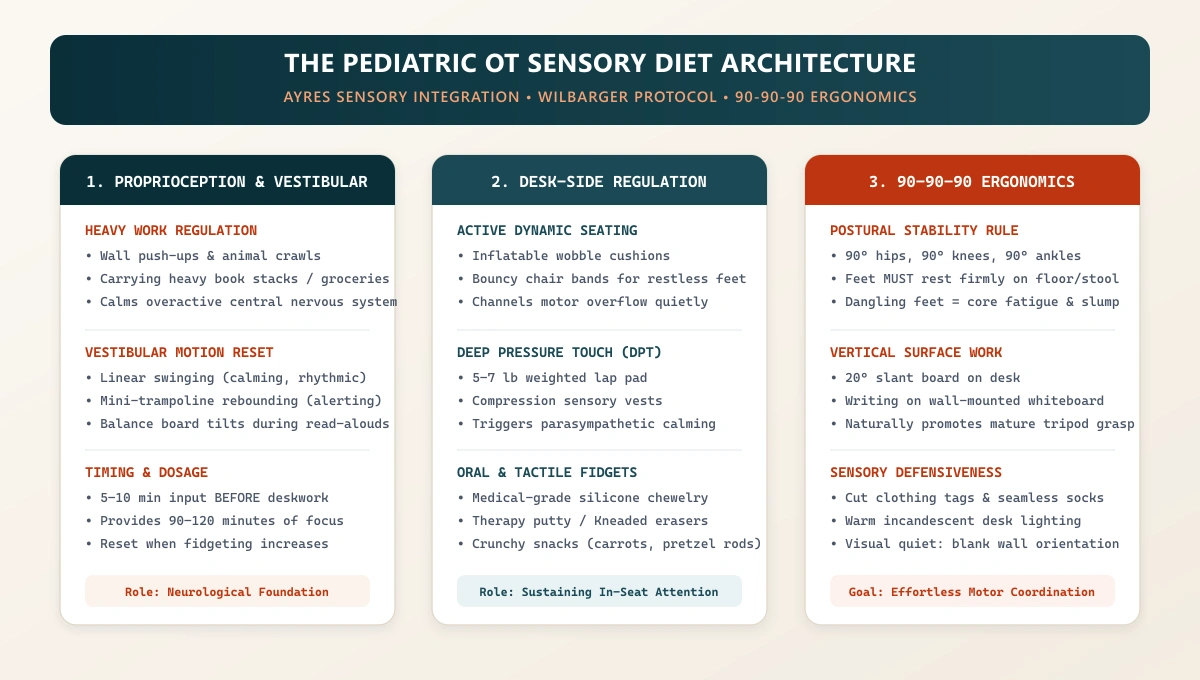
The Pediatric OT Sensory Diet Architecture
1. The Eight Sensory Systems and Neurological Arousal
Most parents were taught that humans possess five senses: sight, sound, touch, taste, and smell. Pediatric occupational therapy evaluates eight distinct sensory systems[2]:
- The Tactile System: Touch, texture, pain, and temperature.
- The Auditory System: Sound frequency, volume, and background auditory filtering.
- The Visual System: Visual acuity, spatial tracking, and sensitivity to glare/clutter.
- The Olfactory System: Smell processing.
- The Gustatory System: Taste, oral texture, and temperature.
- The Vestibular System: Located in the inner ear; detects gravity, head movement, balance, and spatial orientation.
- The Proprioceptive System: Receptors in muscles, joints, and tendons that tell the brain where the body is in space without looking.
- Interoception: The internal bodily sense of hunger, thirst, heart rate, bladder fullness, and emotional tension.
The “Just-Right” Arousal Window:
Every child’s brain operates on an arousal spectrum:
- Under-Aroused (Low Registration / Sluggish): The child appears sleepy, slumps across the table, moves slowly, and misses instructions. They require alerting sensory inputs (fast spinning, jumping, bright light, cold water, crunchy snacks).
- Over-Aroused (Hyper-Responsive / Sensory Defensive): The child is easily agitated, covers their ears, reacts aggressively to minor bumps, and exhibits fight-or-flight panic. They require calming sensory inputs (deep pressure, rhythmic linear swinging, dim lighting, heavy work).
- Sensory Seeker: The child crashes into furniture, taps pencils, fidgets constantly, and craves intense sensory feedback to keep their brain awake.
A Sensory Diet is not a food plan; it is a carefully timed schedule of targeted sensory activities that keeps your child inside the “Just-Right Window” throughout the school day[3].
2. Proprioceptive “Heavy Work”: The Universal Regulator
If an OT could give homeschooling parents only one tool, it would be Proprioceptive Heavy Work.
Proprioception is the only sensory system that is bi-directional: it calms an over-aroused child while simultaneously waking up an under-aroused child. When muscles contract and joints compress under resistance, the brain releases serotonin and dopamine, creating an immediate stabilizing, centering effect.
Top Heavy Work Activities for the Homeschool Morning (5–10 Minutes Before Deskwork):
- Animal Crawls: Bear crawls, crab walks, or frog hops across the living room rug.
- Wall Push-Ups & Chair Push-Ups: Placing hands flat against a sturdy wall and pushing with full upper-body resistance.
- The “Library Porter”: Give the child a heavy plastic bin loaded with 10–15 hardcover library books and have them push or carry it across the hallway to the school table.
- Therapy Ball Squeezes / “Steamroller”: Have the child lie prone (on their stomach) on a rug while the parent slowly rolls a large 65cm exercise ball over their back and legs with firm, gentle downward pressure.
- Mini-Trampoline Rebounding: 50 brisk bounces on a fitness rebounder with firm foot landings.
A 10-minute heavy work sequence provides a neurological “calm-alert” window that lasts between 90 and 120 minutes of focused cognitive desk time.
3. The 90-90-90 Ergonomic Rule and Postural Stability
One of the most frequent causes of sloppy handwriting, seat-squirming, and short attention spans is a catastrophic violation of pediatric ergonomics.
When a 7-year-old sits at an adult dining table, their feet dangle six inches above the floor. To stay upright, the child must fire their core abdominals and stabilizing trunk muscles continuously. Within five minutes, physical fatigue sets in; the child hooks their feet around chair rungs, leans their chest on the table, props their head in their non-dominant hand, and produces illegible, shaky pencil strokes[4].
The Pediatric OT Posture Standard:
- 90° Angle at Hips: Back flush against the chair support.
- 90° Angle at Knees: Thighs parallel to the floor without pressure behind the knee joint.
- 90° Angle at Ankles: Feet must be planted firmly flat.
- The Desk Height Check: When seated, the child’s bent elbows should rest naturally on the desk surface without elevating the shoulders.
💡 The DIY Homeschool Fix: If you cannot buy an adjustable ergonomic youth desk, simply place a sturdy wooden crate, yoga block, or thick phonebook under your child’s feet at the dining chair so their soles rest flat. You will see handwriting control improve immediately.
4. Vertical Surface Writing and Hand Ergonomics
Many parents battle poor pencil grip, complaining that their child holds their pencil with a tight “fist” (palmar grasp) or hooks their wrist inward.
Before doing tedious pencil-grip drills, change the plane of writing. Moving pencil work from a flat tabletop to a vertical or slanted surface triggers immediate biomechanical correction:
- The 20-Degree Slant Board: Elevating work on a 20-degree wooden slant board (or a 3-inch three-ring binder turned sideways) automatically puts the wrist into 20–30 degrees of extension. Wrist extension mechanically stabilizes the arch of the hand, forcing the index finger and thumb into an open, mature dynamic tripod grasp.
- Wall Whiteboards and Easels: Have your child practice spelling words, phonics phonograms, and math equations while standing at a wall-mounted whiteboard. Standing writing strengthens the shoulder girdle, engages core stabilizers, and crosses the neurological midline.
5. Desk-Side Regulation Tools That Actually Work
When children must sit for focused reading or math instruction, provide subtle sensory release valves that do not distract from cognitive processing:
- Inflatable Wobble Cushions: A textured rubber disc placed on the chair seat provides continuous micro-vestibular adjustments that keep the brain alert without leaving the chair.
- Bouncy Chair Resistance Bands: Thick latex exercise bands looped around the front legs of the chair allow restless legs to kick and push with heavy proprioceptive resistance quietly.
- Weighted Lap Pads (5% to 10% of Body Weight): Placing a 3-to-5 pound weighted pad across the thighs provides deep pressure touch (DPT), stimulating the vagus nerve to reduce fidgeting.
- Oral Motor Chewelry: For children who chew pencil tops, shirt cuffs, or fingernails, provide medical-grade silicone chew necklaces. Mastication is a powerful self-regulation tool.
Sample Homeschool Sensory Diet Schedule
| Time of Day | Nervous System Goal | Prescribed Sensory Diet Activity |
|---|---|---|
| 8:30 AM | Neurological Awakening | 10 min trampoline jumping, cold face splash, 25g protein breakfast |
| 8:50 AM | Focus Pre-Flight | 5 min Heavy Work: Wall push-ups, bear crawls to desk |
| 9:00 AM – 9:45 AM | Deskwork Regulation (Math) | 90-90-90 seated posture, footrest secured, weighted lap pad across knees |
| 9:45 AM | Sensory Brain Break | Linear backyard swing (calming) or obstacle course crawl |
| 10:00 AM – 10:45 AM | Fine-Motor Scaffolding (LA) | Slant board on desk, therapy putty hand warm-up, oral chewelry |
| 11:00 AM | Midday Sensory Reset | Outdoor nature walk: climbing trees, stepping on uneven logs |
Frequently Asked Questions About Homeschool Sensory Diets
How do I know if my child is a sensory seeker or sensory avoider? ↓
Can a sensory diet cure Sensory Processing Disorder (SPD) or ADHD? ↓
Why does spinning make my child more wild instead of calm? ↓
How heavy should a weighted lap pad or blanket be for safety? ↓
Disclaimer: This post is for informational and educational purposes only, accurate to the best of our knowledge at publication. It does not constitute advice. We do not guarantee accuracy or completeness and accept no liability for any decisions or losses resulting from reliance on this content.