

Disclaimer: This post is for informational and educational purposes only, accurate to the best of our knowledge at publication. It does not constitute advice. We do not guarantee accuracy or completeness and accept no liability for any decisions or losses resulting from reliance on this content.
In January 2023, the Iowa General Assembly enacted landmark school choice legislation known as the Students First Act (House File 68). Codified under Iowa Code § 257.11B, the statute established an Education Savings Account (ESA) program designed to empower Iowa parents with state funding to select the educational environment best suited to their children.
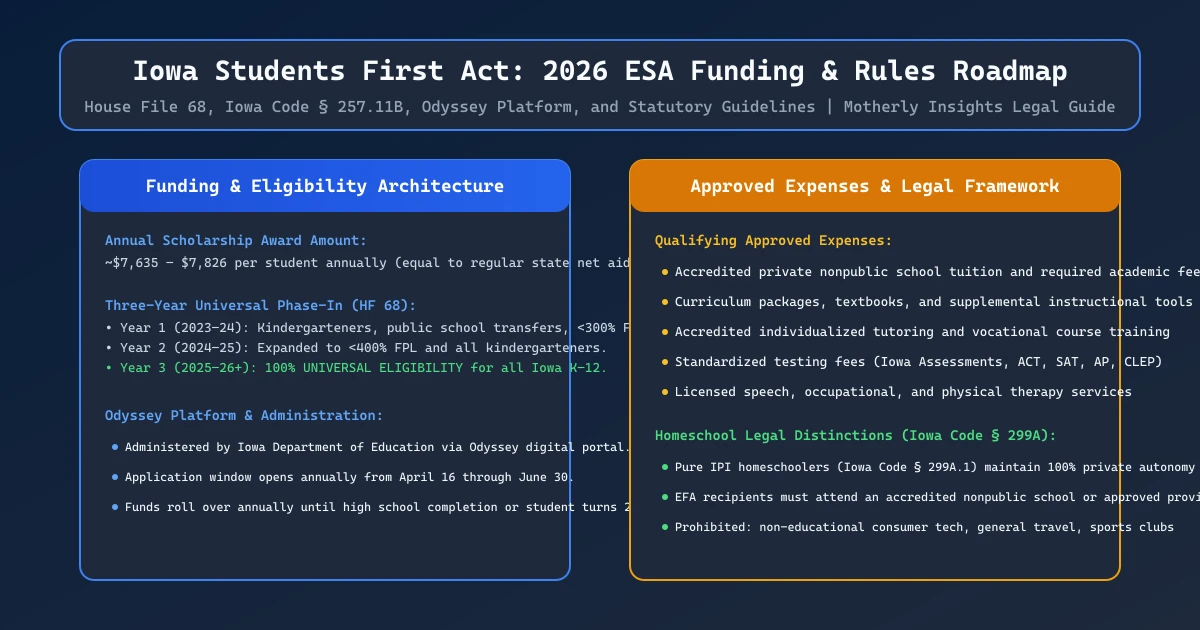
Under the Students First Act, the State of Iowa deposits 100% of the regular state foundation aid per pupil (approximately $7,635 to $7,826+ annually) into an individualized digital account for each qualified student. Administered by the Iowa Department of Education in partnership with educational technology vendor Odyssey, the program has completed its phased rollout and is now universally accessible to all Iowa K–12 resident students.
For Iowa homeschool families, navigating the Students First Act requires understanding critical statutory distinctions. While the ESA primarily funds accredited nonpublic school tuition, tutoring, and curriculum, families educating at home under Iowa Code Chapter 299A must evaluate how accepting state funds interacts with Independent Private Instruction (IPI) privacy versus Competent Private Instruction (CPI) regulations.
This legal and practical analysis—authored by statutory education counsel—breaks down the Students First funding formula, the universal application process via the Odyssey platform, qualifying purchases, and compliance guidelines.
1. How Much Funding Does the Iowa Students First ESA Provide?
Under Iowa Code § 257.11B, the annual ESA scholarship amount is determined by the statewide state foundation aid per pupil established by the Iowa Legislature for that fiscal year:
| Academic School Year | Annual Award Per Student | Application Window | Account Management Platform |
|---|---|---|---|
| 2023–2024 (Phase 1) | $7,635 | May 31 – June 30 | Odyssey digital portal |
| 2024–2025 (Phase 2) | $7,826 | April 16 – June 30 | Odyssey digital portal |
| 2025–2026 (Phase 3 Universal) | ~$7,980 (Projected) | April 16 – June 30 | Odyssey digital portal |
| 2026–2027 (Ongoing) | ~$8,120+ (Estimated) | April 16 – June 30 | Odyssey digital portal |
Funds are deposited in two semi-annual installments directly into the family’s account on the Odyssey platform. Unspent funds roll over from year to year as long as the student remains eligible and enrolled, accumulating until the student graduates from high school or reaches age 20.
2. Universal Eligibility: The Three-Year Rollout Completed
The Students First Act was designed with a three-year phase-in to allow schools and families to adapt to the new educational choice framework:
Year 1 (2023–2024 School Year)
Eligible students included incoming kindergarteners, public school transfer students, and private school students whose household income did not exceed 300% of the federal poverty level (FPL).
Year 2 (2024–2025 School Year)
Eligibility broadened to all incoming kindergarteners, all public school transfers, and existing private school students whose household income was at or below 400% of the federal poverty level.
Year 3 (2025–2026 and 2026–2027 School Years: 100% Universal)
All household income caps and prior enrollment restrictions are permanently eliminated. Any Iowa resident child eligible for public elementary or secondary school enrollment qualifies for an ESA.
3. Approved vs. Prohibited Educational Expenses
Under Iowa Code § 257.11B(3) and Iowa Administrative Code rules, ESA funds may only be spent on qualified educational expenses:
Approved Qualifying Expenses (Green Light)
- Accredited Nonpublic School Tuition and Fees: Tuition, registration fees, and laboratory fees at accredited Iowa private schools.
- Comprehensive Curricula & Textbooks: Required textbooks, literature anthologies, and structured homeschool curriculum sets (e.g., Singapore Math, Saxon, Timberdoodle).
- Accredited Tutoring Services: Individualized or small-group academic tutoring provided by an Iowa-licensed teacher or accredited tutoring vendor.
- Concurrent College Enrollment: Tuition and course materials for dual-enrollment college coursework through Iowa community colleges or universities.
- Standardized Testing Fees: Examination fees for national standardized tests (Iowa Assessments, ACT, SAT, AP exams, and CLEP tests).
- Clinical Therapies: Speech-language pathology, occupational therapy, and specialized cognitive therapies delivered by licensed healthcare professionals.
- Instructional Software: Licensed educational software, phonics learning systems, and interactive STEM programs.
Prohibited Expenses (Red Light)
- General adult consumer electronics (televisions, general-purpose smartphones, home gaming consoles).
- Family vacations, general travel costs, vehicle fuel, and non-educational lodging.
- Extracurricular community sports leagues, uniform fees, and recreational equipment unrelated to accredited courses.
- General domestic furniture, household remodeling, and non-educational home decor.
- Goods or services provided directly by a parent or immediate family member.
4. Legal Architecture: Students First ESA vs. Iowa Homeschool Pathways
Iowa law provides distinct statutory mechanisms for home-based instruction under Iowa Code Chapter 299A. Understanding how ESA participation interacts with these options is critical for home educators:
| Legal Pathway | Statutory Basis | State Funding | State Testing / Oversight | Parental Autonomy |
|---|---|---|---|---|
| Independent Private Instruction (IPI) | Iowa Code § 299A.1(2)(b) | $0.00 (Self-funded) | Zero. No reporting, no testing, no state oversight. | Maximum. Total sovereign parental control over curriculum and pace. |
| Competent Private Instruction (CPI) Option 1 | Iowa Code § 299A.2 (Teacher Supervised) | $0.00 (District services available) | Annual assessment or portfolio review supervised by licensed teacher. | High. Parental instruction guided by certified teacher consultant. |
| Competent Private Instruction (CPI) Option 2 | Iowa Code § 299A.3 (Parent Taught Form A) | $0.00 (Dual enrollment access) | Annual standardized testing required; submit Form A to school district. | Moderate. Public school sports and dual enrollment access. |
| Students First ESA Program | Iowa Code § 257.11B | ~$7,826 per year per student | Standardized testing required; expenditures audited by Odyssey. | Subject to accredited nonpublic school or approved vendor enrollment. |
Families operating strictly under Independent Private Instruction (IPI) value complete privacy and non-involvement with state agencies. However, families who utilize accredited hybrid schools, private umbrella programs, or accredited tutoring cooperatives can leverage the ESA to offset thousands of dollars in tuition and instructional expenses.
5. Annual Assessment and Accountability Standards
To ensure academic efficacy, the Students First Act requires that students receiving ESA funding demonstrate academic progress:
- Standardized Assessment: Students must take an approved nationally norm-referenced standardized test annually (such as the Iowa Assessments, Stanford 10, or ACT/SAT for high schoolers).
- Administration and Results: Tests must be administered according to publisher guidelines. Score reports are submitted to the accredited nonpublic school and archived for state department auditing.
- Continuous Enrollment: Students who withdraw from an eligible educational program forfeit remaining uncommitted account funds, which return to the state general fund.
6. How to Apply via the Odyssey Platform: Key Deadlines
The annual application process is administered entirely through the state’s online portal at iowa.withodyssey.com:
Step-by-Step Application Timeline:
- April 16: The annual Students First ESA application window officially opens for the upcoming school year.
- June 30: Firm application deadline. Under Iowa law, applications submitted after June 30 cannot be approved for full-year funding.
- Residency Verification: Parents upload proof of Iowa residency (Iowa driver’s license, utility bill, or state tax filing).
- Account Activation: In late July, approved families receive digital wallet login credentials from Odyssey.
- Funding Release: The first semester allocation (50%) is deposited in August, with the second semester allocation (50%) deposited in January.
7. Best Practices for Hawkeye State Families
The Iowa Students First Act provides unprecedented financial flexibility for parents seeking an alternative to conventional public schooling.
To ensure seamless participation:
- Set Calendar Reminders: Submit your Odyssey application well in advance of the strict June 30 cut-off date.
- Retain Itemized Receipts: Maintain digital backups of all invoices, course syllabi, and receipts for three years in the event of an Odyssey compliance audit.
- Consult Approved Vendor Lists: Review the Odyssey marketplace prior to ordering to ensure curriculum vendors and tutors hold active state-approved status.
Sources & Statutory Citations
- Iowa General Assembly: House File 68 (The Students First Act, 90th General Assembly).
- Iowa Code: Chapter 257, Section 11B (Education Savings Accounts).
- Iowa Code: Chapter 299A (Private Instruction - IPI & CPI Standards).
- Iowa Department of Education: Students First Education Savings Account Operating Manual and Guidance Documents.