If you ask an adult educated in standard institutional schools what they remember about eighth-grade American history, their answers are remarkably predictable: memorizing the date of the Battle of Saratoga for a Friday test, filling out pre-printed worksheet definitions for terms like “mercantilism,” and enduring the monotone hum of a 900-page, committee-authored textbook packed with bolded glossary words, multi-colored text boxes, and artificial review questions. Within two weeks of passing the final exam, virtually all of that factual data was permanently forgotten.
British educational visionary Charlotte Mason (1842–1923) diagnosed this educational tragedy more than a century ago. Mason recognized that the human mind is not an empty receptacle to be mechanically stuffed with disconnected facts; it is a living organism that hungers for real, vital nourishment. She labeled sterile, dumbed-down educational textbooks as “twaddle”—material that insults a child’s intelligence and produces chronic academic apathy.
In contrast, Mason championed the revolutionary power of Living Books: rich, passionately written literature that breathes human life, moral consequence, and imaginative reality into history, geography, and science.
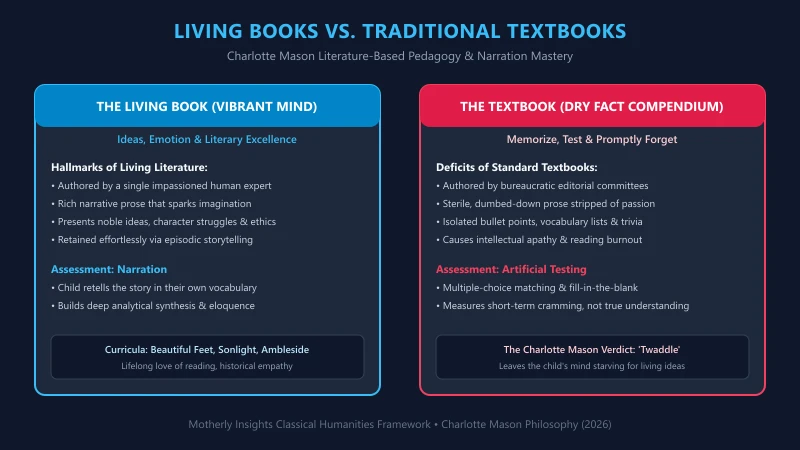
Anatomy of a “Living Book” vs. Traditional Textbook
What exactly transforms a book into a “living book”? The distinction is qualitative and profound:
| Characteristic | The Living Book | The Standard Textbook |
|---|---|---|
| Authorship | Written by a single human being with profound passion and expertise for the subject | Assembled by a corporate editorial committee designed to offend nobody and satisfy state standards |
| Literary Quality | Rich, evocative prose, elevated vocabulary, and imaginative narrative pacing | Choppy, sterile sentences, dumbed-down language, and artificial text callout boxes |
| Cognitive Focus | Conveys living ideas, ethical dilemmas, character virtues, and human struggles | Compiles disconnected facts, dates, definitions, and multiple-choice quizzes |
| Student Reaction | “Read another chapter, please!” Absorbed voluntarily during bedtime reading | Dragging feet, glazed-over eyes, and sighing with academic exhaustion |
| Retention Mechanism | Episodic narrative memory and emotional empathy | Short-term cramming for an exam, followed by immediate cognitive purging |
The Two Essential Questions of the Living Book Audit
When evaluating whether a historical book belongs on your homeschool shelf, ask two diagnostic questions:
- Was this book written by someone who is deeply, hopelessly in love with this subject? (Compare a biography of George Washington written by David McCullough with a two-paragraph textbook blurb).
- Does this book leave the reader with inspiring ideas to ponder, or merely facts to memorize?
The Cognitive Neuroscience of Narrative Memory
Why do children who cannot remember what year the Stamp Act was passed remember every single plot nuance, emotional motivation, and tragic sacrifice in Johnny Tremain or The Bronze Bow?
Modern cognitive psychology provides the empirical answer. Renowned Harvard psychologist Jerome Bruner demonstrated that the human brain operates in two distinct cognitive modes:
- The Paradigmatic (Logico-Scientific) Mode: Rational, analytical, categorized fact collection.
- The Narrative Mode: Organizing human experience, intention, action, and consequence into chronological, emotional stories.
Evolutionary biology reveals that human communication developed around firelight storytelling long before written encyclopedias existed. When historical events are embedded in a vivid narrative, the brain activates the same sensory and emotional neural networks as if the child were experiencing the event firsthand. The student does not merely read about Valley Forge; they feel the freezing snow through paper-thin boots, smell the smoke of wet firewood, and experience the agonizing leadership weight carried by George Washington.
The Art of Narration: Retelling Over Testing
A cornerstone of literature-based home education is the complete elimination of artificial fill-in-the-blank worksheets and multiple-choice tests. In their place, Charlotte Mason instituted Narration: the ancient art of “telling back.”
When a child is handed a multiple-choice quiz, they engage in simple passive recognition—hunting for visual cues to match a question with four pre-written options. When a child is asked to narrate, they must perform complex executive processing:
- Retrieve the entire narrative sequence from memory.
- Filter out minor details and identify the primary causal chain of events.
- Organize thoughts chronologically with logical transitions.
- Articulate the synthesized story using their own rich vocabulary and sentence structure.
Developmental Stages of Narration (Grades 1–12)
- Form I: Early Elementary (Grades 1–3 • Ages 6–9): Strictly Oral Narration. Read a single short section of a living book aloud (5 to 10 minutes max). Close the book and ask: “Tell me what happened to Columbus when the crew threatened mutiny.” The child narrates orally. The parent never interrupts to correct minor pronunciation; narration is a celebration of what the child did retain.
- Form II: Upper Elementary (Grades 4–6 • Ages 9–12): The transition to Written Narration. Children begin writing 1 to 2 written narrations per week, summarizing chapters of historical biographies, alongside oral narrations. They illustrate scenes, create character sketches, and maintain a Book of Centuries timeline.
- Form III+: Middle & High School (Grades 7–12 • Ages 12–18): Analytical Narration & Synthesis Essays. Students read complex living history texts independently (e.g., Churchill’s History of the English-Speaking Peoples, Plutarch’s Lives). Their narrations evolve into thesis-driven analytical essays, Socratic seminar debates, and comparisons of opposing historical viewpoints.
Top Literature-Based History Curricula Compared
For home educators seeking pre-curated booklists and historical teacher guides, several premier programs excel:
1. Beautiful Feet Books
- Philosophy: Literature-rich history and character formation rooted in Charlotte Mason principles.
- Pedagogy: Curates world-class living picture books, historical novels, and primary biographies into chronological year-long courses (Early American History, Medieval History, Ancient History, History of Science).
- Format: Gorgeous full-color teacher guides featuring conversational discussion prompts, map work, recipe connections, and timeline building.
- Best For: Families seeking warmth, beauty, high moral character, and gentle multi-age integration.
2. Sonlight Curriculum
- Philosophy: Fast-paced, literature-heavy Christian world history and geography.
- Pedagogy: Legendary for its sheer volume of exceptional read-alouds. Students read dozens of historical fiction novels and biographies per year while parents read historical “spine” narratives aloud.
- Format: Massive, ultra-detailed Instructor’s Guides (IGs) with day-by-day 36-week schedules, historical notes, vocabulary definitions, and map coordinates.
- Best For: Voracious reading families who want a complete, open-and-go roadmap requiring zero lesson planning.
3. BookShark
- Philosophy: The secular sister curriculum to Sonlight.
- Pedagogy: Shares Sonlight’s proven literature-rich structure and comprehensive instructor guides, but replaces religious commentary and missionary biographies with secular historical and cultural explorations.
- Best For: Secular home educators, charter school families, and those utilizing state homeschool funding allotments (such as Florida PEP or Alaska correspondence programs).
4. AmblesideOnline (AO)
- Philosophy: Pure, uncompromised classical Charlotte Mason education.
- Pedagogy: A free, non-profit 12-year curriculum mapped directly to Charlotte Mason’s original PNEU booklists. Features rigorous classical literature, primary historical documents, Shakespeare, and high-level historical spines (e.g., H.E. Marshall’s Our Island Story, This Country of Ours).
- Best For: Budget-conscious classical educators seeking deep intellectual rigor and historical authenticity.
Curating an Heirloom Living Home Library on a Budget
The biggest practical objection to literature-based homeschooling is financial: How can a family afford to purchase dozens of physical living books every year?
Building a rich family living library is an investment that blesses children, grandchildren, and generations to come. Here are the strategies experienced home educators use:
1. Master the Public Library System
- Interlibrary Loans (ILL): Never assume your local branch has everything. Utilize interlibrary loan networks to request rare, out-of-print historical biographies from regional university and county libraries.
- Digital Audiobooks (Libby & Hoopla): High-quality historical audiobooks allow children to listen to challenging living literature during afternoon quiet time or family car trips.
2. Specialty Living Book Reprint Publishers
Certain independent publishers specialize in rescuing beloved, out-of-print classical children’s literature from obscurity:
- Living Book Press: Exceptional hardcovers and paperbacks of classic Charlotte Mason spines.
- Yesterday’s Classics: Over 300 classic history, literature, and nature books for children.
- Bethlehem Books: Faith-affirming, beautifully written historical fiction and biography classics.
- Purple House Press: Rescuing mid-century treasures like the Madeline companion titles and classic historical adventures.
3. Frugal Sourcing Tactics
- Friends of the Library Book Sales: Often sell discarded hardcover children’s biographies and historical novels for $0.50 to $1.00.
- ThriftBooks & AbeBooks: Search specifically for older printings of award-winning Newbery and Caldecott historical fiction titles.
- Internet Archive & Public Domain Scans: Thousands of pre-1928 living books are available completely free as searchable digital PDFs for tablet reading.
When you replace the sterile bullet points of a standard textbook with the soaring prose and human drama of living books, history ceases to be a subject on a transcript. It becomes an intimate, lifelong conversation with the heroes, philosophers, martyrs, and adventurers who built the modern world.
Disclaimer: This post is for informational and educational purposes only, accurate to the best of our knowledge at publication. It does not constitute advice. We do not guarantee accuracy or completeness and accept no liability for any decisions or losses resulting from reliance on this content.