
When parents first discover the educational philosophy of Dr. Maria Montessori—Italy’s pioneering female physician and developmental scientist—they are often captivated by the serene aesthetic of a Montessori Children’s House (Casa dei Bambini)[1].
They marvel at three- and four-year-old children slicing cucumbers with real knives, pouring water from delicate porcelain pitchers without spilling, assembling intricate geometric wooden puzzles in quiet concentration, and manipulating golden glass beads to calculate four-digit addition problems[2].
Yet, when modern families attempt to bring Montessori into their homes, they frequently fall into one of two damaging extremes:
- The Commercial Aesthetic Trap: Spending thousands of dollars on expensive wooden toys and matching beige shelves, only to find their children dumping bins and ignoring the materials.
- The Academic Rush Trap: Skipping over foundational sensory and domestic work to force abstract phonics flashcards and math workbooks onto three-year-olds.
True Montessori homeschooling is neither a sterile catalog aesthetic nor a rigid academic drill[3]. It is a profound, scientifically grounded philosophy of human development centered around one core maxim: “Help me to do it by myself.”
In this comprehensive 2026 practical guide, we deconstruct the neurology of the First Plane of Development, explore how to curate a home Prepared Environment on a budget, and examine the four foundational avenues of Montessori Primary education: Practical Life, Sensorial exploration, Language, and Concrete Mathematics.
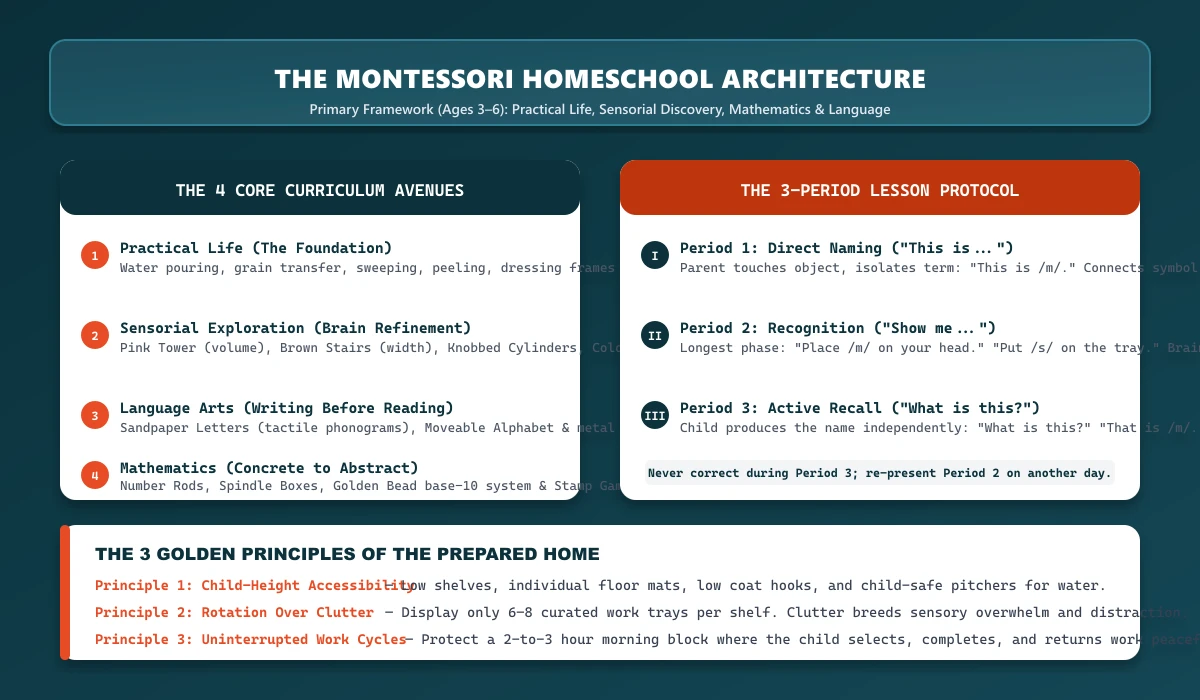
1. The Neurology of the First Plane: The Absorbent Mind (Ages 0 to 6)
Dr. Montessori observed that children do not learn like miniature adults. While adults acquire knowledge through conscious, effortful intellectual study, children in the First Plane of Development (Ages 0 to 6) possess what she termed the Absorbent Mind.
A young child absorbs the entirety of their culture, language, physical environment, and emotional atmosphere effortlessly, much like a sponge absorbs water. They do not need formal grammar lessons to learn their native tongue; they absorb its syntax, vocabulary, and phonetic accents simply by living within its acoustic space.
The Four Sensitive Periods of Early Childhood
During the primary years (ages 3 to 6), the Absorbent Mind operates through intense, transient windows of developmental focus called Sensitive Periods:
- The Sensitive Period for Order (Ages 1 to 3.5): The child has an urgent psychological need for physical predictability. Everything must have a designated place. Inconsistency or domestic chaos triggers acute emotional dysregulation.
- The Sensitive Period for Movement (Ages 0 to 4): The drive to refine gross- and fine-motor coordination—running, climbing, balancing, and manipulating small objects with the fingertips.
- The Sensitive Period for Language (Ages 0 to 6): An insatiable hunger for rich, precise vocabulary, storytelling, and sound isolation.
- The Sensitive Period for the Refinement of the Senses (Ages 2.5 to 6): The instinctual desire to touch, classify, sort, smell, and compare physical textures, weights, temperatures, and sounds.
When you align your home education with these biological sensitive periods, learning requires zero bribery or coercion; the child’s own neurological drive propels them toward deep focus.
2. The Prepared Environment: Cultivating Independence at Home
The central role of a Montessori parent is not that of a traditional lecturer, but that of a curator of the environment.
In conventional homes, the physical space is engineered exclusively for adult comfort: light switches are unreachable, cups are stored on high shelves, clothing is locked in tall closets, and toys are piled into chaotic toy bins. This structural reality forces the child into a state of perpetual dependency: “Mom, get me water! Dad, reach my shirt!”
A Montessori Prepared Environment redistributes spatial agency to the child:
Key Principles of a Montessori Home
- Child-Height Accessibility:
- Low, two-shelf bookcases where every work tray is displayed horizontally with space around it.
- A low coat hook and shoe basket at the front entryway so the child can dress independently.
- A child-height floor mirror and low dresser containing only 2 to 3 seasonally appropriate clothing choices.
- Order and Beauty (Simplicity over Clutter):
- Discard massive plastic toy bins where pieces are lost and broken.
- Display only 6 to 8 curated activities per shelf. When a shelf is uncluttered, a child’s brain calms down, enabling sustained focus. Rotate materials every few weeks based on observed interests.
- Real, Functional Tools Over Plastic Toys:
- Use real, child-sized glass drinking cups, ceramic bowls, and metal butter knives.
- When a plastic cup drops, it bounces without consequence. When a small glass cup shatters, the child experiences a natural, tangible physical truth: Glass is fragile and requires careful, two-handed movement. (Always supervise and teach sweeping etiquette with a small dustpan).
- Individual Work Rugs / Mats:
- Provide small rolled cotton mats (24 x 36 inches). The child unrolls their mat on the floor before working. The rug establishes a sacred physical boundary: everything on the mat belongs to that specific work, protecting it from younger siblings and keeping materials organized.
3. Practical Life: The True Engine of Cognitive Development
The most frequent error new Montessori homeschoolers commit is viewing Practical Life (domestic chores, self-care, pouring) as a warm-up activity to be rushed through on the way to “real” academic reading and math.
In clinical reality, Practical Life is the most intellectually important avenue in the entire Montessori curriculum.
When a 3.5-year-old child stands at a low table carefully transferring dry red lentils from one ceramic bowl to another using a small metal spoon, they are not merely playing house; their brain is executing complex neurological wiring:
- Executive Function & Working Memory: Holding a multi-step sequence in mind (pick up spoon, scoop lentils, stabilize wrist, hover over second bowl, tilt spoon, check for spills).
- Bilateral Coordination & Hand Dominance: Stabilizing the bowl with the non-dominant hand while manipulating the tool with the dominant hand.
- Left-to-Right Visual Orientation: All Montessori pouring and transferring activities are arranged from left to right, training the eyes for future reading and writing trajectories.
- The Three-Finger Pincer Grasp: Holding a spoon, tongs, eyedropper, or clothes pin strengthens the exact three fingers (thumb, index, middle) that hold a pencil.
Core Practical Life Activities for the Home
| Developmental Category | Home Activity Examples | Cognitive & Motor Benefit |
|---|---|---|
| Preliminary Motor Skills | Dry pouring (beans), water pouring with identical glass creamers, spooning, using ice tongs. | Wrist stabilization, hand-eye coordination, self-correction of spills. |
| Care of the Person | Dressing frames (large buttons, zippers, snaps), hand washing station, nose blowing, shoe polishing. | Personal autonomy, dignity, fine-motor finger isolation. |
| Care of the Environment | Sweeping with small broom and dustpan, wiping table spills with a sponge, window squeegee, flower arranging. | Sense of belonging, responsibility, purposeful physical effort. |
| Food Preparation | Peeling clementines, slicing bananas with a wavy wooden cutter, spreading butter on toast, juicing oranges. | Multi-step task completion, hygienic sequencing, genuine nutritional contribution. |
| Grace & Courtesy | Greeting guests, saying "excuse me," offering food, rolling and carrying a work rug without bumping furniture. | Social awareness, spatial proprioception, impulse control. |
4. Sensorial Education: Materialized Abstractions
Dr. Montessori described the human mind as a “mathematical mind.” From birth, human beings long to measure, compare, order, and categorize reality.
The Sensorial Materials are physical tools engineered to isolate a single physical attribute—such as color, dimension, weight, texture, or pitch—while keeping all other variables constant:
The Classic Sensorial Repertoire
- The Pink Tower: Ten wooden cubes graduated in size from $1 ext{ cm}^3$ to $10 ext{ cm}^3$, all painted identical light pink. Because color and texture are constant, the child’s mind isolates only one variable: three-dimensional volume. As the child carries the heavy bottom cube with two hands and balances the tiny top cube with fingertip precision, their body physically internalizes base-10 mathematics and cubing.
- The Brown Stair (Broad Stair): Ten brown prisms of identical length ($20 ext{ cm}$), varying only in thickness from $1 ext{ cm}$ to $10 ext{ cm}$. Isolates two-dimensional width and height.
- The Red Rods: Ten rods of identical square cross-section ($2.5 ext{ cm}$), varying in length from $10 ext{ cm}$ to $100 ext{ cm}$ ($1 ext{ meter}$). Isolates one-dimensional length, serving as the direct physical preparation for the Number Rods in math.
- Knobbed Cylinder Blocks: Wooden blocks containing cylindrical inserts that vary in height, diameter, or both. The small wooden knobs can only be held using the exact three-finger pincer grasp required for holding a pencil, providing unconscious pre-writing training.
5. The 3-Period Lesson: How to Present Knowledge
In Montessori pedagogy, parents never lecture, interrogate, or drill with flashcards. New vocabulary and concepts are introduced using the Three-Period Lesson (adapted from 19th-century French physician Édouard Séguin):
Period 1: Naming (Introduction)
- The Goal: Build an immediate connection between the physical object and the spoken word.
- The Action: Place the object on the mat. Touch it gently and say clearly:
“This is large.” (Pause). “This is small.”
Period 2: Recognition (Association & Movement)
- The Goal: Test comprehension without forcing verbal performance. This is the longest and most playful period.
- The Action: Engage the child in movement and spatial puzzles:
“Show me the large cube.” “Place the small cube on your head.” “Hide the large cube behind your back.” “Hand me the small cube.”
- If the child makes a mistake in Period 2, never correct them or say “No, that’s wrong.” Simply take the object back, say “Let’s try again,” and return to Period 1 on another day.
Period 3: Active Recall (Verification)
- The Goal: Verify that the child has internalized the concept and can retrieve the term independently.
- The Action: Point to the object and ask:
“What is this?”
- The child responds independently: “Large.”
6. Language Arts: Writing Before Reading
One of Dr. Montessori’s most startling pedagogical discoveries was that writing naturally precedes reading.
Reading is a synthesis of multiple complex cognitive skills: visual decoding, auditory blending, and intellectual comprehension. Writing, by contrast, is an analytical encoding process: a child who knows what sound they want to say can express that thought by selecting matching symbols.
The Montessori Literacy Pathway
- Oral Sound Games (I-Spy): Before introducing letters, play phonemic awareness games: “I spy with my little eye something on the rug that begins with the sound /m/.”
- Sandpaper Letters: Wooden boards with letters cut from fine sandpaper. The child traces the textured letter with their index and middle fingers (following the exact stroke direction used in handwriting) while vocalizing the phonetic sound: /m/… /m/… /m/. This integrates tactile touch, muscle memory, auditory sound, and visual symbol simultaneously.
- The Moveable Alphabet: A large wooden box containing multiple cut-out wooden letters. Long before a child’s hand can hold a pencil without fatigue, they can compose complex thoughts on a floor rug using the Moveable Alphabet: placing letters side by side to spell c-a-t, f-r-o-g, or entire stories.
- The Explosion into Reading: Once a child has spent months composing words with the Moveable Alphabet, a spontaneous “explosion into reading” occurs. The child looks at a word they did not write and suddenly realizes they can decode its phonetic meaning.
7. Concrete Mathematics: From the Senses to the Mind
Traditional schooling treats math as an abstract paper game of memorizing memorized algorithms and symbol manipulation.
Montessori mathematics grounds every mathematical reality in physical matter:
- Number Rods: Alternating blue and red wooden rods that represent quantities 1 through 10 as discrete, measurable physical lengths. The child does not merely see the numeral “5”; they hold a wooden rod that is five times longer than the 1-rod.
- The Golden Beads: Dr. Montessori’s legendary material for teaching the decimal base-10 system. A single golden bead represents 1 unit. Ten beads wired together on a wire represent 1 ten-bar. Ten ten-bars wired side by side form a 100-square. Ten hundred-squares stacked together form a heavy wooden 1,000-cube. A four-year-old child holding a heavy thousand-cube in their small hands understands the true physical weight and magnitude of a thousand decades before ever encountering an algebraic formula.
- The Stamp Game: Once the physical Golden Beads are mastered, the child transitions to the Stamp Game—small wooden square tiles representing 1, 10, 100, and 1,000—bridging the journey from concrete mass to symbolic calculation.
Final Thoughts: Protecting the Child’s Inner Teacher
The ultimate measure of a successful Montessori homeschool is not whether your five-year-old is doing long division or reading classic novels; it is whether your child possesses deep, joy-filled concentration, self-discipline, and reverence for their home and community.
When you slow down, prepare a home environment that honors your child’s dignity, and step back to observe without interrupting, you unleash what Dr. Montessori called the child’s “inner teacher.” In the quiet, unhurried rhythms of your living room, you give your child the greatest foundation for lifelong scholarship: the unbreakable confidence that they are capable of mastering their world with their own two hands.
Frequently Asked Questions
Do I need to buy expensive official Montessori materials to homeschool?
No. While certain iconic materials (such as Sandpaper Letters and the Moveable Alphabet) are well worth purchasing, you do not need a complete Children’s House in your living room. Practical Life uses everyday kitchen utensils (pitchers, bowls, spoons, sponges). Nature provides unlimited sensorial sorting (pinecones, acorns, river stones, leaves). Focus your budget on independence and real tools rather than thousands of dollars in commercial wooden manipulatives.
How do I manage a 3-hour work cycle with a baby or toddler around?
In a homeschool setting, multi-age domestic life is natural. Create a safe, contained floor area for the baby with sensory baskets, while older children work on elevated low tables or behind child-safety gates where delicate work mats cannot be trampled. Involve the toddler in simple water pouring or fruit washing tasks alongside older siblings.
Can I blend Montessori with other homeschool philosophies like Charlotte Mason?
Yes! Many of the world’s most joyful home educators practice an “eclectic” fusion of Montessori and Charlotte Mason. Both methods share a profound reverence for the child as a complete human person, emphasize living firsthand observation over dry worksheets, and reject artificial rewards and punishments. Montessori provides unmatched early-childhood independence and concrete math/sensory foundations, which transition seamlessly into Charlotte Mason living literature, nature journaling, and narration in the elementary years.
Disclaimer: This post is for informational and educational purposes only, accurate to the best of our knowledge at publication. It does not constitute advice. We do not guarantee accuracy or completeness and accept no liability for any decisions or losses resulting from reliance on this content.