For generations, conventional classroom history instruction has relied on sterile chronological textbooks: passive chronologies of dates, battles, and treaties that reduce the rich tapestry of human triumph, tragedy, and innovation to multiple-choice memorization drills. Children emerge from these regimens viewing historical figures not as breathing human beings who grappled with uncertainty, fear, moral dilemmas, and economic scarcity, but as static names chiseled onto marble monuments.
In a home education environment, however, families possess the extraordinary freedom to dismantle this textbook paradigm. Through living history and historical immersion, history transforms from an abstract reading assignment into an active, multidisciplinary investigation. By interrogating authentic primary source documents, touching genuine artifacts, preparing historical recipes, weaving period textiles, and stepping into the shoes of everyday citizens from centuries past, children forge profound cognitive and emotional connections with history that last a lifetime.
As Unit Studies Lead at Motherly Insights and an instructional designer specializing in cross-disciplinary humanities, I have spent decades developing immersive living history unit studies. Whether you are homeschooling a curious seven-year-old or mentoring a high school junior preparing for rigorous college-level historiography, this comprehensive guide provides the pedagogical blueprints, digital archival resources, material culture projects, and multi-age schedules necessary to bring the past vividly to life in your living room.
The Pedagogical Power of Historical Empathy & Somatosensory Learning
To understand why living history produces such exceptional intellectual retention, we must examine the cognitive science of memory and narrative comprehension. Educational psychologist Jerome Bruner famously demonstrated that human minds are hardwired to retain facts up to twenty times more effectively when embedded within a coherent, emotionally resonant narrative rather than memorized as disconnected propositions.
When children encounter history through experiential immersion, three distinct cognitive mechanisms are activated:
- Affective Historical Empathy: Historical empathy is not mere sentimental sympathy. Rather, it is the disciplined cognitive effort to understand how historical actors perceived their world, interpreted their constraints, and made decisions based on the limited knowledge available to them at that moment. When a child learns that a 14th-century merchant made decisions under the shadow of the Black Death without germ theory, their judgment shifts from condescending modern hindsight to profound analytical curiosity.
- Somatosensory Encoding: Hands-on material culture—smelling wood smoke during a hearth cooking experiment, feeling the resistance of linen thread pulled through heavy canvas, or straining to illuminate a handwritten ledger with a single beeswax candle—creates sensory memory anchors. Neurological research confirms that multimodal tactile experiences stimulate hippocampal pathways far more robustly than visual scanning of flat textbook pages alone.
- Agency and Inherent Causality: In living history, historical events are not presented as inevitable outcomes. By examining original correspondences, diaries, and opposing political broadsides, students realize that history was shaped by human choices, philosophical debates, and unpredictable environmental conditions. This realization empowers students to recognize their own civic agency in contemporary society.
Interrogating Primary Sources: The Junior Historian’s Detective Toolkit
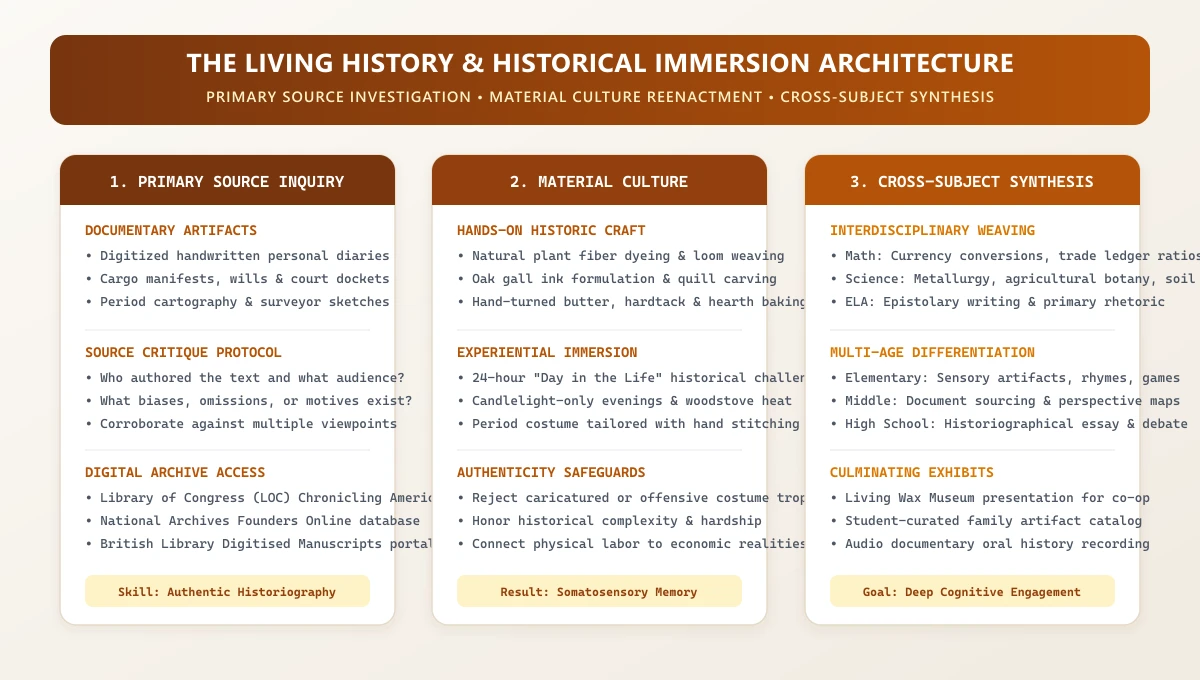
The foundational pillar of authentic living history is the primary source document. A primary source is immediate, first-hand evidence produced by people who lived through an event: personal letters, handwritten diaries, cargo manifests, probate inventories, colonial court dockets, diplomatic dispatches, architectural sketches, folk ballads, and period cartography.
Secondary sources—such as modern textbooks or encyclopedias—are interpretations written after the fact. While well-researched secondary works provide helpful framing, relying exclusively on them robs students of the thrill of original historical discovery.
The Five-Step Document Analysis Protocol
To teach your homeschoolers how to critique primary sources like professional historians, introduce this five-step interrogation routine whenever examining a new historical document:
- Sourcing: Who authored this document, in what geographic location, and in what exact year? What was the author’s social status, occupation, political allegiance, or religious background? What motivated them to write this text down at this precise moment?
- Contextualization: What major political, economic, or cultural crises were unfolding simultaneously? What everyday technologies existed, and what common scientific misunderstandings prevailed? How did the physical environment shape the author’s choices?
- Corroboration: How does this author’s account compare with accounts written by opposing parties, marginalized observers, or neutral foreign travelers? Where do the narratives align, and where do stark contradictions appear?
- Close Reading: What specific language, metaphors, rhetoric, and emotional cadence does the author employ? What words have shifted in meaning over the centuries? What critical perspectives are conspicuously omitted from the text?
- Historiographical Synthesis: What does this document reveal about the broader values, anxieties, and societal structures of the era? What questions remain unresolved, requiring further archival investigation?
Premier Free Digital Archives for Homeschoolers in 2026
You do not need access to university rare book vaults to inspect world-class primary sources. Today, the world’s most prestigious archives offer free, high-resolution digital facsimiles accessible from any home computer:
- The Library of Congress (LOC): The world’s largest library provides the digitized Chronicling America historic newspaper repository, spanning millions of searchable pages from 1770 to 1963, alongside extensive collections of Civil War battlefield maps, panoramic city sketches, and migrant worker oral histories from the Great Depression.
- National Archives Founders Online: A fully searchable, annotated database containing over 185,000 original letters and documents written by George Washington, Benjamin Franklin, John Adams, Thomas Jefferson, Alexander Hamilton, and James Madison, allowing students to read unvarnished, spirited debates in the founders’ own handwriting.
- The British Library Digitised Manuscripts Portal: Offers zoomable, ultra-high-definition scans of illuminated medieval manuscripts, Leonardo da Vinci’s personal notebooks, original Magna Carta exemplars, and personal letters from Tudor monarchs.
- The Gilder Lehrman Institute of American History: Curates classroom-ready primary source modules, transcripts, and pedagogical analysis worksheets specifically tailored for K-12 homeschool educators.
- Europeana & Digital Public Library of America (DPLA): Massive open-access aggregators uniting millions of digitized museum artifacts, patent drawings, photographs, and audio recordings from thousands of international cultural institutions.
Material Culture & Authentic Hands-On Reenactment at Home
Reading documents provides the intellectual skeleton of historical understanding; engaging with material culture dresses that skeleton in living muscle and sinew. Material culture refers to the physical objects that people created, utilized, cherished, and discarded.
Reenactment at home does not require expensive military uniforms or elaborate Hollywood sets. True living history focuses on authentic domestic, economic, and practical routines that illuminate daily survival and human ingenuity across the centuries.
1. The Historical Kitchen & Hearth Cooking
Culinary history is one of the most accessible and captivating immersion pathways. Preparing period-accurate food forces students to confront the reality of seasonal food preservation, agricultural limitations, and laborious manual preparation before modern refrigeration and grocery chains:
- Colonial & Pioneer Living: Bake genuine hardtack (ship’s biscuit) using only flour, water, and salt, experiencing firsthand why sailors soaked their rations in broth or coffee for hours to prevent chipped teeth. Churn fresh cream into butter using a simple glass jar, recording the physical energy and time expenditure required.
- Ancient Roman & Mediterranean Life: Recreate authentic ancient Roman meals utilizing garum (fermented fish sauce), barley porridge, and honey-roasted figs, referencing recipes recorded in Marcus Gavius Apicius’s 1st-century culinary manual De Re Coquinaria.
- Medieval & Tudor Feasts: Bake trenchers (coarse whole wheat sourdough bread bowls used as plates) and stew pottage made with dried peas, oats, leeks, and root vegetables, discussing food stratification between aristocracy and tenant farmers.
2. Period Fiber Arts, Weaving & Natural Dyeing
Before industrial steam-powered textile mills, producing clothing was the single most labor-intensive domestic enterprise on Earth. Introducing children to traditional textile crafts transforms their appreciation for modern manufactured goods:
- Drop Spindle Spinning: Purchase raw cleaned wool roving and wooden drop spindles. Allow students to practice teasing fibers, twisting them into yarn, and understanding the physical tensile strength required for spinning wheel technology.
- Botanical Dyeing Vats: Collect onion skins, dried marigold blossoms, walnut hulls, or madder root. Simmer raw linen or wool samples in these natural dye baths, observing how natural mordants (like alum) permanently fix pigments into organic fibers.
- Hand Looms & Tablet Weaving: Construct simple cardboard lap looms or wooden inkle looms to weave bookmarks, ribbons, and belts, discovering the mathematical rhythm of warp and weft counts.
3. Scriptorium Arts: Quill Carving & Oak Gall Ink
Step back before the advent of fountain pens and ballpoints by establishing a home scriptorium:
- Feather Quill Curing & Carving: Obtain natural turkey or goose flight feathers. Strip the outer barbs, temper the shaft in heated sand to harden the barrel, and practice cutting a clean, flexible writing nib using an X-Acto hobby knife.
- Oak Gall Ink Formulation: Forage or purchase oak galls (the tannins produced by wasps on oak branches). Crush the galls, steep them in rainwater, and mix with iron sulfate (ferrous sulfate) and gum arabic to produce deep black iron gall ink—the identical chemical formula used to pen the Declaration of Independence and Shakespeare’s sonnets.
- Calligraphic Discipline: Have students write an entire historical document using their handmade quill and ink onto parchment or heavy cotton rag paper by the flicker of a single beeswax candle, noticing how handwriting pace naturally dictates thoughtful prose.
4. The 24-Hour “Day in the Life” Historical Immersion
For an unforgettable milestone experience, dedicate a weekend day or full 24-hour cycle to living strictly under historical constraints:
- Switch off all household circuit breakers and electronic devices.
- Prepare all meals from scratch using only ingredients, cookware, and heat sources available in your target era.
- Engage in period chores: wood chopping, candle dipping, hand-washing laundry in galvanized tubs with washboards, and mending garments by hand.
- Spend the evening playing historical parlor games (like Nine Men’s Morris, draughts, or charades), reading historical literature aloud by candlelight, and journaling personal reflections.
Designing Cross-Curricular Thematic Unit Studies
Living history shines brightest when it serves as the unifying thematic anchor for an entire semester or month-long multi-subject unit study. Rather than isolating subjects into rigid 45-minute blocks, an integrated living history unit weaves mathematics, science, language arts, geography, and fine arts around a compelling historical epoch.
The following framework demonstrates how a four-week unit on Maritime Navigation & The Age of Discovery (15th–17th Centuries) harmoniously incorporates all core academic disciplines:
| Academic Subject | Hands-On Immersion & Primary Source Integration | Rigorous Academic Output |
|---|---|---|
| History & Historiography | Analyze Columbus’s original logbook facsimiles alongside Indigenous Taíno oral histories and Bartolomé de las Casas’s critical treatises. | Comparative point-of-view essay evaluating divergent historical interpretations. |
| Applied Mathematics | Master dead reckoning calculations, speed estimation using knot logs and chip lines, and latitude calculations from solar elevation angles. | Student-calculated navigation log plotting a trans-Atlantic voyage route. |
| Laboratory Science | Construct a functional magnetic compass using a magnetized needle and cork; experiment with scurvy prevention using ascorbic acid titrations. | Scientific lab report documenting magnetic declination and nutritional chemistry. |
| Language Arts & Literature | Read classic sea narratives (Defoe, Coleridge’s Rime of the Ancient Mariner) and analyze 16th-century ship surgeon logbooks. | First-person epistolary journal penned in period-accurate historical voice. |
| Geography & Cartography | Study Ptolemaic maps, portolan charts, and the Waldseemüller Map of 1507; draft hand-drawn nautical maps using rhumb lines and tea-stained paper. | Annotated topographical maritime chart complete with compass rose and soundings. |
| Fine Arts & Practical Crafts | Practice nautical knot tying (bowline, sheet bend, clove hitch, monkey’s fist) and carve decorative scrimshaw on soapstone or polymer clay. | Master rigger knot display board and decorative scrimshaw medallion. |
Multi-Age Differentiation: Scaffolding Historical Inquiry
One of the greatest operational benefits of thematic living history is its seamless adaptability for families educating multiple children across varying developmental stages. Rather than teaching three distinct, disconnected history curricula, parents can immerse the entire family in the same historical epoch while differentiating analytical depth according to each child’s cognitive milestone:
Early Elementary (Ages 5–8): Sensory Storytelling & Play
- Pedagogical Goal: Foster emotional wonder, narrative imagination, and basic chronological awareness.
- Core Activities: Dress-up in simple period attire, hands-on food preparation, listening to rich living picture books and folk tales, learning period folk dances and nursery rhymes, building miniature historic dwellings from modeling clay, twigs, or wooden blocks.
- Assessment: Oral narrations (“Tell me what life was like inside a medieval castle”), collaborative drawings, and dramatic puppet plays.
Middle School (Ages 9–13): Sourcing, Craft & Everyday Perspectives
- Pedagogical Goal: Develop source critique skills, understand cause-and-effect relationships, and execute complex hands-on material projects.
- Core Activities: Reading unabridged autobiographies, comparing contrasting newspaper accounts, carving quills and formulating inks, constructing working models (catapults, looms, astrolabes), and tracking trade routes on historical maps.
- Assessment: First-person historical diaries, annotated primary source scrapbooks, and interactive docent presentations for local homeschool co-ops.
High School (Ages 14–18): Historiography, Corroboration & Debate
- Pedagogical Goal: Master rigorous historiographical research, analyze bias and economic structures, and defend complex theses in writing and speech.
- Core Activities: Reading unabridged primary sources (state papers, treaties, philosophical treatises, court transcripts), studying divergent modern schools of historical thought (Marxist economic history, Annales social history, Great Man theory), and conducting original archival research.
- Assessment: Formal 10-page research papers with annotated Chicago-style bibliographies, Lincoln-Douglas style debates on historical foreign policy crises, and multimedia documentary podcasts incorporating historic audio recordings and musical scores.
Sourcing Authentic Artifacts, Field Immersion & Living Museums
While home-based activities form the daily rhythm of study, supplementing your curriculum with authentic physical artifacts and field immersion solidifies learning in profound ways:
- Handling Real Antiques & Relics: You do not need thousands of dollars to own genuine historical artifacts. Inexpensive authentic historical artifacts—such as genuine ancient Roman bronze coins (often available for $10–$20 from certified numismatic dealers), civil war era minie balls, 19th-century stereoview cards, or vintage handwritten letters from flea markets—can be purchased legally and affordably. Handing a child a genuine 1,700-year-old coin bearing the profile of Emperor Constantine instantly collapses the temporal distance between modern life and antiquity.
- Living History Museums: Plan field trips to accredited open-air living history museums where costumed historical interpreters demonstrate heritage trades. Premier North American destinations include:
- Colonial Williamsburg (Virginia): The world’s largest living history museum, featuring master blacksmiths, printers, coopers, wheelwrights, and wigmakers working with 18th-century tools.
- Plimoth Patuxet Museums (Massachusetts): Immerses visitors in a 17th-century English village and a Wampanoag homesite, showcasing authentic indigenous horticulture and colonial timber-frame construction.
- Old World Wisconsin & Connor Prairie (Midwest): Preserves ethnic immigrant farmsteads and 19th-century prairie settlements with working oxen, heritage livestock breeds, and traditional grain harvesting.
- Fortress of Louisbourg (Nova Scotia) & Fortress Louisbourg: Spectacular 18th-century French colonial military garrison offering immersive cannon drills and period bread bakeries.
- Local Historical Societies & Cemetery Walks: Do not overlook local history. Your county historical society often houses microfilmed local land deeds, immigrant naturalization records, and architectural photographs. Strolling through a historic local cemetery allows students to calculate infant mortality rates, track epidemic outbreaks (such as the 1918 influenza pandemic), and notice shifts in funerary symbolism across generations.
Assessment Without Standardized Tests: Portfolios & Living Wax Museums
How do you evaluate mastery in living history without destroying the magic of the subject with rote, multiple-choice quizzes? Authentic assessment in living history mirrors the professional output of historians, museum curators, and cultural preservationists:
- The Living Wax Museum: An extraordinary capstone event for families or co-ops. Each student selects a historical figure, conducts deep primary source research, writes an engaging 2-minute biographical speech delivered in the first person, crafts an authentic period costume, and designs a three-panel backdrop showcasing their character’s artifacts and timeline. On presentation day, students stand freeze-framed like wax statues until visitors press a simulated “button,” springing the figure to life to recite their monologue and answer spontaneous historical questions.
- The Curated Artifact Exhibition: Rather than taking an exam, students assemble a physical or digital museum exhibition. They select 6 to 10 historical artifacts (either genuine antiques, student-crafted replicas, or printed primary documents), write formal museum placards summarizing provenance, historical context, and cultural significance, and host a guided gallery tour for parents, grandparents, and peers.
- The Living History Portfolio: A bound archive containing the student’s handwritten calligraphic documents, pressed botanical samples, annotated maps, photographic evidence of hands-on material crafts, transcribed oral history interviews with elderly community members, and reflective historiographical essays. This portfolio serves as permanent, compelling evidence of high-school-level humanities excellence for college admissions and scholarship committees.
By stepping beyond the confines of commercial textbooks and embracing the rich world of living history, you grant your children far more than academic credits. You endow them with historical empathy, critical discernment, a reverence for human ingenuity, and the enduring understanding that history is not merely a subject to be studied—it is a great, continuing human conversation in which they now take their rightful place.
Disclaimer: This post is for informational and educational purposes only, accurate to the best of our knowledge at publication. It does not constitute advice. We do not guarantee accuracy or completeness and accept no liability for any decisions or losses resulting from reliance on this content.