
The single most destructive fallacy encountered by remote professionals and shift-working parents transitioning into home education is the Institutional Replica Trap. Parents frequently assume that providing a rigorous education requires replicating a compulsory brick-and-mortar schedule: sitting side-by-side at a kitchen table from 8:30 AM to 3:00 PM while simultaneously juggling Slack pings, sprint standups, and corporate deadlines.
This model is a mathematical impossibility. In traditional elementary classrooms, researchers consistently find that out of a six-hour instructional day, genuine academic engaged time (time spent actively learning new concepts or solving problems) totals between 60 and 90 minutes. The remaining four-and-a-half hours are consumed by attendance roll calls, hallway transitions, behavioral redirection, collective administrative announcements, and recess logistics.
When you homeschool, the administrative overhead drops to zero. A full day of high-impact, individualized academic work for an elementary student requires only 90 to 120 minutes of focused effort; middle schoolers require 2.5 to 3.5 hours; and high schoolers thrive on 3.5 to 4.5 hours. By decoupling education from the clock and rebuilding it around modular, asynchronous time blocks, working parents can sustain both an ambitious career and an academically superior home education without chronic sleep deprivation or parental burnout.
The Core Problem: Why Conventional Schedules Break Down
When a working parent attempts to teach in unpredictable 15-minute bursts between corporate video conferences, both work output and child retention collapse. The human brain requires cognitive warm-up time to reach flow state. Shifting attention between debugging code or editing financial spreadsheets and explaining long division creates severe attention residue, leaving parents irritable and children anxious.
The Attention Residue Tax in Home Education
Dr. Sophie Leroy's organizational psychology research demonstrates that when professionals switch between incomplete tasks, cognitive performance on the subsequent task is significantly impaired. In homeschooling, trying to multi-task during your child's math lesson causes instructional errors, impatience, and emotional friction. The solution is complete temporal separation via dedicated, protected time blocks.
To thrive as a working homeschooler, you must shift from a time-based mindset (“We must do school from 9 to 2”) to a cadence-based mindset (“We execute 3 targeted modules when our energy and focus align”).
Visual Architecture: The Working Parent Modular Model
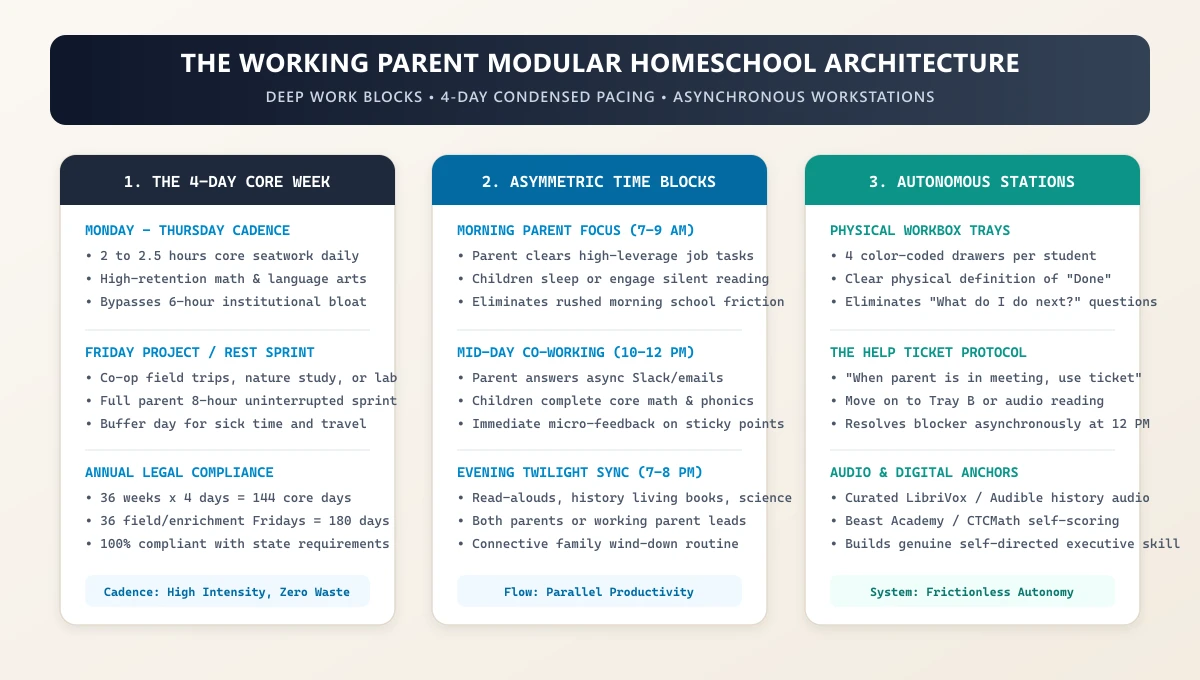
Framework 1: The 4-Day Condensed School Week
The four-day school week is the ultimate organizational weapon for working homeschooling families. Under this framework, intensive parent-guided instruction occurs strictly Monday through Thursday. Friday is designated as an Asynchronous Project & Parent Deep-Work Sprint.
Structuring the Monday–Thursday Core Sprint
During the four core days, academic instruction is ruthlessly prioritized around high-leverage foundational subjects:
- Module A: Mathematical Fluency (45–60 minutes): Dedicated conceptual instruction and independent practice using mastery curricula (such as Singapore Dimensions, RightStart, or Beast Academy).
- Module B: Language Arts & Written Composition (45–60 minutes): Phonics decoding, spelling dictation, and structured composition modeling (such as All About Reading or IEW Structure and Style).
- Module C: Independent Content Reading & Narration (30–45 minutes): Living science or history literature read independently or via high-quality audio recordings, followed by a recorded or oral narration.
Total daily guided instructional time: 2 to 2.5 hours. By concentrating these subjects into high-focus morning or evening windows, students complete four full lessons per week—completing standard 140-to-160-lesson curricula within standard 36-week academic calendars.
The Strategic Value of the “Fifth Day” (Friday)
For the working parent, Friday represents an uninterrupted 7-to-8 hour professional focus day. For the student, Friday is structured around:
- Independent Nature Study or STEM Labs: Open-ended tinkering, observational sketching, or robotics builds that do not require real-time parent supervision.
- Local Co-Op or Enrichment Drop-Off: Homeschool cooperatives, forest school cohorts, or community college dual-enrollment classes that provide social interaction and external mentorship.
- Emergency Academic Catch-Up Buffer: If a child falls ill on Tuesday or the parent faces an unexpected client escalation on Wednesday, Friday absorbs the displaced lesson without knocking the family off schedule.
Statutory Attendance Compliance on a 4-Day Schedule
Parents often worry whether a 4-day week satisfies state statutory attendance minimums (typically 180 instructional days or 900 to 1,000 instructional hours).
Statutory Accounting: The 180-Day Calculation
36 weeks of 4-day core seatwork equals 144 core instructional days. The remaining 36 days are legally and pedagogically satisfied by Friday experiential learning: educational field trips, regional museum programs, physical education athletics, library research, and home economics apprenticeships. In every US jurisdiction, experiential and vocational learning legally constitutes valid instruction.
Framework 2: Asymmetric Day & Night Time Blocking
If your professional role demands rigid core hours (e.g., 9:00 AM to 4:00 PM software releases or customer-facing consulting), daylight schooling must be restructured around Asymmetric Time Blocks.
1. The Early Bird Parent Sprint (6:00 AM – 8:30 AM)
Before children wake or require breakfast, the working parent logs into their professional workspace. In this 2.5-hour distraction-free cocoon, you clear your most intellectually demanding professional tasks—writing architecture specifications, conducting code reviews, or preparing board decks. By 8:30 AM, your highest-priority work deliverables are already completed.
2. The Mid-Day Parallel Co-Working Block (11:00 AM – 12:30 PM)
Rather than trying to teach while taking telephone calls, establish a shared “Parallel Office” routine:
- The parent works on asynchronous, low-cognitive-load corporate tasks (triaging email, drafting documentation, updating Jira tickets).
- The student sits at the adjacent workstation completing self-contained work (copywork, handwriting, math worksheet problem sets).
- The parent is present to answer a 30-second math question without breaking critical focus, creating a calm, shared atmosphere of industry.
3. The Twilight Living Books & Science Block (7:00 PM – 8:15 PM)
Content-rich subjects—history living books, read-aloud literature, and scientific discussions—do not belong in the middle of a frantic workday. Relocate them to the evening.
Replacing passive television or tablet scrolling with an evening family reading hour turns history and geography into a restorative, connective ritual. Both parents (or working single parents) can participate fully without professional guilt, turning education into the centerpiece of the evening wind-down routine.
Engineering the Frictionless Independent Workstation
The linchpin of successful homeschooling for working parents is teaching children how to work independently without requiring parental guidance every ninety seconds. Independence is not an innate personality trait; it is an environmental engineering outcome.
The 4-Drawer Workbox Protocol
Pioneered by Dr. Sue Patrick, the workbox system creates complete physical clarity for the student. Provide your child with a vertical 4-drawer or 6-drawer plastic organizer. Each morning (or Sunday evening), load each drawer with exactly one distinct assignment:
- Drawer 1 (Warm-up & Math): Math workbook open to today’s page with pencil and manipulative blocks already placed inside.
- Drawer 2 (Language Arts & Copywork): Cursive or spelling practice sheet with completed example at top.
- Drawer 3 (Audio Reading & Narration): Tablet or audio player pre-loaded with chapter audio and designated notebook for illustration.
- Drawer 4 (Tactile Enrichment): Logic puzzle, watercolor paper, or coding robot assignment.
When the child completes Drawer 1, they physically close it and advance to Drawer 2. The system eliminates the ambiguity of “How much work do I have to do today?” and prevents children from interrupting meetings to ask what comes next.
The “Help Ticket” System
To eliminate urgent interruptions during corporate client meetings, implement the Help Ticket protocol:
The Meeting Interruption Protocol
- Visual Signal: When a parent is on an active camera call, a red wooden block or LED light is visible on the office door.
- Help Post-It: If a student hits an insurmountable roadblock in Drawer 1, they place a yellow sticky note on the problem, set the drawer aside, and immediately proceed to Drawer 2 or Drawer 3.
- Ticket Resolution: During the parent's scheduled 12:15 PM lunch break, the student presents their Help Tickets, and all conceptual hurdles are cleared in one concentrated 15-minute coaching session.
This protocol trains children in patience, resourcefulness, and self-directed problem-solving—executive function skills that serve them profoundly throughout university and professional life.
Tech Stack: Automated and Self-Scoring Educational Curricula
Working parents must deliberately choose curricula engineered for high student autonomy and clear instructional feedback. The following platforms provide rigorous pedagogical standards while minimizing manual parent grading:
| Subject | Recommended Self-Directed Curricula | Autonomy Level | Parent Time Required Weekly |
|---|---|---|---|
| Elementary Math | Beast Academy Online (comic instruction + interactive hints) | Very High | 30 mins (weekly mastery review) |
| Middle / High Math | Mr. D Math or CTCMath (video instruction + automated grading) | High | 45 mins (exam oversight) |
| Foundational Phonics | All About Reading (scripted direct instruction) | Low (Parent-Led) | 4 x 20 mins (must be 1-on-1) |
| Grammar & Mechanics | Fix-It! Grammar (IEW daily editing exercises) | High | 15 mins (daily 3-minute check) |
| History & Geography | Story of the World Audiobooks + Jim Weiss narrations | Very High | 30 mins (listening together at dinner) |
| Science & Nature | Mystery Science open-and-go video inquiries + kit boxes | High | 45 mins (weekend experiment assist) |
Real-World Case Studies: How Working Families Structure Their Weeks
Case Study A: The Dual-Remote Tech Family (Ages 7 & 10)
- Schedule: 4-Day Condensed Week (Monday – Thursday).
- Morning Rhythm: Parents trade off 8:00 AM – 9:00 AM core math instruction while the other conducts daily scrum.
- Mid-Day Rhythm: Children complete reading drawers, educational audio, and typing practice while parents work in adjacent room.
- Evening Rhythm: 7:00 PM family read-aloud and science discussion over tea.
- Friday: Children attend a local outdoor nature cooperative from 9:00 AM to 2:00 PM; both parents execute deep professional sprints.
Case Study B: The Healthcare Shift Worker (Ages 6 & 9)
- Schedule: Non-traditional 3-Day Intensive + Weekend Blocks.
- Rhythm: Parent works three 12-hour shifts on Tuesday, Wednesday, and Thursday.
- School Execution: Full school days occur Saturday, Sunday, Monday, and Friday. Education is completely decoupled from the institutional 5-day week, allowing the family to enjoy quiet weekday community resources (libraries, science centers) on Mondays with zero crowds.
Psychological Health: Protecting the Parent-Child Bond
The greatest vulnerability in a working homeschool household is the erosion of warmth. When every interaction becomes transactional—checking assignments, issuing reminders, managing schedules—the relational bond between parent and child suffers.
To safeguard this relationship, establish one inviolable rule: The Morning Connection Minimum. Before checking email, before opening Slack, spend ten minutes looking into your child’s eyes over breakfast, sharing a brief morning reading, or stepping outside together into the fresh morning air.
Home education is not an obstacle to your professional career; it is a conscious restructuring of family life that allows your work and your children to flourish in parallel. When you discard the rigid timetable of the traditional schoolroom and embrace modular, asynchronous design, you give your family the twin gifts of academic excellence and genuine domestic peace.
Disclaimer
Disclaimer: This post is for informational and educational purposes only, accurate to the best of our knowledge at publication. It does not constitute advice. We do not guarantee accuracy or completeness and accept no liability for any decisions or losses resulting from reliance on this content.