
When parents first discover that their child is profoundly gifted, the initial reaction is often a mixture of pride and relief. Yet as the child enters the elementary years, that relief frequently gives way to confusion, exhaustion, and intense worry.
Parents watch their eight-year-old devour complex high school biology textbooks on cellular mitosis, yet dissolve into an uncontrollable sobbing meltdown on the kitchen floor because their pencil lead broke. They observe a ten-year-old composing elaborate musical themes or mastering linear algebra, yet incapable of remembering to put on both socks before leaving the house.
In traditional school settings, these uneven children are viewed through a lens of deficit: teachers complain that the child is “lazy,” “willfully uncooperative,” or “emotionally immature.” In many cases, their intense physical drive and sensory sensitivities lead to hasty psychiatric misdiagnoses of oppositional defiant disorder or purely behavioral ADHD.
The missing conceptual key is Asynchronous Development.
When parents understand that giftedness is not merely a high IQ score, but an entirely different developmental trajectory characterized by uneven internal growth, the parenting paradigm shifts from frustration to profound empathy.
This guide explores the foundational clinical frameworks of asynchronous development, decodes Polish psychiatrist Kazimierz Dabrowski’s Five Overexcitabilities (OEs), and provides a blueprint for structuring a grade-free, multi-level homeschool that allows your asynchronous learner to flourish without burnout.
1. The Columbus Group Definition: “Many Ages at Once”
In 1991, an interdisciplinary group of psychologists, educators, and researchers known as the Columbus Group met in Ohio to challenge the prevailing view that giftedness is simply high academic achievement. Led by Dr. Linda Kreger Silverman, they formulated a revolutionary definition that remains the clinical gold standard today:
"Giftedness is asynchronous development in which advanced cognitive abilities and heightened intensity combine to create inner experiences and awareness that are qualitatively different from the norm. This asynchrony increases with higher intellectual capacity. The uniqueness of the gifted renders them particularly vulnerable and requires modifications in parenting, teaching, and counseling in order for them to develop optimally."
— The Columbus Group (1991)
The “Many Ages” Phenomenon
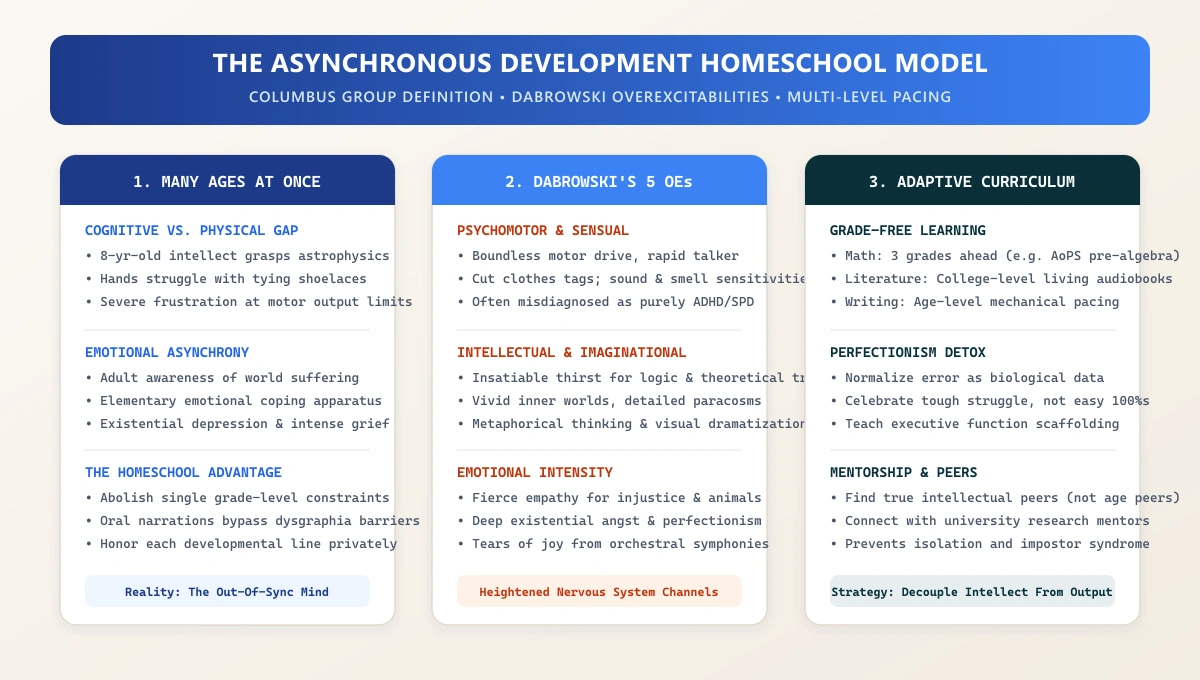
Unlike neurotypical children whose intellectual, social, emotional, and physical milestones progress in relatively synchronized lockstep, the gifted child lives in multiple developmental ages simultaneously:
- Intellectual Age: A 7-year-old child may possess an intellectual comprehension age of 14, debating moral philosophy, cosmological physics, or historical geopolitical conflicts.
- Physical/Motor Age: The same child possesses a physical chronological age of 7; their small finger muscles tire quickly, making prolonged pencil handwriting physically painful.
- Emotional Age: Because their massive intellectual antennae process adult realities (death, climate change, warfare, social injustice) that their immature emotional nervous system cannot yet integrate, their emotional coping age may resemble that of a 5-year-old.
When adults expect an eight-year-old who speaks like a professor to handle emotional frustration like a professor, unreasonable expectations trigger severe anxiety and behavioral meltdowns.
2. Dabrowski’s Theory of Positive Disintegration: The 5 Overexcitabilities
In the 1960s, Polish psychiatrist and psychologist Kazimierz Dabrowski developed the Theory of Positive Disintegration (TPD). Dabrowski observed that intellectually and creatively gifted individuals frequently possess heightened neurological sensitivities, which he termed Overexcitabilities (OEs) (from the Polish nadpobudliwość, meaning “super-stimulability”).
These overexcitabilities represent five distinct physiological channels through which the nervous system experiences the world with extreme vividness:
| Overexcitability (OE) | Observable Behavioral Manifestations | Homeschool Support Strategy |
|---|---|---|
| 1. Psychomotor | Boundless physical energy, rapid pressured speech, fidgeting, compulsive pacing while thinking | Provide standing desks, balance ball chairs, trampoline breaks, and allow pacing during oral narrations. |
| 2. Sensual | Extreme sensory sensitivity; hatred of clothing tags, sock seams, bright fluorescent lights, loud blender noises | Cut out clothing tags, use seamless bamboo socks, provide noise-canceling headphones, and create dim sensory nooks. |
| 3. Intellectual | Insatiable curiosity, love of theoretical puzzles, intense questioning of authority, passion for truth | Provide advanced college-level living books, access to university lectures, and unhurried rabbit-hole research hours. |
| 4. Imaginational | Rich internal paracosms (imaginary fantasy worlds), vivid visualization, mixing fantasy with reality, night terrors | Encourage creative storytelling, digital worldbuilding, comic illustration, and validate imaginary companions. |
| 5. Emotional | Extreme empathy, acute distress over animal suffering or global news, intense loyalty, perfectionism tears | Co-regulate through calm presence; limit exposure to adult news media; teach somatic grounding and deep breathing. |
Recognizing that these traits are neurological hardwiring—not character defects—allows homeschooling parents to design a home environment that honors intensity rather than punishing it.
3. Decoupling Input from Output: The Homeschool Superpower
The single greatest educational tragedy for asynchronous learners in standard classrooms is the Output Bottleneck:
- A school says: “You cannot be placed in the 6th-grade history class, because you cannot write a five-paragraph essay in cursive.”
- As a result, the child is trapped in 2nd-grade history, bored to tears reading trivial paragraphs, while their mind craves deep historical analysis.
Homeschooling provides the ultimate solution: Decoupling Cognitive Input from Motor Output.
The Decoupled Instruction Blueprint
1. Oral Narration & Speech-to-Text
When assessing literature, history, or science, allow your child to narrate their thoughts orally while you scribe or while they use voice-to-text dictation software. This allows their profound insights to flow freely without being throttled by underdeveloped fine-motor handwriting mechanics.
2. Separate Handwriting as a Standalone Therapy
Practice physical pencil grip and cursive for just 10 minutes a day as a separate, low-stress developmental skill (e.g., using Handwriting Without Tears), completely detached from their intellectual academic work.
3. Grade-Free Subject Modularity
Throw away the concept of an overall 'grade level.' Your child might be 8th grade in mathematics (studying Art of Problem Solving Pre-Algebra), 11th grade in science (watching university MIT OpenCourseWare lectures), 4th grade in spelling, and 2nd grade in physical handwriting. In home education, this is completely normal and healthy.
4. Dismantling the Perfectionism Paralysis Trap
Gifted children frequently develop severe Perfectionism Paralysis:
- Because early learning comes effortlessly to them without trying, they subconsciously internalize the belief: “Being smart means doing everything instantly and perfectly.”
- When they finally encounter a genuinely challenging problem (often in competitive pre-algebra, chess, or musical instrument practice), they hit an emotional wall. They view difficulty not as a challenge, but as an existential threat to their identity: “If this is hard, I must be stupid.”
- The result is avoidance, defiance, procrastination, and crumpled papers.
The Home Detox Strategy
- Praise the Struggle, Not the Outcome: Never praise ease. If your child completes a worksheet in three minutes with 100% accuracy, say: “I apologize, I gave you work that was too easy. You didn’t get to learn anything new. Let’s find something challenging.”
- Model Adult Mistakes: Make deliberate errors while cooking, building, or calculating on the whiteboard. Verbalize your self-talk: “Oops, I miscalculated that angle! That’s interesting data. Let me erase and try a different method.”
- The 80% Rule: A child who gets 100% on everything is in the wrong curriculum. A healthy learning zone maintains an 80% success rate, where 20% of the material requires revision, debugging, and grit.
5. Finding Intellectual Peers
One of the deepest wounds for asynchronous children is profound social isolation. Being surrounded by same-age chronological peers with whom they have zero intellectual overlap often results in “masking” (dumbing themselves down to fit in) or social alienation.
Homeschool parents must intentionally orchestrate Intellectual Peer Matching:
- Join regional or national gifted homeschool circles, robotics teams (FIRST LEGO League / FTC), math circles, or community theater troupes.
- Provide age-independent outlets: a gifted ten-year-old may play Minecraft or climb trees with eight-year-old neighborhood friends for physical play, while discussing quantum theory with an adult mentor or university professor.
- Acknowledge that a gifted child rarely finds a single peer who matches all their developmental ages; they need a mosaic of friends for different facets of their personality.
Pedagogical References and Clinical Citations
- Silverman, L. K. (2012). Giftedness 101. Springer Publishing Company.
- Mendaglio, S. (Ed.). (2008). Dabrowski’s Theory of Positive Disintegration. Great Potential Press.
- Daniels, S., & Piechowski, M. M. (2009). Living with Intensity: Understanding the Sensitivity, Excitability, and Emotional Development of Gifted Children. Great Potential Press.
- Webb, J. T., et al. (2016). Misdiagnosis and Dual Diagnoses of Gifted Children and Adults (2nd ed.). Great Potential Press.
- The Columbus Group. (1991). Unpublished baseline white paper defining Asynchronous Development in Gifted Education. Columbus, OH.
Disclaimer: This post is for informational and educational purposes only, accurate to the best of our knowledge at publication. It does not constitute advice. We do not guarantee accuracy or completeness and accept no liability for any decisions or losses resulting from reliance on this content.