When a child transitions from early childhood (ages 3 to 6) into the elementary years (ages 6 to 12), their psychological landscape undergoes a profound neurological transformation. In Montessori pedagogy, this transition marks the entry into the Second Plane of Development.
The young child in the First Plane was a sensorial explorer whose primary unconscious question was, “What is this?” They refined their senses by pouring water, scrubbing tables, and stacking pink tower cubes. But the elementary child suddenly develops two formidable new cognitive tools: the reasoning mind and the moral imagination. Their urgent, burning questions shift outward toward the infinite: “Why did the universe begin? Who invented numbers? Why do animals adapt? What is my purpose on this earth?”
Traditional schooling responds to this intellectual expansion by fracturing knowledge into disconnected academic silos: forty minutes of arithmetic, followed by a bell, followed by thirty minutes of spelling, followed by twenty minutes of state history.
Dr. Maria Montessori recognized that dividing reality into arbitrary textbook subjects deadens the elementary mind. In response, she designed Cosmic Education: an integrated, breathtaking philosophical framework that gives the child the whole universe first, revealing the interconnected web binding astronomy, geology, chemistry, biology, history, and human culture into a single magnificent story.
The Philosophy of Cosmic Education: Giving the Whole to Explain the Part
Conventional education attempts to teach from the microscopic to the macroscopic: a child learns about their neighborhood, then their city, then their state, and only in high school touches upon astrophysics or deep geologic time.
Montessori inverted this sequence. In Cosmic Education, we present the grandest, most awe-inspiring canvas first: the creation of the cosmos.
Maria Montessori on the Elementary Child's Need for Totality
"Let us give the child a vision of the whole universe... If the idea of the universe be presented to the child in the right way, it will do more for him than just arouse his interest, for it will create in him admiration and wonder, a feeling loftier than any interest and more satisfying. The child's mind will then no longer wander, but can be fixed and will work."
— Dr. Maria Montessori, To Educate the Human Potential (1948)
When a child perceives that the calcium in their own bones was forged inside dying supernovae, and that the modern alphabet in their pencil evolved through four thousand years of Phoenician maritime trade, learning ceases to be a chore. It becomes a sacred act of cosmic citizenship.
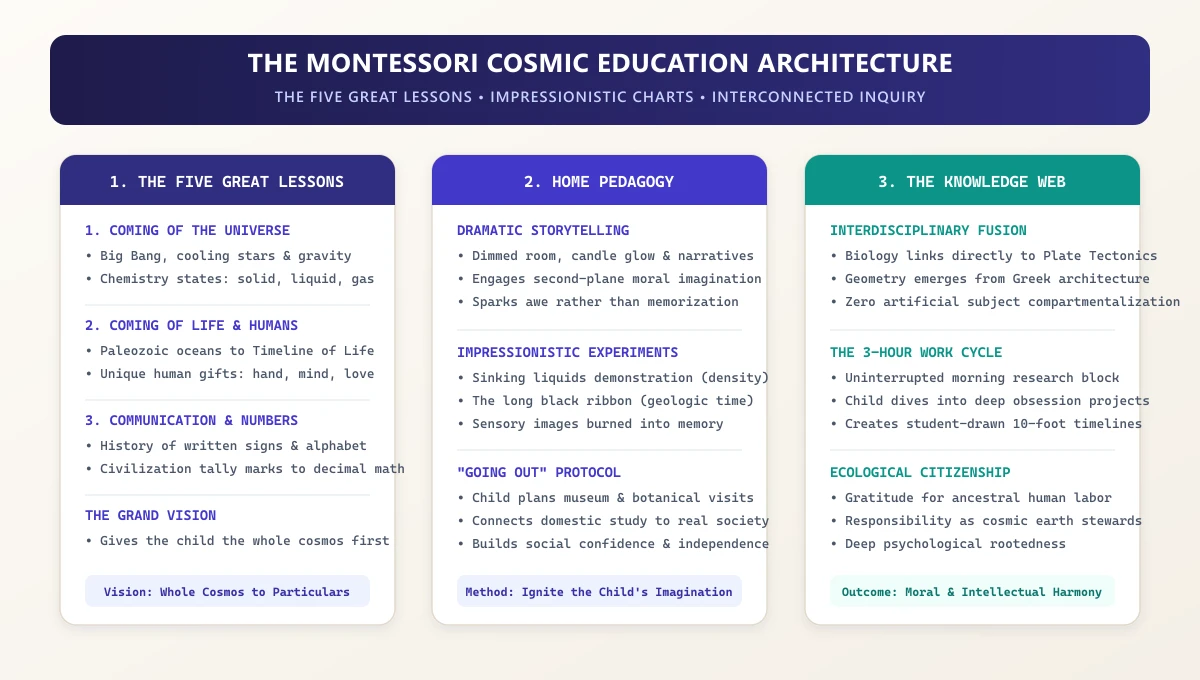
Visual Architecture: The Cosmic Education Framework
Pillar 1: The Sequence of the Five Great Lessons
At the beginning of each academic year, the Montessori guide (or homeschooling parent) presents the Five Great Lessons. These are not dry lectures; they are dramatic, multi-sensory oral narratives accompanied by impressionistic science experiments, lavish charts, and symbolic demonstrations.
1. The First Great Lesson: The Coming of the Universe & the Earth
- The Narrative: The origins of matter, the cosmic laws of gravity and cooling, and the formation of the oceans, continents, and atmosphere.
- Academic Doorways: Astrophysics, physical chemistry (solids, liquids, gases), plate tectonics, volcano formation, and physical geography.
- Classic Home Demonstration: Pouring water, vegetable oil, and honey into a clear glass cylinder to demonstrate liquid density, illustrating how the molten Earth naturally differentiated into its dense nickel-iron core, rocky mantle, and floating crust.
2. The Second Great Lesson: The Coming of Life
- The Narrative: The arrival of single-celled organisms in the Precambrian seas, the rapid explosion of marine invertebrates, the emergence of amphibians and reptiles, and the triumphant reign of flowering plants and mammals.
- Academic Doorways: Paleontology, biological taxonomy, comparative anatomy, botany, and the Five Kingdoms of Life.
- The Central Material: The Timeline of Life—a stunning 15-foot hand-drawn silk or paper banner illustrating the geological eras (Paleozoic, Mesozoic, Cenozoic) and showing the cyclical rise, specialization, and mass extinction of species.
3. The Third Great Lesson: The Coming of Humans
- The Narrative: The arrival of human beings on the planet, possessing three unique cosmic gifts that distinguish them from all other creatures: the thinking mind (intellect), the working hand (opposable thumb and fine motor dexterity), and the loving heart (empathy and culture).
- Academic Doorways: Anthropology, world archaeology, human geography, and the Fundamental Needs of Humans.
- The Dramatic Demonstration: The Long Black Strip of Ribbon (300 feet of black fabric rolled out across the backyard representing geologic time, terminated by a tiny 1-centimeter sliver of white ribbon at the very end representing the entire existence of the human species). The visual impact leaves children speechless at humanity’s recent arrival.
4. The Fourth Great Lesson: The Story of Writing (The History of Signs)
- The Narrative: How human beings invented symbolic marks to preserve their thoughts across distance and time: Cave paintings at Lascaux, Sumerian cuneiform clay tablets, Egyptian papyrus hieroglyphs, and the revolutionary Phoenician sound-based alphabet.
- Academic Doorways: Etymology, linguistics, phonics, world literature, calligraphy, and cultural history.
5. The Fifth Great Lesson: The Story of Numbers (The History of Mathematics)
- The Narrative: The origin of counting: tally marks on wolf bones, the invention of zero by ancient Indian mathematicians, Mayan base-20 vigesimal structures, Roman numeral limitations, and the elegance of the Hindu-Arabic decimal system.
- Academic Doorways: Number theory, base arithmetic, geometry origins, architectural engineering, and advanced computational fluency.
Pillar 2: Home Impressionistic Pedagogy: Setting the Stage
Parents often assume that presenting the Great Lessons requires an expensive, fully equipped Montessori classroom. In reality, the domestic setting offers an intimacy that elevates the wonder of these narratives.
Staging the Great Lessons at Home
- The Environment of Wonder: Present the lessons in the evening or in a room with blinds drawn. Light a single beeswax candle to represent the intense ignition of the stars. Keep your voice measured, hushed, and dramatic.
- Impressionistic Demonstrations: Use simple household materials to illustrate cosmic laws. Extinguish a candle under an inverted mason jar to show how oxygen supports combustion; drop vinegar onto baking soda to model volcanic degassing; drop food coloring into cold vs. hot water to illustrate convective thermal currents.
- The Pause of Silence: When the story concludes, blow out the candle and sit in silence for two minutes. Do not immediately assign follow-up worksheets. Allow the awe of the cosmos to settle deeply into the child's imagination.
Pillar 3: Child-Led Research and the “Going Out” Protocol
The Great Lessons are not meant to impart exhaustive factual knowledge; they are intellectual sparks designed to trigger months of self-directed inquiry.
Following the First Great Lesson, one eight-year-old may become obsessed with crystal formation and spend three weeks growing alum crystals and researching mineral crystal lattices. Another ten-year-old, captivated by the Third Great Lesson, may decide to research how ancient Roman aqueducts transported water across mountain valleys, building scale models out of clay in the backyard.
The Elementary 3-Hour Work Cycle at Home
To allow cosmic inquiries to flourish, preserve an unbroken 3-Hour Morning Work Cycle (9:00 AM – 12:00 PM):
- The child works without arbitrary 40-minute subject bells.
- They move freely between mathematical computation, drafting hand-illustrated timelines, and reading scientific living books.
- The parent acts as an observer and resource facilitator, introducing targeted 1-on-1 lessons (e.g., fraction multiplication or Latin root word cards) only when needed to unblock the child’s research.
The “Going Out” Protocol
Dr. Montessori emphasized that the elementary child cannot remain confined within four domestic walls. When a student hits the limits of home resources, they execute a Going Out expedition:
- Child-Led Logistics: If the child’s research on Cretaceous fossils requires deeper knowledge, the child (with parent supervision) phones the local natural history museum, checks public transit routes or driving times, and drafts a list of five specific questions for a paleontologist.
- Community Immersion: Visiting local rock quarries, water treatment plants, municipal observatories, or botanical greenhouses transforms the community into the child’s true laboratory.
State Portfolio Compliance: Documenting Cosmic Education
Homeschooling parents often ask how an interconnected, story-based curriculum translates into mandatory state homeschool portfolios, standardized testing benchmarks, and annual superintendent reviews.
Because Cosmic Education encompasses deep, rigorous academic disciplines, translating student work into conventional subjects is seamless:
| Child’s Self-Directed Cosmic Project | Conventional Academic Subject | Statutory Portfolio Documentation Entry |
|---|---|---|
| Hand-illustrated 8-foot Timeline of the Paleozoic Era | Earth & Life Science, World History | “Comparative paleontology, geologic chronometry, evolutionary taxonomy, and historical documentation.” |
| Calculating planetary orbital distances using astronomical scales | Applied Mathematics & Astrophysics | “Scientific notation, proportional ratios, astronomical geometry, and planetary physics.” |
| Replicating ancient Sumerian cuneiform on clay tablets | Fine Arts, Linguistics, Anthropology | “History of written language, Mesopotamian cultural development, and ancient ceramic sculpting.” |
| Measuring chemical solubility and liquid saturation curves | Chemistry & Quantitative Data Analysis | “Phase changes, molecular dissolution, thermal saturation thresholds, and empirical data graphing.” |
State homeschool evaluators consistently praise Montessori portfolios because they showcase authentic student-created artifacts, multi-page handwritten research monographs, and original scientific diagrams rather than fill-in-the-blank worksheets.
Ecological Citizenship: Nurturing the Whole Human Being
The ultimate purpose of Montessori Cosmic Education is not merely intellectual brilliance; it is moral development.
When a child understands that thousands of ancient human generations sacrificed, invented, and persevered so that we might enjoy running water, printed books, musical instruments, and medical science, their heart swells with profound gratitude. And when they witness the delicate balance governing the Earth’s atmosphere and oceans, they naturally develop a protective reverence for the natural world.
Cosmic Education teaches our children that they are not isolated spectators in a cold universe. They are active, beloved participants in an ongoing cosmic symphony—gifted with a brilliant mind and a loving heart to heal, build, and elevate the world around them.
Disclaimer
Disclaimer: This post is for informational and educational purposes only, accurate to the best of our knowledge at publication. It does not constitute advice. We do not guarantee accuracy or completeness and accept no liability for any decisions or losses resulting from reliance on this content.