
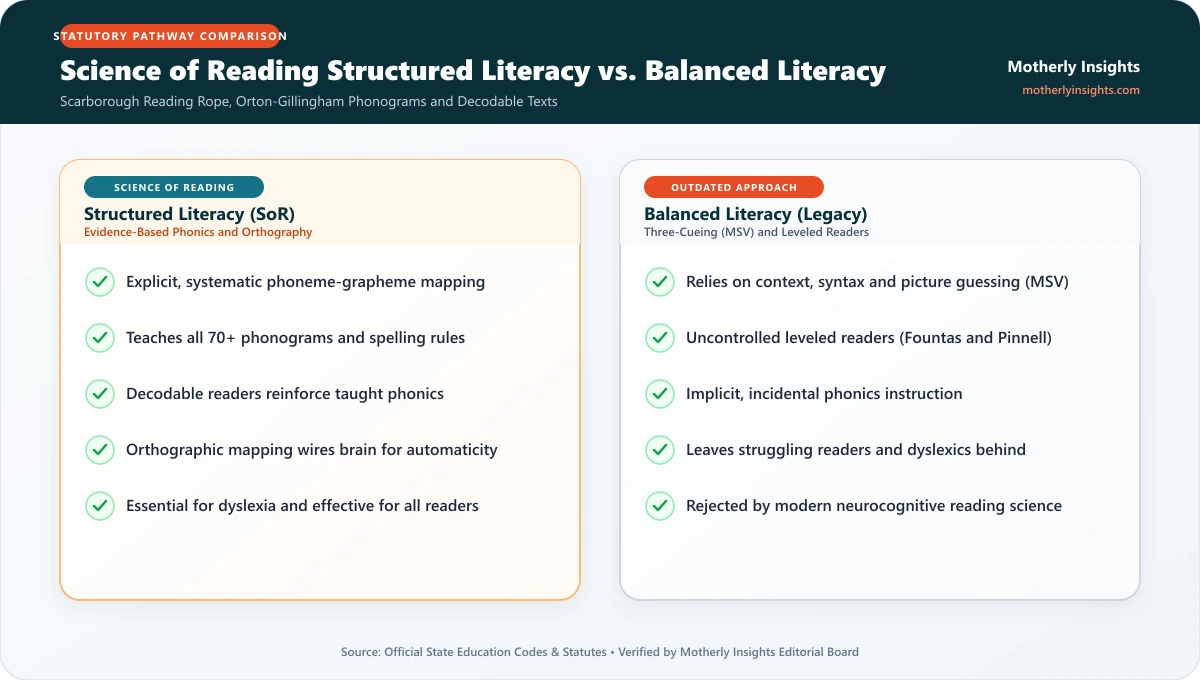
A nationwide educational transformation has permanently altered early literacy instruction. Decades of cognitive science, neuroimaging, and linguistics have coalesced into what is universally termed the Science of Reading (SoR)—discrediting the legacy “balanced literacy” movement and its flawed three-cueing (MSV) guessing habits in favor of explicit, systematic, multi-sensory structured literacy[1].
For home educators, this scientific consensus is empowering. Teaching a child to read does not require mysterious pedagogical intuition or luck; it is a predictable neurobiological process of orthographic mapping—wiring the brain’s visual word form area to automatically link phonemes (sounds) with graphemes (letters).
However, selecting an authentic Science of Reading curriculum can feel overwhelming. Many commercial publishers have simply rebranded outdated leveled-reader packages with “Science of Reading” stickers.
This comprehensive guide analyzes the cognitive science behind Scarborough’s Reading Rope, contrasts structured literacy with balanced literacy, and provides an objective, head-to-head comparison of the five premier evidence-based homeschool phonics programs: All About Reading (AAR), Logic of English (LOE), UFLI Foundations, Barton Reading & Spelling, and Pinwheels.
Pedagogical Crossroads: Structured Literacy vs. Balanced Literacy
Before evaluating individual curricula, understand why the instructional architecture makes all the difference for beginning and struggling readers.
1. The Neurocognitive Framework: How the Human Brain Learns to Read
Unlike oral speech, which human brains evolved to acquire naturally through immersion, reading is an entirely unnatural invention. Human brains do not possess an innate “reading center”; rather, reading requires repurposing neural networks across the visual, phonological, and semantic processing centers of the brain[2].
1. The Simple View of Reading (Gough & Tunmer, 1986):
Cognitive science demonstrates that reading comprehension is the mathematical product of two independent cognitive components:
$$\text{Reading Comprehension (RC)} = \text{Decoding (D)} \times \text{Language Comprehension (LC)}$$
- If a student cannot decode words accurately ($D = 0$), reading comprehension is zero, regardless of how strong their oral language and intelligence are.
- If a student has oral language deficits ($LC = 0$), decoding alone produces word-calling without understanding.
2. Scarborough’s Reading Rope (2001):
Dr. Hollis Scarborough conceptualized skilled reading as two intertwined strands:
- Lower Strand (Word Recognition): Phonological awareness, decoding (the alphabetic principle), and sight recognition (orthographic mapping). These strands become increasingly automatic with practice.
- Upper Strand (Language Comprehension): Background knowledge, vocabulary, syntax/language structures, verbal reasoning, and literacy knowledge. These strands become increasingly strategic.
3. Why Balanced Literacy & Three-Cueing Failed:
For three decades, conventional schools taught children the three-cueing system (MSV), instructing beginning readers to guess unfamiliar words using:
- Meaning (M): “Look at the picture.”
- Syntax (S): “Does it sound right in the sentence?”
- Visual (V): “Look at the first letter and make a guess.”
Neuroscience proved that guessing is the habit of struggling readers, not skilled readers. Skilled readers process every single letter in a word sequentially in milliseconds through orthographic mapping. Authentic Science of Reading programs eliminate guessing entirely.
2. Head-to-Head Comparison of Premier Homeschool SoR Curricula
| Curriculum | Approach | Best For | Daily Lesson Time | Cost (Level 1) | Teacher Prep |
|---|---|---|---|---|---|
| All About Reading (AAR) | Pure Orton-Gillingham | Visual & Kinesthetic Learners, Dyslexia | 20 minutes | ~$160 (complete kit) | Zero (open-and-go script) |
| Logic of English (Foundations) | Multi-Sensory SoR (Riggs/Spalding) | Fast-Paced Learners, Integrated Handwriting | 25–35 minutes | ~$195 (complete kit) | Minimal (clear teacher guide) |
| UFLI Foundations | Explicit Classroom & Home SoR | Budget-Conscious, Direct Instruction | 30 minutes | ~$70 (manual + free online apps) | Low to Medium |
| Barton Reading & Spelling | Clinical Orton-Gillingham | Moderate-to-Severe Dyslexia | 45–60 minutes | ~$350 per level | High (training DVD/videos) |
| Pinwheels (Rooted in Language) | Neuro-Linguistic Literacy | Language Processing Delays & Fine Motor | 30 minutes | ~$120 (PDF / printed) | Medium (teacher training heavy) |
3. In-Depth Curriculum Profiles
1. All About Reading (AAR) by Marie Rippel
- Pedagogical Structure: Heavily grounded in the Orton-Gillingham methodology. Mastery-based, non-graded levels (Pre-Reading through Level 4).
- Core Strengths:
- Sensorial Letter Tiles: Uses physical (or digital tablet) magnetic color-coded letter tiles to build, segment, and blend phonemes physically.
- Exceptional Decodable Readers: 100% of the stories in AAR readers use only phonograms and rule-breakers previously taught. Children never encounter untaught words, eliminating guessing anxiety.
- Parent-Friendly Scripting: Lightly scripted teacher manuals require zero prior linguistics training. Open the book and teach in 20 minutes daily.
- Best Suited For: Parents who want a gentle, multi-sensory, zero-prep reading curriculum that guarantees tears-free confidence.
2. Logic of English (Foundations A–D) by Denise Eide
- Pedagogical Structure: Teaches all 74 basic phonograms and 31 spelling rules explicitly, integrating handwriting (manuscript or cursive), spelling, and comprehension.
- Core Strengths:
- Scientific Precision: Explains the “why” behind 98% of English spelling anomalies. Words traditionally labeled as “sight words” (like said, was, the) are decoded using their exact phonetic rules.
- Kinesthetic Games: Replaces flashcard drill with active physical games (dragon races, beanbag tosses, phonogram tag), making it extraordinarily engaging for active boys and ADHD learners.
- Early Cursive Option: Offers cursive from age four, which neurological research shows reduces letter reversals (such as b/d confusion)[3].
- Best Suited For: Inquisitive children who ask “Why does that word say that?” and active learners who need whole-body kinesthetic games.
3. UFLI Foundations (University of Florida Literacy Institute)
- Pedagogical Structure: Developed by leading university literacy researchers. A single, comprehensive manual covering 128 systematic, cumulative lessons from kindergarten through 2nd grade.
- Core Strengths:
- Unbeatable Value: A single $70 physical manual covers two full academic years. All companion slide decks, roll-and-read games, decodable passages, and letter tiles are provided online for free.
- Rigorous Lesson Sequence: Each 8-step daily routine includes visual drills, auditory blending, phoneme manipulation, new concept introduction, guided spelling, and decodable sentence reading.
- Best Suited For: Budget-conscious families and former public educators who appreciate efficient, research-validated instructional sequences without expensive physical kits.
4. Barton Reading & Spelling System by Susan Barton
- Pedagogical Structure: A gold-standard, clinical Orton-Gillingham remediation program divided into 10 sequential levels.
- Core Strengths:
- Designed specifically for parents of children diagnosed with moderate to severe dyslexia who cannot progress in standard phonics programs.
- Meticulously structured teacher training videos guide parents step-by-step through clinical error-correction procedures and finger-tapping sound segmentation.
- Best Suited For: Diagnosed dyslexic learners requiring intense clinical remediation at home.
4. Key Selection Criteria: How to Choose for Your Child
Before purchasing, evaluate your child’s specific developmental indicators:
- Check Phonemic Awareness First: Before beginning any phonics program, ensure your child can orally isolate, blend, and segment sounds (e.g., “What word is /k/ /a/ /t/?”). If they struggle orally, begin with Heggerty Phonemic Awareness or All About Reading Pre-Reading.
- Assess Writing Readiness: If your child’s fine-motor grip is not yet ready for pencil writing, select All About Reading, which separates reading decoding from handwriting. If your child is eager to write, Logic of English pairs decoding with letter formation seamlessly.
- Pacing and Lesson Length: The optimal Science of Reading lesson is 15 to 25 minutes daily. Short, focused, consistent daily lessons wire the brain far more effectively than prolonged, exhausting weekly sessions.
Frequently Asked Questions About Science of Reading Phonics
What is the difference between "Sight Words" and "Heart Words"? ↓
Why are decodable readers better than leveled readers (like Bob Books or early readers)? ↓
How long does it take for a child to complete phonics instruction? ↓
Disclaimer: This post is for informational and educational purposes only, accurate to the best of our knowledge at publication. It does not constitute pedagogical, clinical, or diagnostic advice. We do not guarantee accuracy or completeness and accept no liability for any decisions or losses resulting from reliance on this content.