
When families step outside the industrial conveyor belt of traditional schooling, they quickly discover that education does not require replicating a classroom at the kitchen table. Two of the most liberating, popular, and effective home education frameworks embraced by modern parents are Unschooling and Eclectic Homeschooling[1].
While both approaches reject rigid boxed-curriculum packages in favor of individualized, curiosity-driven education, they operate on distinct operational principles.
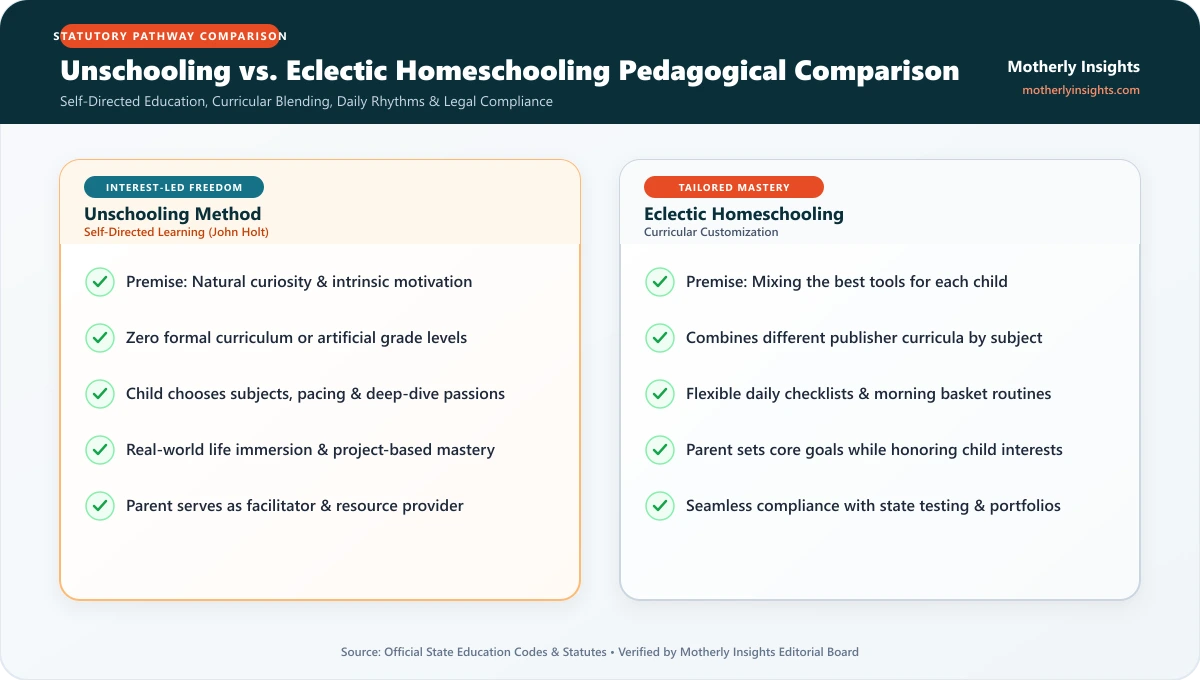
Unschooling (pioneered by educator John Holt) is a comprehensive philosophy of Self-Directed Education (SDE) where children retain complete autonomy over what, when, and how they learn. Conversely, Eclectic Homeschooling (often described as relaxed or customized homeschooling) is a pragmatic, parent-facilitated method that strategically mixes and matches different publisher curricula, hands-on projects, and child-led unit studies across different academic subjects.
This comprehensive guide analyzes core philosophies, daily rhythms, “strewing” vs. loop scheduling, state legal compliance in high-regulation jurisdictions, and high school transcript creation for non-traditional learners.
Pedagogical Crossroads: Unschooling vs. Eclectic Customization
Before re-imagining your family’s daily routine, compare the structural pillars of each approach.
1. Foundational Philosophies: Natural Learning vs. Tailored Instruction
The fundamental difference between Unschooling and Eclectic homeschooling lies in where educational authority and curricular initiative reside:
The Unschooling Philosophy: Trusting the Learner
- Origins: Coined in 1977 by American author and former teacher John Holt in his landmark publication Growing Without Schooling, unschooling asserts that human beings are biologically hardwired to learn. Learning is not a product of instruction; it is a natural byproduct of living fully in the world[2].
- Core Premise: The child directs their own educational journey based on intrinsic curiosity. There are no compulsory curriculum textbooks, artificial grade levels, or standardized testing drills.
- The Parent’s Role: The parent transitions from a didactic “teacher” into a supportive resource facilitator and partner. Parents provide transportation, mentorship, materials, and rich community experiences, engaging in deep conversations without imposing tests.
- Deschooling: Crucial to successful unschooling is the deschooling process—a decompression period where parents and children intentionally unlearn institutional expectations regarding grades, bells, and artificial academic schedules.
The Eclectic Philosophy: Curricular Customization
- Core Premise: Eclectic homeschooling recognizes that no single publisher or methodology fits every child or every academic discipline. An eclectic parent might observe that their child thrives with a mastery-based conceptual math program, requires an explicit Orton-Gillingham phonics curriculum for reading, enjoys Charlotte Mason living books for history, and prefers interest-led unit studies for science.
- The Parent’s Role: The parent acts as an educational curator and guide. Parents establish overarching academic goals and structure daily rhythms, while actively incorporating the child’s input, interests, and natural learning velocity.
- Flexibility with Purpose: Unlike unschooling, an eclectic homeschool generally includes planned core academic work (such as math and language arts), but dispenses with busywork in favor of streamlined, focused mastery.
2. Daily Rhythms & Instructional Frameworks
How does each philosophy translate into an ordinary weekday morning?
| Feature | Unschooling | Eclectic Homeschooling |
|---|---|---|
| Curriculum Use | Zero Compulsory Textbooks: Real-world tools, documentary films, library books, coding platforms, and apprentice experiences. | Selective Multi-Publisher Mix: Carefully chosen math and reading programs paired with interest-led unit studies and literature. |
| Daily Schedule | Organic & Fluid: Driven by current passions (e.g., spending 3 weeks building a robotics engine, coding a game, or baking historical recipes). | Flexible Routine: A structured morning block (e.g., Morning Basket + Math + Writing) followed by open afternoons for hobbies and nature study. |
| Environmental Design | “Strewing”: Intentionally leaving intriguing books, scientific specimens, art supplies, or documentary links around the home to spark voluntary curiosity. | The Loop Schedule: Cycling through secondary subjects (geography, poetry, art, music) on a revolving checklist without rigid day-of-the-week deadlines. |
| Assessment & Metrics | Self-evaluated mastery: Does the project work? Is the code functional? Did the child achieve their personal goal? | Completed assignments, oral narrations, end-of-unit projects, and parent-administered mastery reviews. |
3. Navigating State Legal Compliance as an Unschooler or Eclectic Homeschooler
One of the most persistent concerns for prospective non-traditional home educators is navigating statutory oversight. How do families comply with state requirements for mandatory subjects, attendance logs, and annual assessments?
1. Re-Framing Real-World Life into Statutory Subject Areas
State compulsory education statutes universally require instruction in core subjects (reading, math, science, history, civics). Non-traditional families translate everyday life into formal legal compliance with ease:
- Culinary Mathematics: Halving a recipe, calculating baker’s percentages, or budgeting family grocery expenses translates into Applied Mathematics & Fractions.
- Strategy Gaming & Minecraft: Managing resource economies, redstone logic circuits, and spatial architectural design translates into Computer Science, Geometry, and Engineering Concepts.
- Nature Foraging & Gardening: Soil pH testing, plant identification, and composting cycles fulfill Botany, Ecology, and Earth Science.
- Civic Engagement & Podcasting: Following a municipal zoning debate, volunteering at an animal shelter, or researching historic court cases satisfies Social Studies and Civics[3].
2. Satisfying State Evaluation Requirements
In states requiring annual assessments (such as Florida, Ohio, Virginia, or Pennsylvania):
- Portfolio Reviews: The majority of unschoolers and eclectic homeschoolers select certified teacher portfolio evaluations over standardized multiple-choice testing. Parents present a photo-rich portfolio binder or digital slideshow documenting books read, field trips, written stories, artistic projects, and audio/video recordings. Friendly homeschool evaluators review the portfolio and certify regular academic progress.
4. High School Transcripts & College Admissions for Non-Traditional Learners
Contrary to outdated myths, unschooled and eclectic high school graduates are eagerly recruited by universities, including highly selective institutions. Research conducted by Dr. Peter Gray of Boston College demonstrates that self-directed learners excel in college due to their high self-motivation and autonomous study habits.
Authoring the Non-Traditional High School Transcript:
- Transcribing Projects into Carnegie Units: A year-long intensive interest—such as running a digital graphic design business, self-publishing a novel, or restoring a vintage automobile—translates into valid high school credits (e.g., Digital Media Production (1.0 Credit) or Automotive Engineering & Applied Physics (1.0 Credit)).
- External Validation: Homeschoolers validate home-based learning through standardized testing (SAT, ACT, Classic Learning Test), dual-enrollment college coursework, or community college letters of recommendation.
- The Project Portfolio: Colleges increasingly welcome supplemental project portfolios containing links to digital art galleries, GitHub code repositories, photography collections, or entrepreneurial business ventures.
Decision Matrix: Which Approach Fits Your Family?
Choose Unschooling if:
- Your child has experienced severe burnout, anxiety, or school refusal in traditional classroom settings.
- You deeply trust that children learn naturally when immersed in a rich, loving, resource-dense environment.
- You are comfortable letting go of artificial timelines, standardized scopes, and adult-imposed academic schedules.
- Your child possesses intense, sustained self-motivated passions (e.g., animal care, programming, theater, mechanics).
Choose Eclectic Homeschooling if:
- You want the security of systematic progress in core foundational skills (math and reading) combined with freedom in content subjects.
- You want to pick the absolute best individual curriculum for your child in each subject without being locked into one publisher.
- You thrive with a predictable, flexible daily rhythm (such as a 2-hour morning learning routine) that leaves afternoons free for exploration.
- You enjoy curating resources, reading aloud together, and guiding your child through dynamic unit studies.
Frequently Asked Questions
What if an unschooled child chooses to play video games all day? ↓
How expensive is eclectic homeschooling compared to a boxed curriculum? ↓
Can a family transition from eclectic homeschooling to unschooling (or vice versa)? ↓
Disclaimer: This post is for informational and educational purposes only, accurate to the best of our knowledge at publication. It does not constitute legal or financial advice. We do not guarantee accuracy or completeness and accept no liability for any decisions or losses resulting from reliance on this content.