
Selecting a homeschool science curriculum represents one of the most significant pedagogical forks in the road for home educators. Science instruction inevitably intersects with fundamental questions regarding the origins of the universe, the age of the Earth, the development of biological life, and the boundary between empirical observation and metaphysical belief.
For decades, the homeschool publishing market was overwhelmingly dominated by conservative Christian, Young Earth Creationist (YEC) publishers. Over the past decade, however, exponential growth in secular, neurodiverse, and charter-funded homeschooling has catalyzed an explosion of rigorous, inquiry-based, Next Generation Science Standards (NGSS)-aligned secular science alternatives.
Whether you are preparing a high schooler for competitive pre-med university admissions, navigating public charter funding restrictions, or seeking a science curriculum that aligns with your family’s worldview, this guide provides an authentic, empirical comparative analysis of secular, faith-based, and faith-neutral homeschool science curricula.
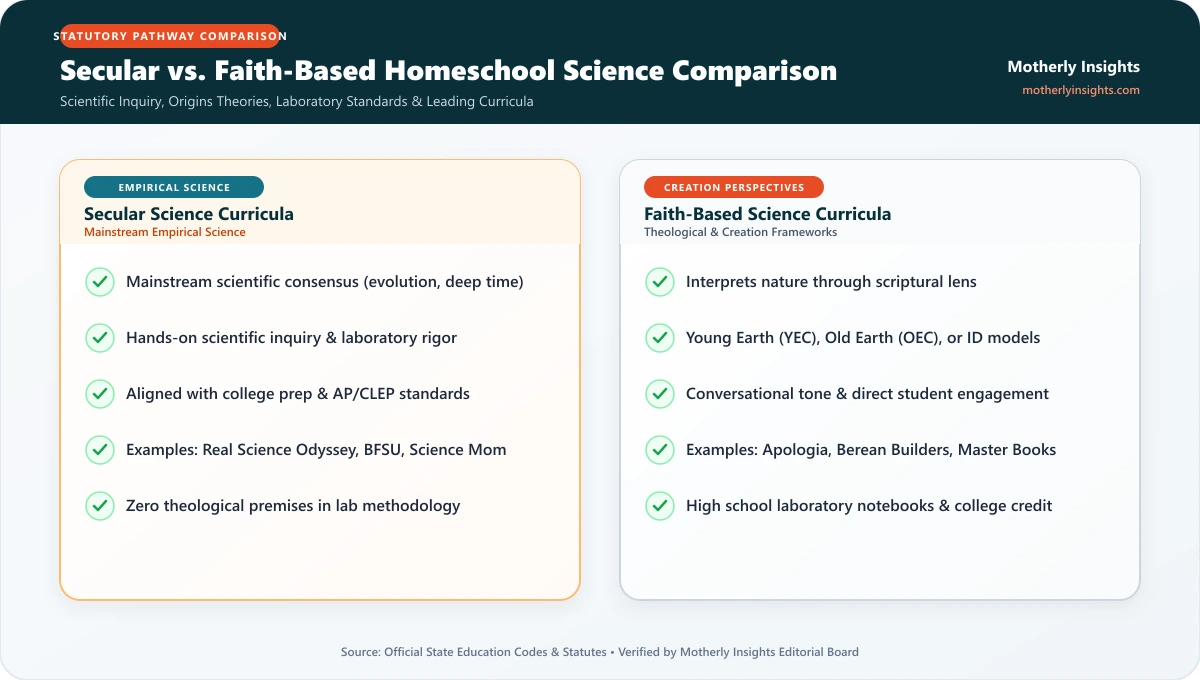
1. Defining the Paradigms: Secular, Faith-Based, and Neutral
Before evaluating individual curricula, parents must understand how publishers categorize and construct their science texts. The fundamental differences lie in their epistemological framework—how knowledge is validated and what constitutes authoritative truth.
Secular Science
Secular science curricula adhere strictly to the modern scientific consensus established by peer-reviewed research, the National Science Teaching Association (NSTA), and the National Academy of Sciences.
- Key Tenets:
- Earth’s age is approximately 4.54 billion years, and the universe originated approximately 13.8 billion years ago.
- Evolution via natural selection, common descent, and speciation are foundational organizing principles of biological sciences.
- Hypotheses must be empirically testable, falsifiable, and grounded in natural mechanisms without invoking supernatural interventions.
Faith-Based Science (Creationist & Providential)
Faith-based curricula integrate theological scripture directly into the scientific narrative, treating biblical revelation as equal to or superior to empirical observation.
- Young Earth Creationism (YEC): Taught by Apologia, Master Books, and BJU Press. Posits that the universe and life were created in six literal 24-hour days approximately 6,000 to 10,000 years ago, explaining geological strata through Noah’s global flood and rejecting macroevolution.
- Old Earth Creationism (OEC) / Intelligent Design (ID): Posits that God guided the creation of the universe over billions of years, accepting standard cosmological and geological dating while arguing that complex biological structures require an intelligent designer rather than unguided natural selection.
Faith-Neutral (“Neutral”) Science
Neutral science curricula deliberately avoid contentious topics—specifically the age of the earth, cosmic origins, and biological evolution—to appeal to both secular and religious families.
- Key Tenets: Concentrates on physics, chemistry, meteorology, anatomy, and descriptive biology (classification, cell structure) while remaining silent on the history of life on Earth. Examples include early editions of Real Science-4-Kids.
2. In-Depth Secular Science Curricula
For families seeking rigorous, empirical, and charter-approved science, the following curricula represent the premier secular options available today.
1. REAL Science Odyssey (Pandia Press)
- Target Audience: Grades K–9
- Approach: Inquiry-based, hands-on, literature-supported scientific exploration.
- Strengths: Written explicitly to demystify complex scientific principles through accessible, engaging lab experiments using household items. Units cover Life, Earth & Environment, Chemistry, Physics, and Astronomy. The biology courses teach evolution and deep time clearly, accurately, and unapologetically.
- Parental Lift: Moderate. The program requires consistent preparation of laboratory materials and active participation during demonstrations, making it ideal for parents who love hands-on learning.
2. Building Foundations of Scientific Understanding (BFSU by Dr. Bernard Nebel)
- Target Audience: Grades K–8 (divided into three volumes: K–2, 3–5, and 6–8)
- Approach: Socratic dialogue, multi-threaded conceptual integration.
- Strengths: Widely regarded by STEM educators as the most intellectually rigorous elementary science curriculum in existence. Rather than teaching science in disjointed weekly units, BFSU threads four parallel learning progressions: Nature of Matter, Life Science, Physical Science/Engineering, and Earth/Space Science. Students learn to think like actual research scientists.
- Parental Lift: High. BFSU is not an open-and-go workbook; it is a teacher’s manual requiring parents to read lesson concepts in advance and lead exploratory conversations.
3. Centripetal Press / Novare Science
- Target Audience: Grades 7–12 (Honors & College Prep)
- Approach: Mastery-based, integrated mathematics, laboratory discipline.
- Strengths: Developed by classical educator John D. Mays, Centripetal Press is the secular imprint of Novare Science. It eliminates the traditional “cram-pass-forget” cycle by requiring cumulative weekly quizzes, precise technical laboratory notebooks, and direct mathematical integration into physics and chemistry.
- Parental Lift: Low-to-Moderate. Exceptionally clear textbooks with complete video teacher instruction kits and lab experiment manuals.
4. Science Mom & Math Dad
- Target Audience: Grades 4–8
- Approach: Video-based lectures, interactive workbooks, entertaining demonstrations.
- Strengths: Created by professional biochemist Jenny Ballif (“Science Mom”), this digital curriculum delivers thorough, humorous, and visual video explanations of biology, chemistry, earth science, and physics. Completely secular, highly engaging for visual and neurodivergent learners, and virtually zero preparation time for parents.
3. In-Depth Faith-Based Science Curricula
For Christian families seeking a worldview integrated with scriptural theology, these programs dominate the home education landscape.
1. Apologia Educational Ministries (Exploring Creation With…)
- Target Audience: Grades K–12
- Approach: Conversational narrative, immersion approach (Charlotte Mason style in elementary; rigorous textbook style in high school).
- Worldview: Strictly Young Earth Creationist (YEC).
- Strengths: Written in a warm, direct-to-student conversational tone. High school texts (Biology, Chemistry, Physics, Advanced Biology) feature comprehensive wet-lab protocols, slide preparations, and dissection modules that prepare students exceptionally well for standardized content recall.
- Considerations: The text explicitly argues against macroevolution, uniformitarian geology, and standard cosmological dating throughout every grade level.
2. Berean Builders (Dr. Jay L. Wile)
- Target Audience: Grades K–12
- Approach: Chronological / Historical science progression.
- Worldview: Young Earth Creationist with historical scientific context.
- Strengths: Written by the original creator of Apologia after parting ways with the publisher. Rather than dividing science into modern subject silos, Berean Builders teaches science through the chronological timeline of human discovery (e.g., Science in the Ancient World, Science in the Industrial Age). Every single lesson contains a hands-on physical experiment.
- Considerations: Dr. Wile presents the scientific discoveries of historical Christian and secular scientists respectfully while maintaining an overt young-earth theological foundation.
3. Master Books (God’s Design for Science)
- Target Audience: Grades 1–8
- Approach: Short, consumable lessons, devotional emphasis.
- Worldview: Overt, literal Young Earth Creationism with Answers in Genesis affiliation.
- Strengths: Highly structured, gentle workload, requiring only 15–20 minutes per day. Excellent for large families juggling multiple grade levels who want science directly connected to daily biblical devotionals.
- Considerations: Significantly less laboratory depth and mathematical application compared to secular or Apologia high school sequences.
4. Head-to-Head Comparison Matrix
| Feature / Criteria | REAL Science Odyssey | BFSU (Dr. Nebel) | Centripetal Press | Apologia Science | Berean Builders |
|---|---|---|---|---|---|
| Worldview | Strictly Secular | Strictly Secular | Strictly Secular | Young Earth (YEC) | Young Earth (YEC) |
| Evolution Taught? | Yes (Core concept) | Yes (Inquiry-based) | Yes (Standard science) | No (Refuted in text) | No (Refuted in text) |
| Earth Age Taught | 4.54 Billion Years | Deep Time | 4.54 Billion Years | 6,000–10,000 Years | 6,000–10,000 Years |
| Parent Preparation | Moderate | High (Parent-led) | Low | Low (Self-guided) | Moderate |
| Lab Intensity | High (Hands-on) | Socratic / Inquiry | High (Formal lab writeups) | High (Dissections/Chemistry) | Very High (Lab every lesson) |
| Charter / ESA Eligible | 100% Yes | 100% Yes | 100% Yes | No (Sectarian) | No (Sectarian) |
| College Prep Level | K–9 Foundation | K–8 Mastery | Honors / AP Prep | Standard / Honors Prep | Standard Prep |
5. College Admissions, NCAA, and High School Lab Compliance
When homeschooling reaches high school (Grades 9–12), science choices carry legal, financial, and admissions consequences that extend far beyond elementary worldview preferences.
University Laboratory Science Requirements (e.g., UC A-G / Tier-1 Colleges)
Competitive colleges typically require a minimum of 2 to 3 years of laboratory science (Biology, Chemistry, and Physics). To count as an authentic laboratory course:
- Hands-On Wet Labs: Digital simulations alone are frequently disqualified by state university systems. High schoolers must perform physical experiments involving chemical titrations, microscopic examination, electrical circuits, and biological dissections.
- Formal Laboratory Notebooks: Students must maintain detailed, bound laboratory journals recording hypotheses, procedural steps, quantitative data tables, error analyses, and evidence-based conclusions.
- Scientific Consensus on Biological Evolution: For students pursuing STEM, pre-med, or biological science degrees, state university admissions committees (such as the University of California A-G audit guidelines) require transcripts to reflect comprehensive mastery of modern evolutionary biology and standard genetic mechanisms.
NCAA Eligibility Center Audits
If your student athlete plans to compete at NCAA Division I or Division II collegiate levels, homeschool core courses face rigorous transcript validation:
- Science courses must be college preparatory in rigor, include documented laboratory experiences, and cover standard empirical scientific content.
- Courses that eliminate fundamental scientific concepts (e.g., cell division, speciation, geological dating) may require additional transcript documentation and course description audits by the NCAA eligibility clearinghouse.
6. Navigating Public Charter Schools and ESA State Funding
A rapidly expanding segment of homeschoolers now utilizes state Education Savings Accounts (such as Arizona’s Empowerment Scholarship Account [ESA], Florida’s Personalized Education Program [PEP], or Utah’s Fits All Scholarship) or enrolls in public homeschool charter programs (such as in California, Alaska, or Idaho).
The Strict Non-Sectarian Rule
Under state constitutional provisions and statutory funding frameworks, public tax dollars cannot be spent on religious instruction or sectarian curricula.
- Permissible Purchases: Curricula published by Pandia Press (REAL Science Odyssey), Centripetal Press, Holt McDougal, Pearson, and Science Mom are fully eligible for state allotment reimbursement.
- Prohibited Purchases: Faith-based materials from Apologia, Master Books, BJU Press, and Abeka cannot be purchased using charter school allotment funds or state ESA accounts.
- The Hybrid Solution: Families who wish to utilize faith-based science while enrolled in public charters must purchase their religious science materials out-of-pocket, using their public allotment strictly for non-sectarian lab equipment (microscopes, glassware, digital balances) and supplemental secular reference materials.
7. How to Choose the Right Path for Your Homeschool
To determine the ideal curriculum for your student, ask three diagnostic questions:
- What are your student’s post-secondary goals? If your student aspires to enter pre-med, veterinary medicine, evolutionary biology, or competitive Tier-1 STEM programs, grounding them in secular, standard scientific terminology and modern evolutionary biology is critical to avoid freshman-year remedial confusion.
- Are you utilizing state public funding or charter oversight? If yes, select a rigorously secular program to ensure immediate procurement approval and eliminate administrative friction.
- What is your daily instructional style? If you prefer an open-and-go video model, Science Mom provides effortless engagement. If you thrive on deep discussion and Socratic thinking, BFSU delivers unmatched cognitive depth. If you seek structured classical mastery, Centripetal Press provides university-level laboratory preparation.
Science at home is one of the greatest privileges of home education. By tailoring the epistemological framework, laboratory rigor, and curriculum format to your child’s specific developmental timeline, you cultivate authentic intellectual curiosity and a lasting love for scientific inquiry.
*Disclaimer: This post is for informational and educational purposes only, accurate to the best of our knowledge at publication. It does not constitute advice. We do not guarantee accuracy or completeness and accept no liability for any decisions or losses resulting from reliance on this content.*